Douro Valley, Portugal

Image

Douro Valley Portugal

“But Portugal has a peaceful feel about it. I sit on the terrace overlooking the vineyard there and I feel cut off from the world. You need that sort of thing.” Cliff Richard

The Douro Valley is the primary wine-growing region of northern Portugal. It can be a day trip from Porto. I knew it would be beautiful but I didn’t know it would be this beautiful.

Terraced vineyards, green-brown mountains, almond and olive trees swoop down to the glassy, blue Douro River.  This was the view from everywhere.

The Valley isn’t necessarily a secret but  the destination doesn’t see nearly as many tourists as other famed wine regions such as Bordeaux or Napa.

The Douro Valley is a World Heritage Site Wine Region with approximately 2000 years of past. According to UNESCO, you’re stepping  into a winemaking valley full of history. The Romans started to cultivated vines in the valley. By the 18th and 19th Century, Port Wine reached English tables and started to make its own name.

We tour the facilities of a few wineries. We learn about the traditional foot-stomping method to crush grapes, which is still used for  wine production (especially the older vines which create more complex wines.

Across the river from Pinhao, is Quinta de Seixo where the well-known Sandeman winery combines state-of the-art cellar technology with great wine experiences.

We do a wine tasting here with the  absolutely breath taking view.
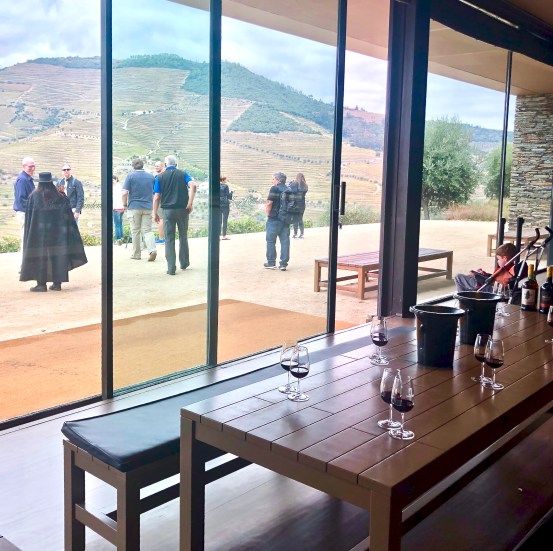
On the banks of the river, along with a Michelin star is DOC restaurant which is one of the best places to go in the valley.

I have a lunch there and it is so delicious we eat a Chef Rui Paula’s restaurant in Porto as well. 

The Douro Valley is a surprisingly quiet and tranquil place to be.
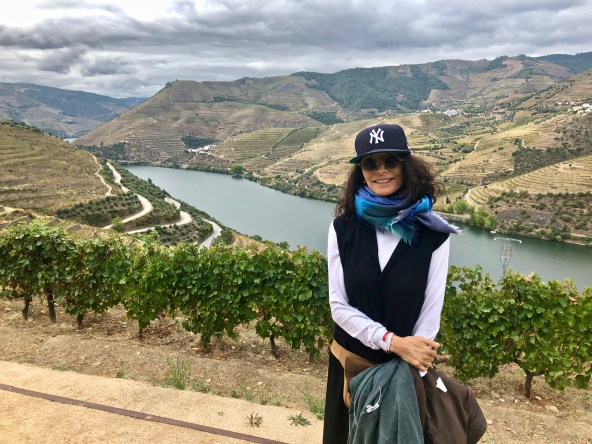
There is always something strange and familiar about a river, hills, grass and trees. Sometimes, the world looks very peaceful. Thanks again to our tour guide Tiago for a wonderful day.    https://www.4u2enjoy.pt/

Fly safe,

JAZ

Things I Lost In The Fire

Image

Things I Lost In the Fire

“So that’s how we live our lives. No matter how deep and fatal the loss, no matter how important the thing that’s stolen from us–that’s snatched right out of our hands–even if we are left completely changed, with only the outer layer of skin from before, we continue to play out our lives this way, in silence” Haruki Murukami. 

When I was a teenager my house burned down in an electrical fire. It was a controlled fire by most standards and we didn’t lose everything.  We moved to the top floor of an apartment building and a few years later during a bad storm, it was hit by lightning. Another fire. 

I never thought about how it affected me. No one was home during the first one and I was away at grad school for the second. I hadn’t lost my room in the first fire. Most of my things were on the roof and covered in soot and ash. It took a long time to get that smell out. 

 I happened to sit next to a woman in a restaurant who had just lost her house in the Malibu fire and was still in shock.  She was telling me about her lost photos. I remembered that I kept my albums and photos in fireproof boxes in a downstairs closet close to a door. They could be dumped in a nearby garbage can and rolled away quickly. I’m not normally that organized. I realized as I spoke to her that I have always lived my adult life with the knowledge that things can be lost instantaneously. 

We all process events differently. What I remember most about the first fire is the dream. The night before I had a very vivid dream that I was walking in debris in my new shoes. I kept wondering why I had worn the shoes. There was a hole in the right shoe from the debris. The next morning I got up and put the new shoes on with trepidation, wondering if I should wear them. Hours later I was walking in what was left of the downstairs and looked down at the wet burned wood  and there was the hole in the right shoe. I never really processed anything but the fact that I had a premonition about it.    

 I thought at the time  that it was just stuff. Kids don’t think a lot about memories.  I  listened to the woman tell me about her lost mementos.  I understand now why I saved every toy and all my children’s schoolwork from birth through high school. I didn’t have anything like that from my own childhood after two fires.  

 She started talking about her books.  Every once in a while throughout my life, I remember a book that I am sure I have. I don’t have it because that library was gone. I think this is what happens after a fire. You don’t remember everything you lost all at once.

Our homes should be places of safety.  Because so many strong memories are formed in our homes, they are very special places to us. House fires can never take those memories away but we lose the feeling of safety which is more of a loss than the stuff. I never dwelt on why this happened to my family twice. We just stayed in the moment and did things one step at a time. Life is busy after a fire and not always in a good way. The best thing is not to stay in the past. It was strange to look back and reflect on that time in my life. I know that this woman, her family and the people who were affected by the California wildfires will get through it also.

Fly safe,

JAZ 

Natural Health Products From Different Countries That I Can’t Live Without

Image

 Natural Health Products From Different Countries That I Can’t Live Without

“We are healthy only to the extent that our ideas are humane.” Kurt Vonnegut, Breakfast Of Champions

Manuka Honey is made by bees that feed the Manuka trees  in New Zealand. It has antibacterial properties and has been used by the Maori in their tonics and remedies for many years. Manuka Honey is graded with UMF rating. A rating of 20 or above will give you the strongest medical benefits. Under that number, it is still expensive and tastes good and acts like other honey. I use it for everything.  It is particularly good for colds and wound healing. You can get it on Amazon.

 Japan is a country of specific etiquette. Correct manners are very important to the Japanese. It’s very easy to embarrass yourself in Japan as an American.  Japan is a society of cleanliness. It is a culture of bath houses and onsens. You have never seen so many people brushing their teeth and gargling  in public restrooms. Japanese are obsessed with Gargling With Salt as a cure for everything. My Japanese friends carry salt when they travel. According to my doctor, it’s a home remedy that really works.  They also carry handkerchiefs in case there is nothing to dry their hands with in a public restroom.

 I stumbled upon Twenty Per Cent Arnica (ours is five percent) in Israel when I hurt my knee in Tel Aviv. Your bruise can be  gone in two days. I found it at a homeopathic pharmacy on Ben Yehuda Street. I use it very sparingly till I get more. 

Coca Tea is used in the Andes to help with altitude sickness- which it does. I drank it every day in Peru.  It also gives you an energy boost without the caffeine spikes. I usually drink it as my second cup of coffee.  It is also good if you have an upset stomach. 

Olive Oil in Spain cures everything. If you are sick, it will make you well. If you are fat it will make you thin.  If you are short, it will make you tall. I also  use it as a make up remover.

 Be physically and mentally prepared to shop in the Spice Market in Istanbul, Turkey.  Be in a good mood. You will have many best friends and marriage proposals. Years ago, a man working there told me of the health benefits of Turmeric. Though the market is known for saffron, I had also heard turmeric was good for illnesses.  I’ve been taking it ever since and most recently bought some at the Arab Market in Jerusalem.

At Ver A Paso market in Belem, Brazil  I got some Brazilian Ginseng from the Amazon. It is used to build your immune system and give energy. They had a lot of interesting health products including many kinds of natural Viagra (seemed to be a big seller)  but that was the only one I knew. 

I came back from Argentina with Yerba Mate and a Yerba Mate cup and straw. Yerba Mate is the national drink of Argentina.  Besides being a stimulant with less caffeine the coffee, it is packed with nutrients. It can boost the immune system, burn fat, increase bone density and help with digestive problems.

Marula Oil is a highly anti-inflammatory plant oil from South Africa and is known for it’s very high antioxidant count and  light texture. It is naturally soothing, fast-absorbing and suitable for all skin types including reactive and sensitive. ( that would be me).  My daughter gave a small bottle to her wedding guests in South Africa. I loved it.  I get it on Amazon now as well. 

Fly safe,

JAZ
Things That I Have Learned In Porto, Portugal

Image

Things That  I Have Learned In Porto, Portugal

“Any Portuguese town looks like bride’s finery –  something old, something new, something borrowed and something blue.” Mary McCarthy

Portugal actually got its name from the city of Porto which was originally named Portus Cale in Latin.

Porto is more commonly known as Oporto, however this is only due to the fact that foreigners misinterpreted locals saying “o Porto” which means “the port” and this eventually led to it being called Oporto.

it is Portugal’s second largest city.

Citizens of Porto are informally known as “Tripeiros” which literally translates to “animal guts”. According to a well-known legend of the 15th century Henry the Navigator needed a lot of supplies for his Conquest of Ceuta. As a result, the city and its citizens gave up all the supplies they had, including all their food. All they had left were the animal “guts” or “tripas”.. As a result, a now-famous dish came along called “Tripas à Moda do Porto.” Because of this dish, the citizens of Porto got the nickname of “Tripeiros.”

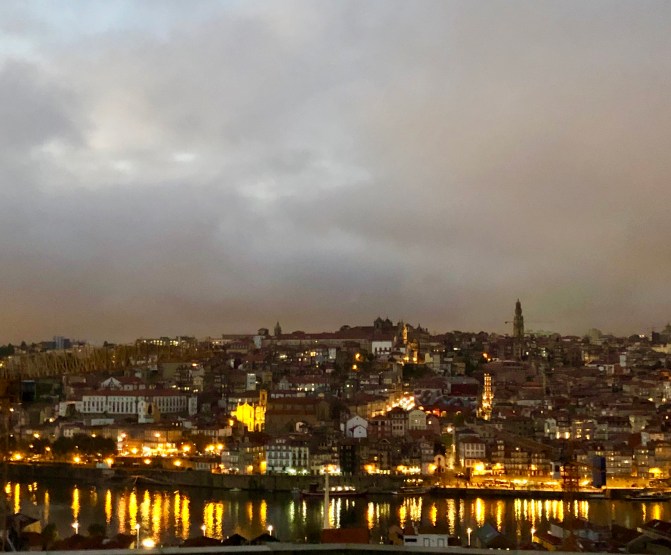
Porto is Portuguese for port. The Port wine cellars are in Gaia which is across the river and the seaport is in the fishing village of Matosinhos. Both are  very close and municipalities. Maybe it should have been called near the port. 

The view from the Yeatman hotel (in Gaia) is spectacular.

So is the spa and the breakfast.

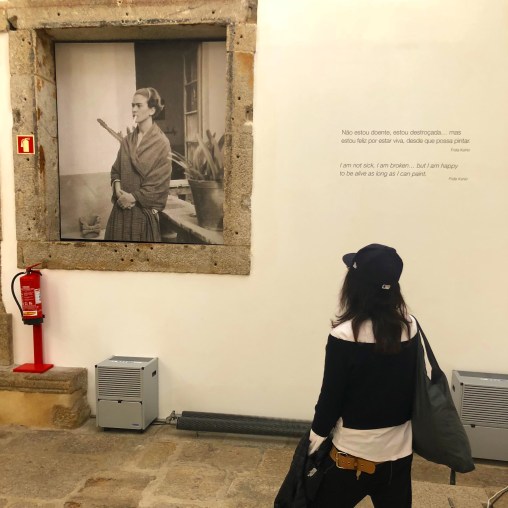
Most prisons are hidden away from a city. Porto’s 18th-century Cadeia de Relação was not.

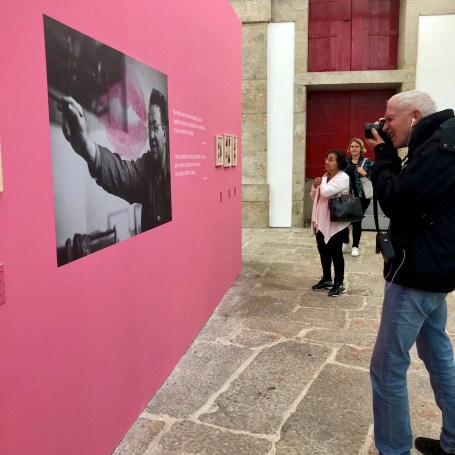
After two centuries as prison, it closed its doors in 1974 and reopened as the Center for Photography.

There was a new traveling exhibition of Frieda Kahlo’s collection of photographs.

I was fascinated by this building as well.

We explored and on the top floor  is the former cell of Camilo Castelo Branco.The famed 19th-century writer was locked up (with his married lover, the writer Ana Plácido) for adultery. His 12 months behind bars inspired several books, as well as a fine bronze sculpture of the couple in the museum’s paved entrance square.

There was also a collection of old cameras  used to take the prison photos.

Portuguese people seem to be great at the English language. Portuguese  is very difficult.

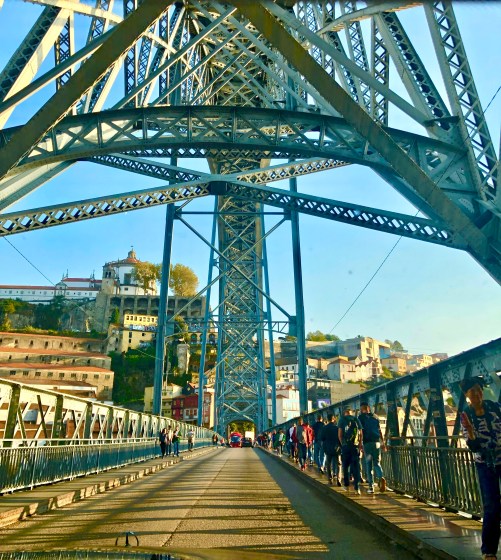
Porto is a city of bridges. It has six iconic bridges.

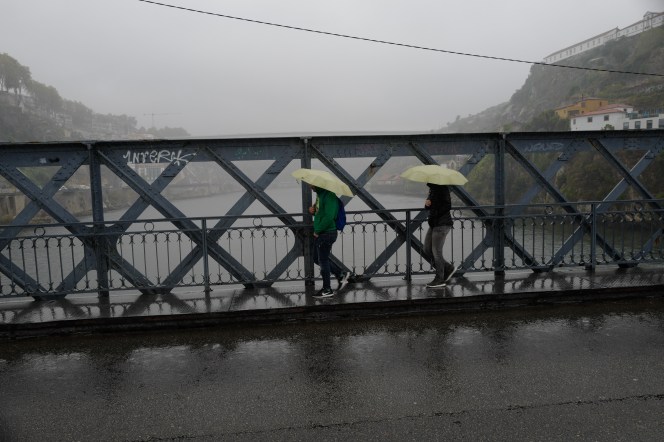
Two were started by Gustav Eiffel (of the tower) and finished by his apprentice  Theophile Seyrig. It is probably easier to walk across the bridges when it isn’t pouring.

The Francesinha (Frenchy) is a typical dish in Porto. It is not for the weak of stomach. Thick white bread housing several layers of cooked meats (including ham, steak and pork) are topped with a beer sauce and finished with a fried egg.It is usually accompanied by a huge dish of fries and multiple beers. I’m all for a curious local combo but this was not for me.

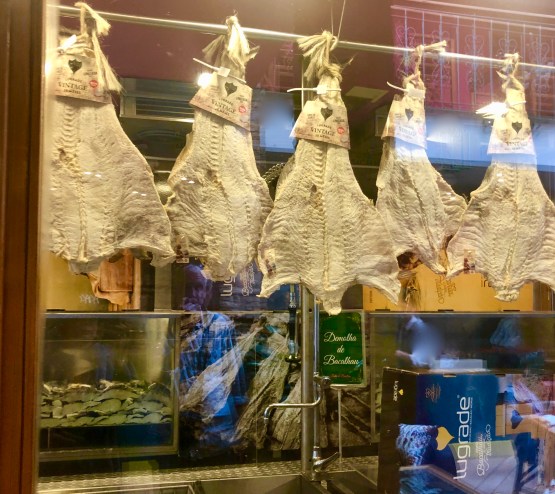
Bacalhau is fresh dry salt cod. The Portuguese are obsessed with bacalhau. It is eaten baked, roasted, barbecued, canned,  in codfish cakes, with potatoes, rice, eggs, cheese, cream and so many other ways. As the Portuguese would say: “There are more than 365 ways to cook bacalhau, one for every day of the year!”

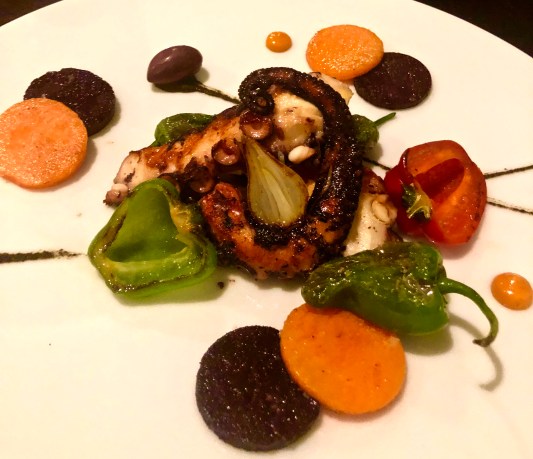
One of my favorite dishes to eat anywhere is octopus but it is especially good and cheap in Portugal. Octopus is rubbery so it is hard to cook. It was always fresh and cooked to perfection in Portugal.

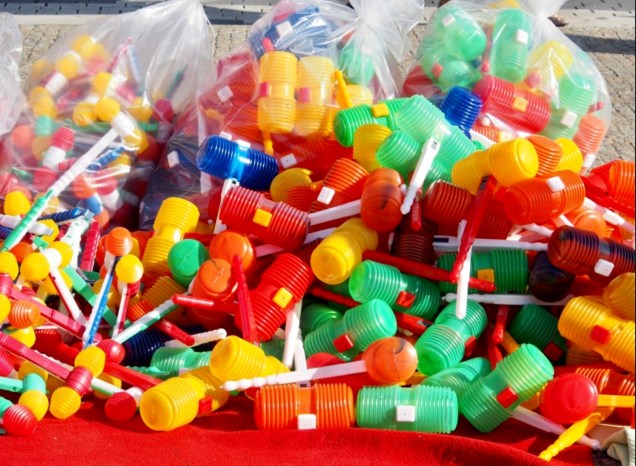
The São João Festival in Porto takes place between the 23rd and the 24th of June each year.. Some silly traditions that happen while you’re out partying on the streets include hitting others on the head with huge (not painful) loud plastic hammers, releasing hot air balloons up into the sky, and waving garlic in front of people’s faces. Might not sound appealing, but it is a lot of fun. The most symbolic item however is a round potted basil plant  and usually comes with a little poem stuck on it.

Fly safe,

JAZ
Twenty-Five Things That I Want To Do In 2019

Image

Twenty Five Things That I Want To Do In 2019

“Life is either a daring adventure or nothing.”  Helen Keller

Go to Sweden.

Go to Iceland.

Spend a day at the Blue Lagoon. 

Be a better friend.

Go to the Galápagos.

Plan less.

Read at least thirty books.

Go to the Amazon.

Take it bird by bird.

Drink one cup of coffee a day. 

Switch to Matcha Tea.

Go to Sedona.

Walk on the beach a few times a week.

Do a street art tour in Los Angeles instead of just taking photos.

See more of Australia.

Walk my dog every day.

Eat breakfast in Venice at least one a week. 

Go to the Faroe Islands.

Work on being fearless.

Give him a drawer.

Stay politically active.

See the Grand Canyon.

Always be grateful. 

Do more yoga

Meditate every day – maybe if I put it last I will do it.

Happy New Year and Fly Safe,

JAZ

New Years Eve

Image

  New Years Eve

“Rituals are the formula by which harmony is restored.” Terry Tempest Williams

I have a confession to make. I have always hated New Year’s Eve. Even when I was really young, I hated the exhaustive energy and resources spent on Dec 31. The overwhelming social pressure to go out and have the best night of your life in a skin tight, can’t breathe dress and painful heels in the freezing cold  (yes even in LA) was never my thing. 

For those of you who are thinking about becoming parents, having children is the best excuse to stay home on Dec 31. Throughout their childhood, I used my children as human shields to avoid what I considered the worst, most overpriced night of the year to go out. 

We created Family New Years and celebrated with champagne and caviar, movies, Chinese food, played celebrities, danced and watched the ball drop.  We kept that going for a long time.

 But the kids grew up and one Dec 31 morning my ex husband thought that would be a good day to leave. Talk about the pressure of making it the most memorable night of the year.  I was in shock and I didn’t know what to do so I did what we always did.

I went to Wally’s to buy caviar and champagne. I hate New Year’s  Eve but I love caviar and every year I buy a decadent one. I sat in the parking lot for a while before I went in.  I finally got out of the car and walked into the store wondering if everyone there would know that this time I would be buying it for myself. I went home and put a movie on. My children and my new therapist called at midnight (probably to make sure that I hadn’t killed myself). 

 I did the same thing for the next couple of years as I struggled to adjust to my new reality.  Being alone on holidays is difficult and scary.  One year I sat in the parking lot of Wally’s before I went in talking with my daughter. She was trying to decide whether to spend New Years with the boy she was obsessed with or the one she just met and would later marry. 

I learned not to rely on other people for happiness around the holidays. I scheduled me  days – massages, foreign films and art. I planned trips in early January so New Year’s Eve would never be too big of a deal and I could focus on caviar, champagne and packing.  I learned that just because you are alone one New Years Eve, doesn’t mean you will always be alone.  I didn’t spend many more New Year’s Eve’s alone.  But I always do the same thing. 

There is always caviar and champagne from Wally’s, Chinese food or pizza, this year – hot dogs and movies.  Every year I take a moment and reflect about the previous year in the parking lot before I go into the store.

This year Wally’s closed their Westwood location ( https://www.wallywine.com Beverly Hills and Santa Monica)  and I didn’t know. I sat outside the parking lot for a few minutes and thought about how great my life is these days. Then I drove  to Wally’s In Beverly Hills and bought caviar. The boyfriend is bringing the champagne.

Happy New Year and Fly Safe,

JAZ

Harry Potter and the Livrario Lello, Porto, Portugal

Image

Harry Potter And The Livrario Lello

“Whether you come back by page or by the big screen, Hogwarts will always be there to welcome you home.” J.K. Rowling

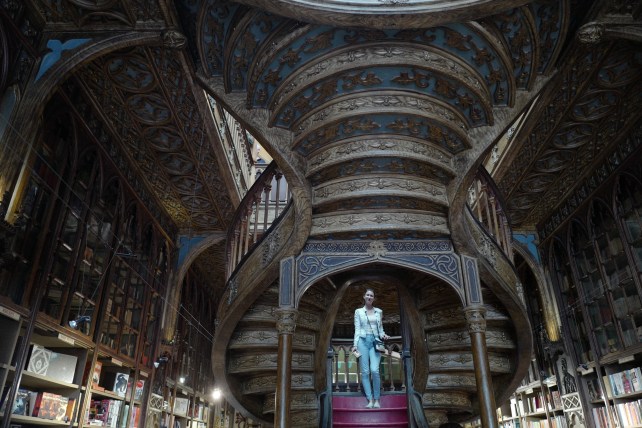
Once upon a time Livraria Lello was an old beautiful book store. The Lello book store was built in 1906 in Porto, Portugal by the Lello Brothers (Antonio and Jose).

Their  book store is one of the most ornate book stores in the world, mixing  Neo-Gothic and Art Deco elements.  The book store is visually stunning.

Carved wood ceilings, a stain-glass roof, an undulating, opulent red staircase, and even a built-in wheel-barrow on rails for moving the store’s 120,000 books all make the Lello seem like a bookstore out of some fantasy-world. 

One day some lady named J.K. Rowling lived in Porto while working on her first book. You might have heard of it- Harry Potter and the Philosopher’s Stone. Livraria Lello is reputed to have inspired parts of Hogwarts.

Since then, it has been inundated with Potter fans from around the world wanting to catch a glimpse and selfie of the bookstore’s interior.

What has resulted is a street-long queue of people who pay five euros per person to look at a set of stairs.

There is another longer queue in the ticket office on the corner if you have  failed to buy your ticket online in advance. (That would be me.)

Being a book lover, I wanted to fall in love with this beautiful book store. Unfortunately with all the tourists, the store is so noisy and crowded,

it is hard to even stand and look at the books.

I did manage to buy one. I did also fall in love with a city who’s number one tourist attraction is a book store.

Fly safe,

JAZ
The Arabic Influence In Granada, Spain

Image

The Arabic Influence In Granada, Spain

“Weep like a woman over what you could not defend as a man.” Mother of Boabdil- the last Sultan in Spain

The Moors invaded Spain in 711 AD and they ruled  for over seven hundred years.  At one time, they ruled as far north as France.   The principal cities of Moorish culture were Toledo, Granada, and Seville.  Eventually the Christian rulers in Northern Spain recaptured Spain. In 1085 Alfonso VI of Leon and Castile recaptured Toledo. Cordoba fell in 1236, and one by one the Moorish strongholds surrendered. The last Moorish city, Granada, was captured by Ferdinand V and Isabella I in 1492..

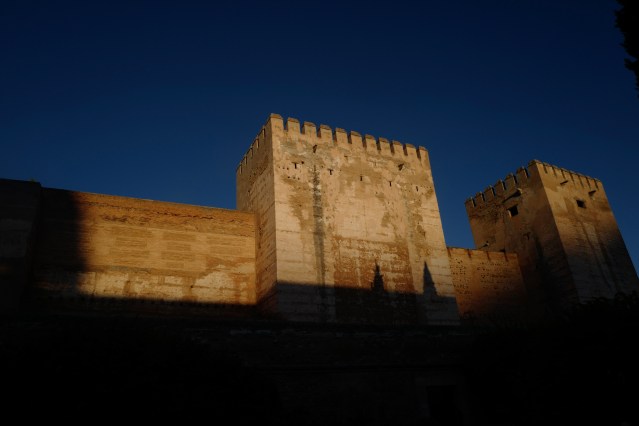
The word ‘Alhambra’ is a short form of the word ‘Calat Alhambra’ which is the name given to a palace and fortress complex located in Granada, Andalusia, Spain. The palace started off as a small fortress that was built in 899.

After years of neglect, the Moorish king of Grenada renovated it in the eleventh century. The fortress was to later be converted into a royal palace in 1333  by Yusuf I, Sultan of Granada.

I spent a day there before so I did not tour again. It is big enough to spend at least a day but you can do the highlights in a few hours.

The area of Granada around the Plaza Nueva and fountain Pilar del Toro is the oldest part of the city of Granada. The Mosque was located here.

The Santa Ana church was built on that same site.  At that time the river would have been visible, not covered over like today. 

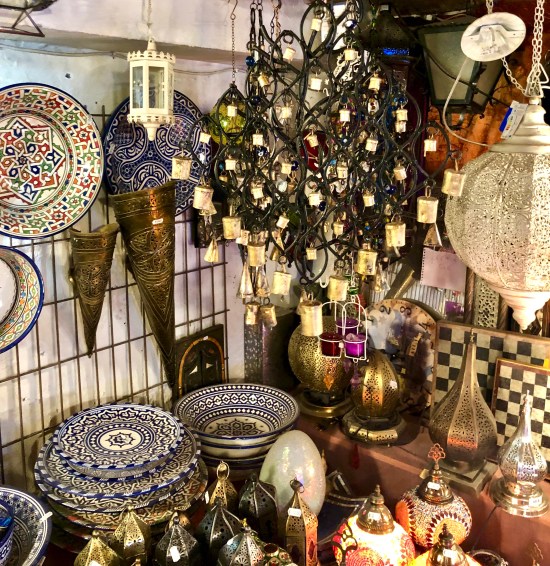
In the city center, the Alcaiceria stands out, like a typically Arabic souk (bazaar) that attracts many tourists and locals alike.

Glittery Moroccan lamps, colorful silk and leather products are fun to look at and buy.

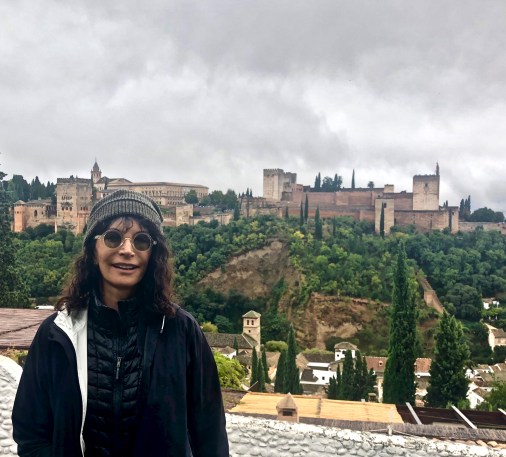
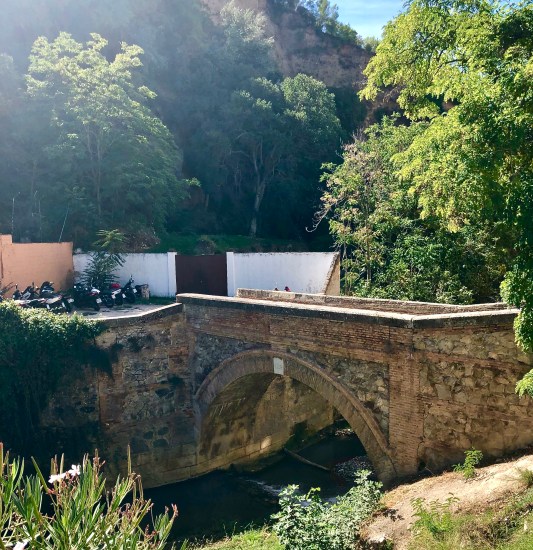
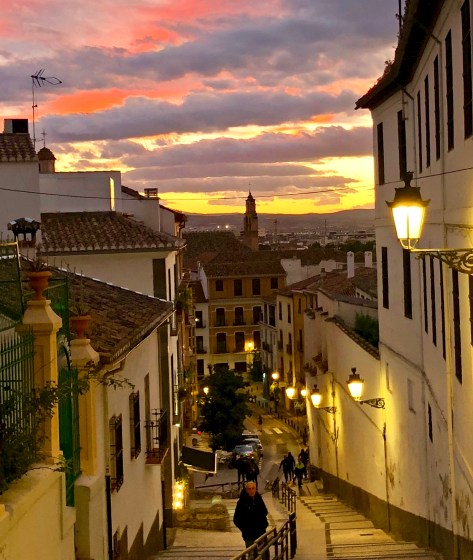
Other signs of Arabic influence can be seen in the Albaci­n, one of the oldest areas in Granada. Perched on the hilltop across a canal from the Alhambra, it consists of steep cobblestone paths and quaint authentic white-washed houses known as El Carmen.

Arabic tea houses and Moroccan shops line the narrow street that leads up to the hilltop.

The perfect way to relax after a day, is to smoke some Arabic water-pipe (Spanish name is cachimas) in the dimly lit aromatic tea houses (teterias).  I wish that I had the photos to show you but here was the day I spent there. Not a person was out.

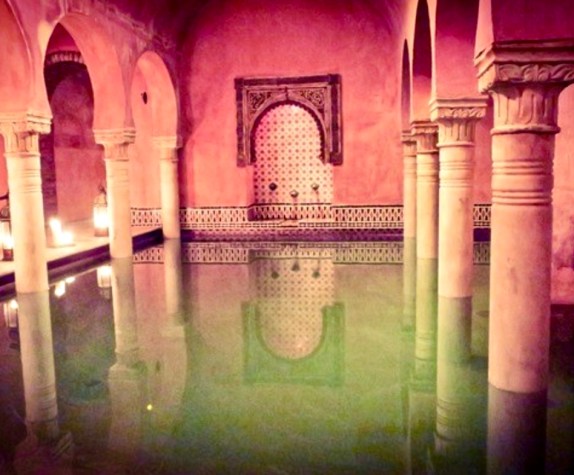
There were several bath houses or hammams  in this area during the Moorish rule. In 1567 due to the difficult situation faced by the Moors in Granada, at the hands of the new Catholic Kings, all hammams in Granada  were prohibited. They also banned speaking  in Arabic and wearing Arab style garments.

The current Hammam Al Andalas  https://www.hammamalandalus.com/en/ is in one of the old bathhouse buildings. It actually dates back to 8th and 14th century. This hammam building was converted into baker ovens in the sixteenth century. The bakers made the most of the heating systems which previously created steam and heated water, for baking their bread.

 As I enter the hammam I have the awkward ‘I forgot my bathing suit moment and it is coed and you have to wear one.” They lend me a bathing suit.  During my stay, I drink  green tea with mint, while  relaxing in the different thermal baths and steam room. As I walked through from the changing area to the baths the humidity and warmth hit me. This steamy comfortable environment is great for unwinding and relaxing tense muscles For a while, there was a quiet relaxed atmosphere and then a bus load of tourists showed up.

Luckily it was time for a wonderful scrub and a soapy cleanse with white frothy bubbles. I go into a different dry space  for a  massage and left completely soft, clean and relaxed.

The Hammam Al Andalus in Granada recreates the feeling of  history and the bathhouses that were  here so long ago. Book it in advance, it fills up quickly and is a wonderful way to capture the feeling old Granada.

Fly safe,

JAZ

Things That I Have Learned In Granada, Spain

Image

Things That I Have Learned In Granada, Spain

“Like Spain, I am bound to the past.” William S. Burroughs

Granada was originally called Gárnata which could mean  “hill of strangers” in Arabic.

Granada was a Muslim Kingdom for almost 781 years, which is the longest culture to rule in Spain. The city was the last stronghold of Muslim Spain which fell to the Catholic Monarchs in 1492.

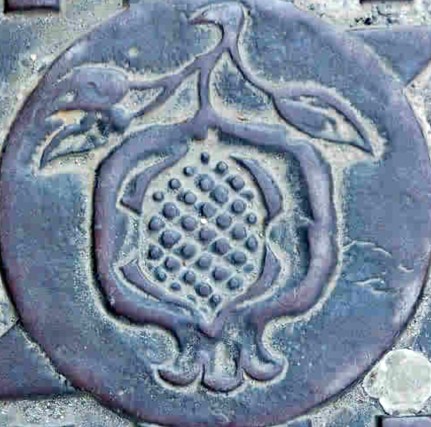
City symbol is the pomegranate which is logical considering that “granada” in Spanish means ‘pomegranate.’

Granada has 250 days of sunlight. Two of them were not while I was there.

Granada is home to 3 UNESCO World Heritage sites – Alhambra, Generalife and Albacin.

Almost 3 million tourists from all around the world visit Granada and the Alhambra every year.

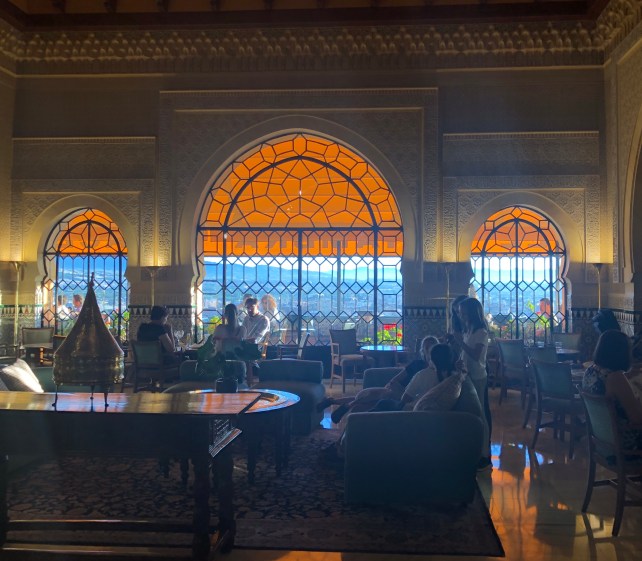
The Alhambra Palace Hotel has incredible views of the city and “Selections from Don Quixote” in the room.

Reading the highlights of Don Quixote in Spanish in Spain was very cool.

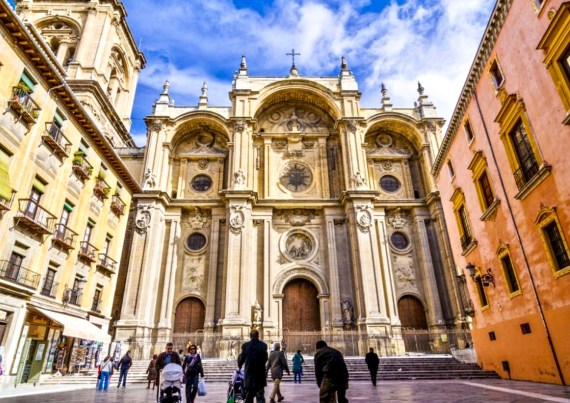
In the Royal Chapel of Granada are the  sarcophagi of Queen Isabella I and King Ferdinand, their daughter Juana and her husband Phillipe.

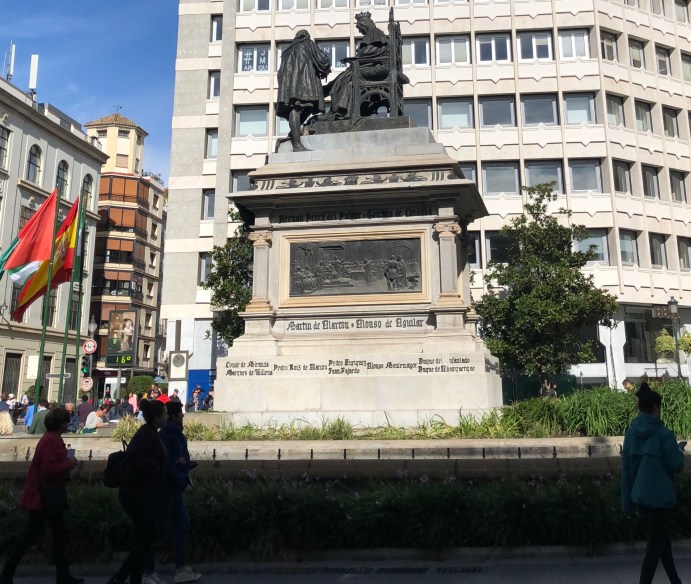
   At the time of the reconquest of Granada Christopher Columbus was looking for sponsors to fund exploration to discover the “New World”. The Spanish monarchs agreed and he went on to discover America.  There is a statue of Christopher Columbus kneeling before Queen Isabella at the end of the Gran Via de Colón in Granada. (His name in Spanish is Cristobal Colón).

Playwright and poet Federico Garcia Lorca was arrested and killed on the orders of right wing military authorities in Granada in 1936 according to newly released documents that shed light on the death of one of the highest-profile victims of the Spanish Civil War.

Granadinos are less friendly and lighthearted than the average Spaniard but that still means that they are more friendly than the French.

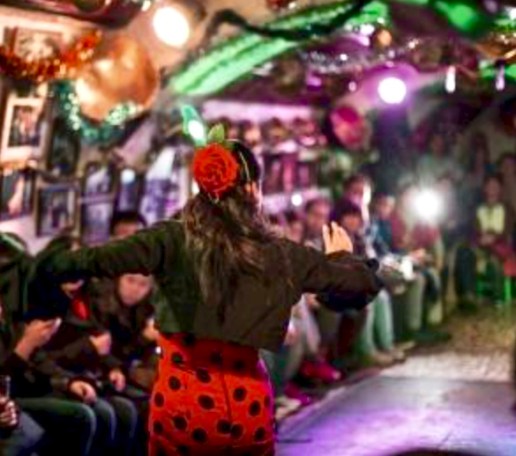
The gypsies arrived in Granada about 600 years ago and one of the places where they congregated was in the caves of the Sacromonte. The mixture of Arabic influence combined with the particular lifestyle and temperament of the gypsies created Flamenco. 

Mario Maya was one of the Spain’s most innovative and influential flamenco dancers. He was born in Córdoba in 1937, but grew up in the Sacromonte of Granada.

Munira is a great store to buy interesting souvenirs and gifts.https://www.munira.net

Granada has hot dry summer and cool winters. In July and August the temperature is often over fourty Celsius. . In 2017 several all time temperature records were broken.

The wettest months are November and December and the day in October that I had a walking tour of Sacromonte and the Albacin neighborhoods up in the hills. I had to make a deal with the taxi driver not to leave us in the pouring rain.

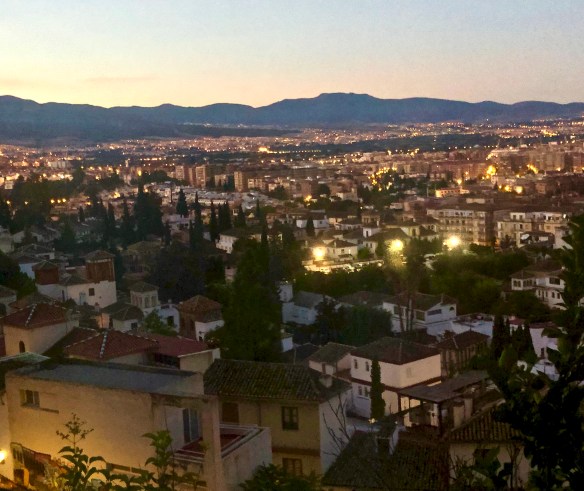
Watching the sunset and sunrise over the city against the Sierra Nevada foothills is really special.


Fly safe,

JAZ