“The rain in Spain stays mainly on the plain.”Lerner and Lowe, My Fair Lady


Fly safe,
JAZ

“The rain in Spain stays mainly on the plain.”Lerner and Lowe, My Fair Lady
Fly safe,
JAZ
Ten Things That I Want To Do In Portugal This Time
“Life is what we make of it. Travel is the traveler. What we see isn’t what we see but what we are.” Fernando Pessoa, Book Of Disquiet
Porto is the colorful, Unesco city that I have wanted to visit. The photos are beautiful and I can’t wait to walk down those streets.
Livraria Lello and Irmao is one of the most beautiful bookstores in the world. Ask JK Rowling.
Drink Port which is named after….
I love seafood and both Porto and Lisbon are on the sea – codfish, sardines, snails, grilled whole fresh fish of the day with coarse salt and crispy, skin, octopus, eels, and snails along with kale soup and pastel de nata is a great reason to go to Portugal (This is a major eating trip)
When I was in Lisbon I didn’t make it to the National Tile Museum ((Museo Nacional De Azulejo). It is located in the Alfama area (where we are staying this time) in a fifteenth century convent. I saw those beautiful tiles on many of the old buildings and palaces when I was there and I want to know more about them.
The Fado Museum (Portuguese guitar music) is also in Alfama and sounds like something I would like. The Fado Museum is a testimony of passion and dedication this country has for Fado and has helped musicians, instrument manufacturers and researchers gain the exceptional esteem which the practice of fado enjoys today.
Buying a few more pair of handmade gloves at Ulisses in Lisbon. They are guaranteed for life so i will check mine before I leave for Portugal .
The Douro Valley is known for its vineyards, landscapes and the Douro River. It’s another amazing place in Portugal that I will see this time.
Drive from Porto to Lisbon stopping in towns and fishing villages along the way.
Buy canned fish to take home from Lisbon. There are many different cans to choose from. Shelves in every corner of the city sit stacked with cans of sardines, horse mackerel, tuna, anchovies, octopus, eel, and more. Some shops sell nothing but tinned fish. It is surprisingly good. It is not like Chicken of the Sea.
Fly safe,
JAZ
Just A Lot Of Walls – Urban Art In Lisbon
“I was here but now I’m gone. I left my name to carry on. Those who liked me, liked me well. Those who didn’t can go to hell'” The bathroom wall
Like any subculture, street art has its own slang. You don’t need to know it to appreciate the art but some words that pop up are spot jocking (putting your work up next to a popular artist for some attention), child style, tiling, (both self-explanatory ), reverse graffiti (creating art by taking off and not applying paint) and one that I heard a lot on my street art tour of Lisbon – intervention. (Sainer)
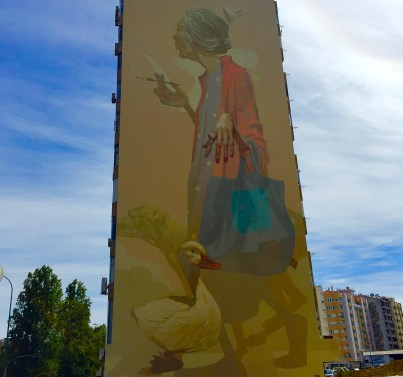
It’s not a word I hear often unless it involves rehab. Intervention is a street art term used to disrupt public space as opposed to street art which is decorative. My street art guide in Lisbon used the word as a form of urban artistic expression. Art intervention is art specifically designed to interact with an existing structure. I guess with that definition all street art can be called an intervention.
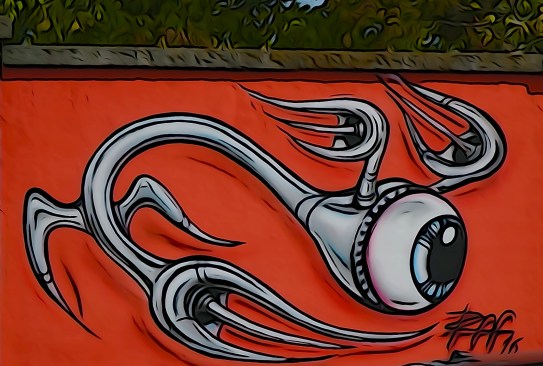
The only street art tour I could find was a private tour given by the street art collective Underdogs. http://www.under-dogs.net/ They have a gallery with exhibitions of interesting street artists, affordable editions at their shared store space, and public art and community programs. They do not do group tours and instead invest their time in promoting artists and art education in the community. (Bicicleta Sem Freio)

My tour guide Marina Rei shows up full of passion and enthusiasm for the art on the streets of her city. She is excited about the artists in residence and the educational programs she has just completed.
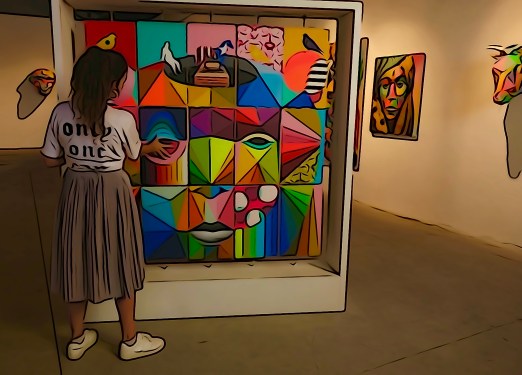
Underdogs was started by a famous Portuguese street artist named Vhils. The word underdog means to struggle against something more powerful than you. They are “underdogs pushing to be top dogs .” (Vhils)

The tour includes works by Alexandre Farto AKA Vhils, PixelPancho, How & Nosm, ±MaisMenos±, Finok, Okuda, Nunca, Clemens Behr, Bicicleta Sem Freio, Wasted Rita, Sainer and Ernest Zacharevic. (Clemens Behr)

Their souvenir shop and offices share space with a paint store. Classic artists, students, serious street artists and vandals come to buy their paint. ( ±MaisMenos±,)

Their art gallery is in an old warehouse area just starting to be gentrified. The current exhibition is by Spanish street artist Okuda.

Street Art started in Lisbon around 1974 when the Carnation Revolution overthrew the Authoritarian regime. Almost all the territories became independent.(A Lei Do Meis Forte -Nomen, Slap ,Kurtz, Exas,Lukas)

Graffiti and tagging began with the new democracy. (Merkel’s Puppets -Nomen,Slap,Kurtz)

Murals appeared around the city similar to those in unstable South American countries portraying the problems and the dreams. There are still references to it throughout the city.

The old warehouses of Clube Naval de Lisboa, are now covered in a work of art by Bicicleta Sem Freio, a group of Brazilian artists. They create murals around the world.

My favorite work that I saw that day was a series of girls by Lithuanian street artist Ernest Zacharevic. He sees himself as a fine artist who paints in the streets and that is evidenced by the combination of spray paint and detailed art. I really wanted one of these. The last time I thought about cutting a piece of street art out of the wall it was by a guy named SAMO in New York.
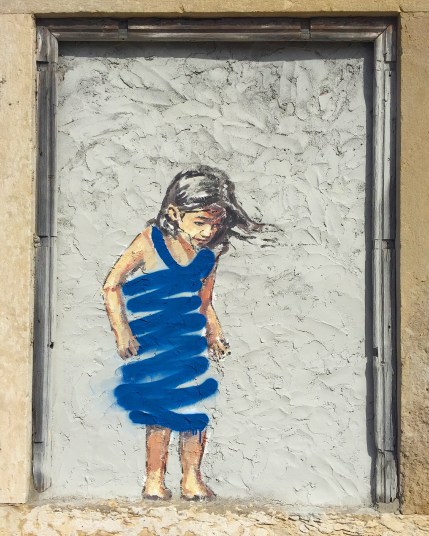
The outdoor walls in Lisbon have become a lot of blank canvases for the artists. It is sometimes a strong form of communication and sometimes it is quieter. But, there is always a splash of color.

Fly safe,
JAZ
Sintra, Caiscais and Estoril, Portugal
“Some places speak distinctly. Certain dank gardens cry aloud for a murder; certain old houses demand to be haunted; certain coasts are set apart for shipwrecks”. ~Robert Louis Stevenson
In the eighteenth and nineteenth centuries Sintra was the place to be for the rich, famous and royal.

There are villas, palaces and castles with a mix of very colorful architectural and decorative features.

It is about an hour out of Lisbon with a cooler mountainous climate.

Pena Palace was built by the last Portuguese Royal Family In the mid-nineteenth century.

The palace is an unusual and ornate blend of design and color.

They were not afraid to mix prints, materials or styles.

It is on the highest hill and views are spectacular.

Being from a country that does have not have royalty, (other than rock, sports and Hollywood royalty) I have used the term castle and palace interchangeably. In Sintra where they have both, I have learned that a castle is built as a defense and a palace is used more to showcase wealth. A good rule of thumb is if there is a moat it is a castle. Pena is for sure a palace.

There is nothing practical here.
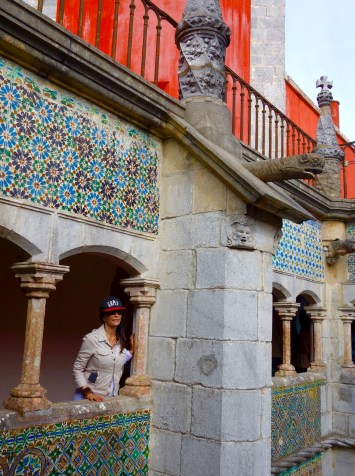
You can see that National Palace with its two chimneys from almost anywhere in Sintra.

It was built as a summer residence for the Portuguese royal family who resided there from the early 15th century and was in continuous use up until the late 19th century. It now belongs to the State and it is used as a Cultural Centre where exhibitions are usually held.

Sintra’s charming historic town centre is listed as a UNESCO World Heritage Site.

Every visitor should spend some time exploring the maze of cobblestone lanes lined with quaint shops and cafes.
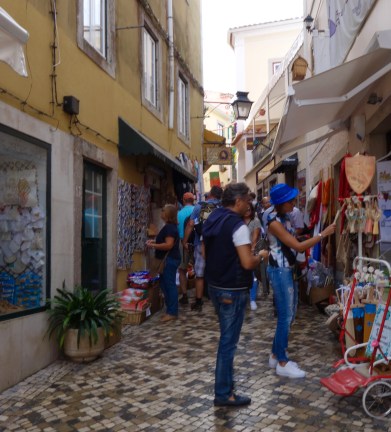
We head to Cascais. Cascais represents the hardest part of the Portuguese language for me. It looks French but it is pronounced Cazh Cezh with a hard C. Sometimes a word looks Spanish and it means the same thing in Portuguese, but when said, it sounds Russian. (photo – Sintra Magik Tours)

Caiscais was once a sleepy fishing village and has transformed into a favorite holiday destination for Portuguese and Europeans.

It is a nice town with cobblestone streets lined with shops, bars and restaurants. It’s not just a holiday town, there’s a resident working population which generally commutes to Lisbon – half an hour or so – so it doesn’t close down as the tourist season ends. (photo-Sintra Magik Tours)

Cabo da Roca is the most westerly point on the European mainland.

It stands on a cliff and it is marked by a monument (with many people taking photos)

and a lighthouse. ( photo – Sintra Magik Tours)

Lisbon and the surrounding area was a spying hotbed during WWll because of the country’s neutrality, the city’s strategic position by the Atlantic and the presence of all sorts of displaced European royalty.

Hotel Palacio was not only Bond’s hotel in On Her Majesty’s Secret Service, but Lieutenant Ian Fleming himself stayed here during the Second World War.

The Allied spies based themselves at the Palacio and the bar they frequented in the hotel, and where Fleming enjoyed a martini or three, is today known as the Spies Bar. ( photo – Sintra Magik Tours)
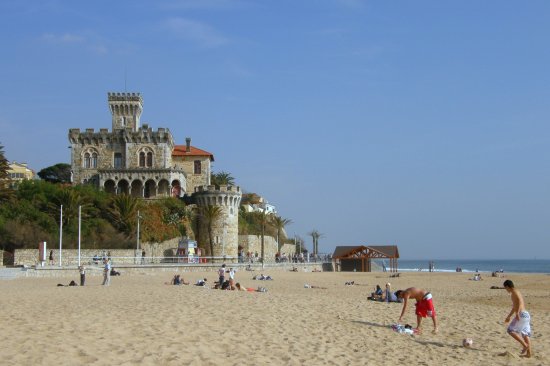
The Casino in Estoril was the basis for Ian Fleming’s first 007 book Casino Royale.

There is no shortage of things to do in Lisbon but if you have a few days definitely get out of the city and explore the surrounding areas. I highly recommend doing it with Diogo of Sintra Magik Tours. http://sintraprivatetours.com/ He is intelligent and very knowledgeable about all of Portugal. As you can see from all the photos of me, he is also an excellent photographer. Special thanks to Sintra Magik tours for answering all my questions and for the needed photos. It was such a wonderful, special day.
Fly safe,
JAZ
Finding Fernando Pessoa in Lisbon, Portugal
“I’m nothing. I’ll always be nothing.I can’t want to be something.
But I have in me all the dreams of the world.” Fernando Pessoa
I was looking on the internet for interesting things to do in Lisbon and there was a tour with Lisboa Autentica http://lisboaautentica.com/en/ of Fernando Pessoa’s Lisbon. Fernando Pessoa was a famous writer and poet in Portuguese speaking countries. Seeing a city through the eyes of its artists, writers or chefs is always the way I want to see a city.

I started reading the Book Of Disquiet and realized that I was reading something amazing. The story is hard to describe. It is a fictional autobiography which deals with the meaning of life and the quest and topics that go with that. The poetic language in which he tells his story is brilliant. A great book to me is when I read it and think that I feel the same way. This made me very interested about who Fernando Pessoa was in Portugal.
The tour was available on my first morning in Lisbon. It was going to be my introduction to the city. I jumped in a taxi and headed to the Cafe Brasilia in Chiado, a heavily touristic area.
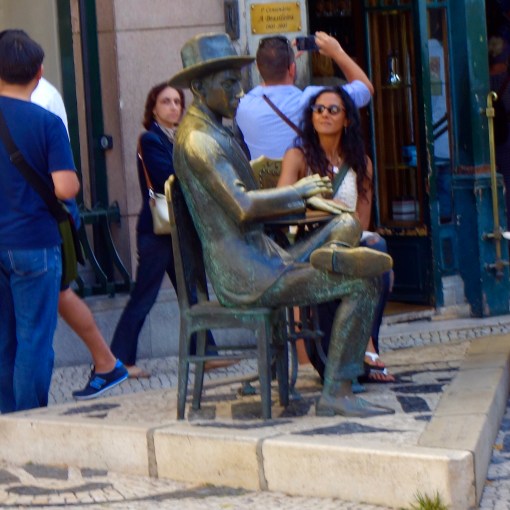
Many of Pessoa’s poems were written in coffee shops – at Brasileira in Chiado or in Terreiro do Passo’s Martinho da Arcada. There is a bronze statue of him at his favorite table outside the Cafe Brasilia.

The tour guide turned out to be a person who had put his soul into learning about Fernando Pessoa. Fabrizio Boscaglia had come from Italy to the University of Portugal where he received his PhD in Philosophy. He was part of the group of researchers who digitalized Fernando Pessoa’s private library and wrote his doctoral thesis about him. I was introduced to Fernando Pessoa through the eyes of someone who’s passion and enthusiasm for his writing had led him to this path.

As we walk the cobblestone streets of Chiado we pass the book headed statue in front of the place of his birth and the “office” where from the Book Of Disquiet worked.
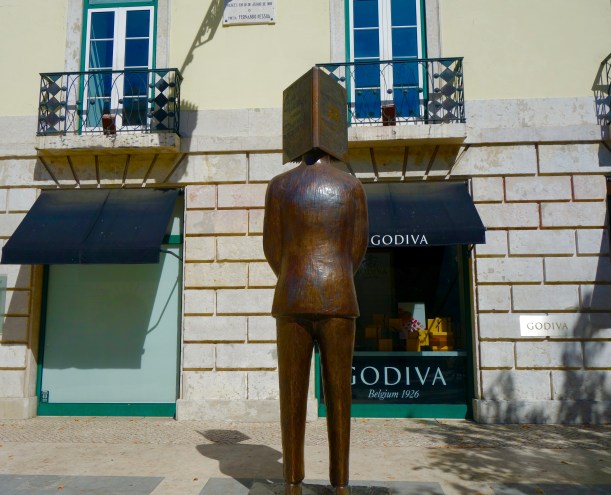
Fernando Pessoa not only wrote under different names, he created different characters or personalities for them. He called them heteronyms. (heteronomonos) I think they were fragments of his personality. These poets he created were also some of the great writers of Portugal. They had their own birth dates, life stories, jobs, astrological charts and literary style quite different from each other. Many of them wrote incredibly beautiful poems. Pessoa who started a literary magazine also critiqued them. Some he liked better than others. There were at least seventy-eight heteronyms and probably many more.

We walk passed the beautiful Manueline Church, Opera House and Theatre as Fabrizio tells us about his life.

Fernando Pessoa moved to Durban, South Africa when he was five years old with his mother’s new husband who was with the consulate. He lived there until he was seventeen. I had just returned from South Africa so I can picture him there.
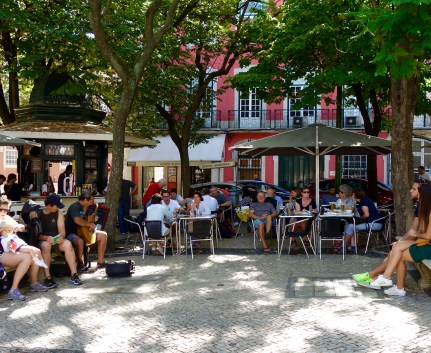
We continue near the places that Pessoa used to meet his lover Ophelia and the bars where he drank with his friends.

Fabrizio saw my interest and offered me the “advanced Fernando Pessoa tour” usually given in Portuguese. I was in. What better way to understand Fernando Pessoa and see Old Lisbon than with someone who cared so deeply about him.

We meet a few days later in the Alfama district of Lisbon, which is a maze of beautiful narrow uphill streets.

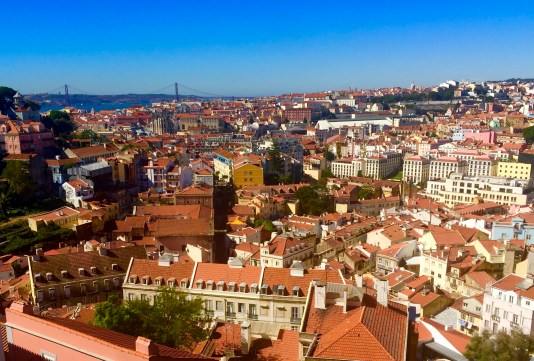
The city’s poorest residents, dock workers and sailors once lived there. It is now gentrified and trendy but still charming. There are several historic buildings and churches and one of the most beautiful views of Lisbon is here.
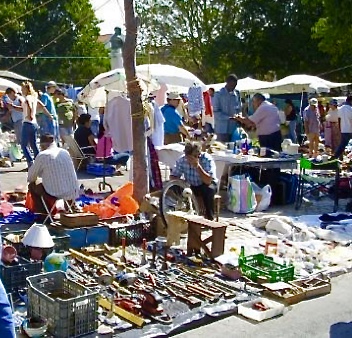
The Thieves Market -Fiera De Ladra happens every Tuesday and Friday. It is a flea market full of junk and treasures. A market had been in that spot had since the seventeenth century.

Fabrizio continues to tell me stories and little known facts about Fernando Pessoa as we navigate the picturesque streets as he once did.
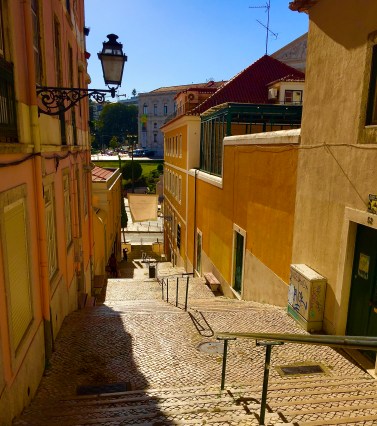
Casa Fernando Pessoa is the house where Fernando Pessoa lived. Outside is a café with quotes from his poetry. Inside is a museum with his private objects, interactive exhibits, a small bookstore and a library.

One side of the library is dedicated to Fernando Pessoa books. Fabrizio shows me the book he published and is about to publish another one. The other side is a poetry section with books of poems from all over the world.

Fernando Pessoa published one book of poems in his life time called Mesagem. He died a penniless alcoholic.
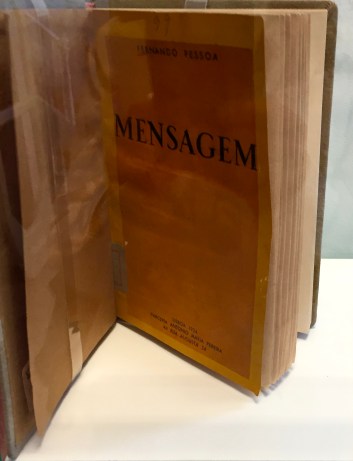
The manuscript for the Book Of Disquiet was found in a trunk after his death along with many other unpublished works.

Pessoa is so important to modern Portuguese culture that he is buried in the 500-year-old Jerónimos Monastery, one of the most important buildings in all of Portugal, under a simple memorial.

I highly recommend taking the Fernando Pessoa tour with Fabrizio. He speaks so passionately that you become absorbed in the story. It is not often that you find a tour guide so educated in a subject and with such a unique perspective. He is also a really nice guy. It was an honor to see Lisbon with him.
Fly safe,
JAZ
Street Art In Lisbon – Portuguese Pavement
“Where utility ends and decoration begins is perfection.” Jack Gardner
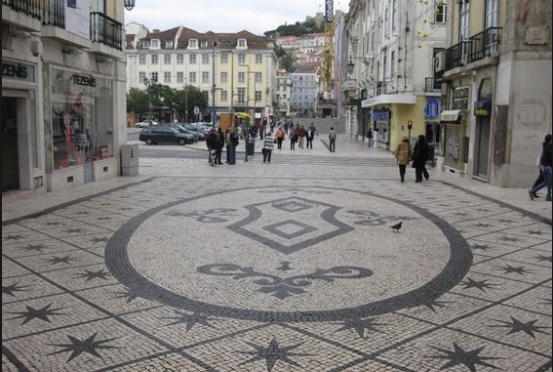
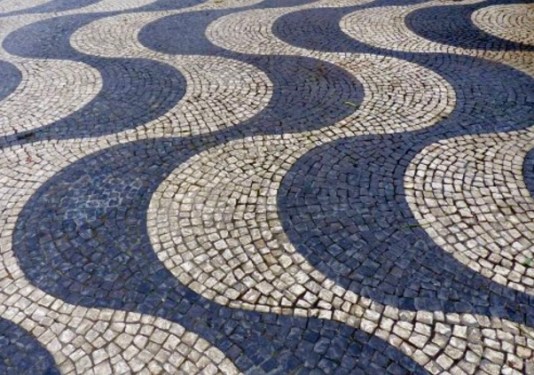
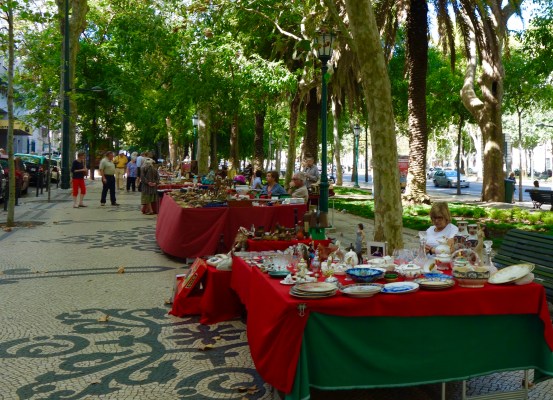
If you read my blog, you know I am a fan of street art. Lisbon is no exception. There is very interesting urban art but there is also calcada portuguesa .They are street tiles painstakingly laid down by hand in a variety of mosaic patterns throughout the city. It started in the mid nineteenth century and can be seen in the historic parts of Lisbon.






Fly safe,
JAZ
Things I Have Learned In Lisbon, Portugal
“We leave something of ourselves behind when we leave a place, we stay there, even though we go away. And there are things in us that we can find again only by going back there.” Pascal Mercier, Night Train to Lisbon
Lisbon is known to be built on seven hills: Castelo, Graca, Monte, Penha de Franca, S.Pedro de Alcantara, Santa Catarina and Estrela. It makes the capital of Portugal similar to such cities as Rome, Istanbul and Moscow.

The views are crazy good from different parts of the city. My hotel was at the top of one of the hills because I was always walking up the wrong street to get there and having to walk down and up again. Walking the streets of Lisbon is a definite workout.

Lisbon’s superb natural setting, spread across seven hills facing the Tagus River, offers a network of terraces from which to contemplate the beauty of the city. They are called “miradouros” or viewpoints, they’re usually located at the highest points of each hill, and all have spaces to sit and rest. Some even have cafes serving snacks and light refreshments.
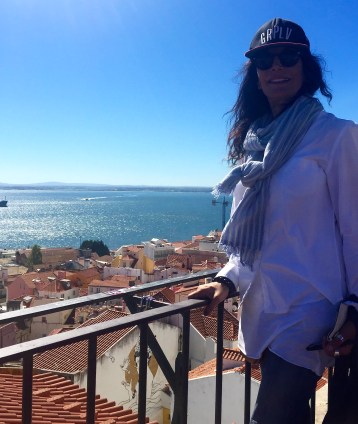
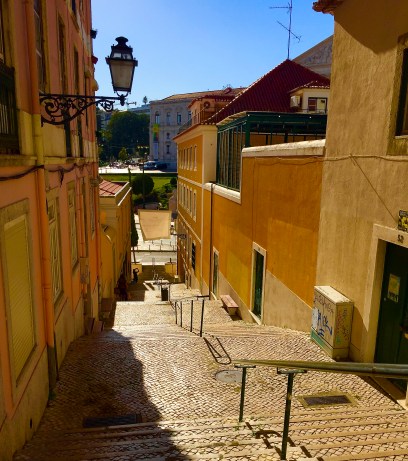
I’m usually not a fan of getting lost but I didn’t mind in Lisbon. There are interesting streets that I would have missed.
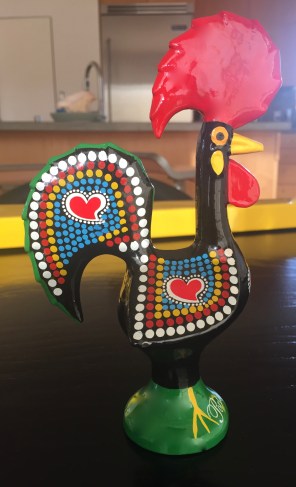
The Barcelos Rooster is considered to be the unofficial symbol of Portugal. The story varies but it has to do with a roasted rooster getting up from the table and declaring a falsely accused religious pilgrim innocent. It is carried for good luck. I buy every country’s good luck charms.
In Lisbon, there exists one of the oldest bakeries that makes Pastel de Nata. It’s located in the neighborhood of Belem. The Antiga Confeitaria de Belém is a favorite of locals and tourists alike.

The tarts here are called Pastéis de Belem and served plain with cinnamon and sugar toppings.

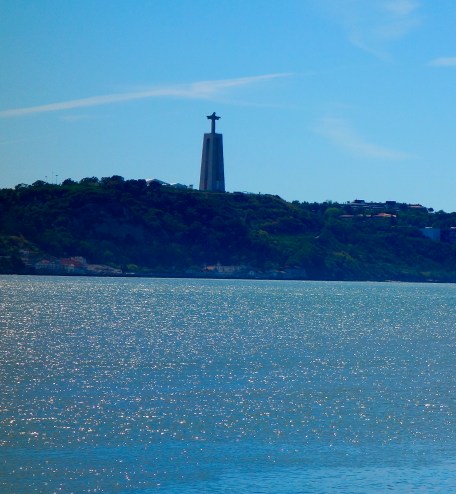
Lisbon has its own Cristo Rei (Christ the King statue) – a Catholic monument overlooking the city, standing on the left bank of the river. It was inspired by the Christ the Redeemer statue in Rio de Janeiro in Brazil. The statue commemorates Portugal’s survival of WWII.
The Jerónimos Monastery was constructed in the Portuguese Manueline style. The Monastery was commissioned by King Manuel in 1501 and took 100 years to finish. The monks role was to pray for the King’s eternal soul and give spiritual help to navigators and sailors leaving to explore the world.

Vasco de Gama who is buried here left from this site in 1497. There are no advance tickets so come early or be prepared to wait up to an hour. The cloisters and architecture are magnificent and worth the admission. The Church of Belem is free.

Tower of Belem is Lisbon’s iconic landmark. The Tower is located on the Tagus River a twenty-minute walk from the Monastery. It was built in the Manueline style the sixteenth century as part of a defense wall which was never finished.

Manueline style is a very specific interpretation of Gothic architectural structure and decoration only found in Portugal.The style emerged during the reign of King Manuel I (1495-1521) but the name was not adopted until the 19th century.

Buying gloves at the tiny Ulisses glove shop in Lisbon is a serious experience. They have made unique and high quality gloves in the same way since 1928. Place your elbow on a cushion and have the special opportunity of getting gloves fit to your hand. They are guaranteed for life and you don’t need a receipt as they know which are their gloves.

The Vasco da Gama Bridge over the Tagus River is the longest bridge in Europe – 17, 2 km (10.7 miles) long.

Fiera de la Ladra (thieves market) is a flea market in the Alfama district every Tuesday and Thursday. A market has been in this place since the twelfth century. It is one of the oldest areas in Lisbon and so beautiful to walk around in.
Lisbon was the first city in the world to import Guinness from the UK.
Sardines are a typical Portuguese meal . I can live without them but they weren’t that bad served fresh and much larger than the canned variety.

Canned fish seems to be a common staple in Portugal and there is a lot to choose from.

Right up there with sardines, octopus is the most fished species in Portugal. It is one of my favorite dishes and I had it a lot.

Eating grilled fish in Portugal (Peixe Grelhado) is an amazing experience.

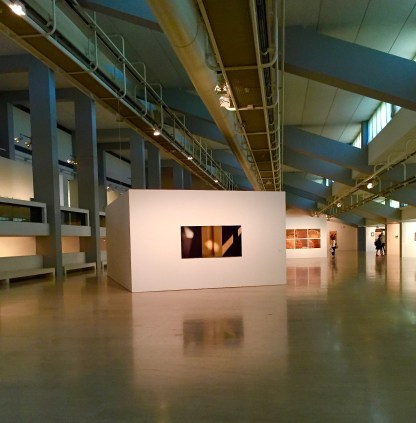
Museu Berardo is a wonderful space for modern and contemporary art in Belem.The collection owes its existence to the Portuguese businessman Joe Berardo who, in his lifetime, amassed a great number of works of contemporary art. The space houses the permanent collection and changing contemporary exhibitions.

The Gulbenkian Museum is located in a modern complex with beautiful gardens and ducks, an extensive library and a Modern Art Center.The Gulbenkian collection was mostly collected by Calouste Gulbenkian during his lifetime.

The Modern Art Center(CAM) has an extensive collection of twentieth and twenty-first century modern Portuguese art. Temporary exhibits are scheduled throughout the year of Portuguese and international artists.
Lisbon was a love at first sight city for me. It is beautiful, colorful, full of layers and character. People are so friendly and helpful and many speak English or Spanish. The city is relatively inexpensive. Portuguese seafood is a reason alone to come here. It is very easy to get around by walking, taxi, boat or public transportation. I want to return soon.
Bom Viagem
JAZ
Last Ten Things I Googled
Google can bring you back 100,000 answers. A librarian can bring you back the right one.” Neil Gaiman
Weather in Petra, Jordan.
What is apple cider vinegar good for?
How are the teams shaping up on the Voice?
Did the brother kill JonBenet Ramsey?
Best things to buy in Portugal.
Are there Starbucks in Jordan, Israel and Portugal? (for my collection not for the coffee)
Guy who asked me out in Lisbon.
Best stain removers.
How much water has to leak before you have mold?
Fernando Pessoa quotes.
Best falafel in Tel Aviv
and that was just this morning.
Fly safe,
JAZ
Ten Reasons To go To Lisbon, Portugal
It is important when in Lisbon to eat as many pastries as possible. There is a bakery on almost every corner. I had pastel de nata for the first time at a Portuguese bakery with a very long line in Sao Paulo, Brazil. I cant wait to try them here.
Lisbon is one of the cheapest European cities.
Lisbon gets 3000 hours of sunlight every year.
Lisbon is well-known for its excellent street art. Everywhere you turn you will be amazed to see a creative masterpiece.
Fado is the traditional folk music of Portugal. It is probably the most melancholy music you’ll ever hear and still somehow makes the ideal soundtrack for every trip to Portugal.
About a half hour by train from Lisbon is the fairytale town of Sintra. it is filled with castles, estates, palaces and amazing scenery. The monarchy came here to enjoy the summer.
One of the 20th century’s great philanthropists, Armenian Calouste Gulbenkian, left much of his art and historic artifacts to his favorite city, Lisbon. The museum now houses one of Europe’s most epic collections. There’s also an affiliated modern art museum nearby which I am interested in seeing.
Portugal seems to be in the second-tier in the wine world, right after France, Italy and Spain despite the famous Port Wine and even though Portuguese wines win the most prestigious awards every year. Chances are there is a great quality wine at a very reasonable price waiting for me.
See the Toree de Belem and the Mosteiro dos Jerónimos. This 15th-century monastery was built to commemorate Vasco da Gama’s “discovery” of India. This Byzantine and Gothic tower stands out over the mouth of the Tejo, guarding the entrance to the city’s harbor
Go to the beach. Water is a big part of the Portuguese identity and mine too.
Fly safe,
JAZ
 Travel Well, Fly Safe
You must be logged in to post a comment.