“To be fully alive is to have an aesthetic perception of life because a major part of the world’s goodness lies in its often unspeakable beauty.” Yukitaka Yamamoto
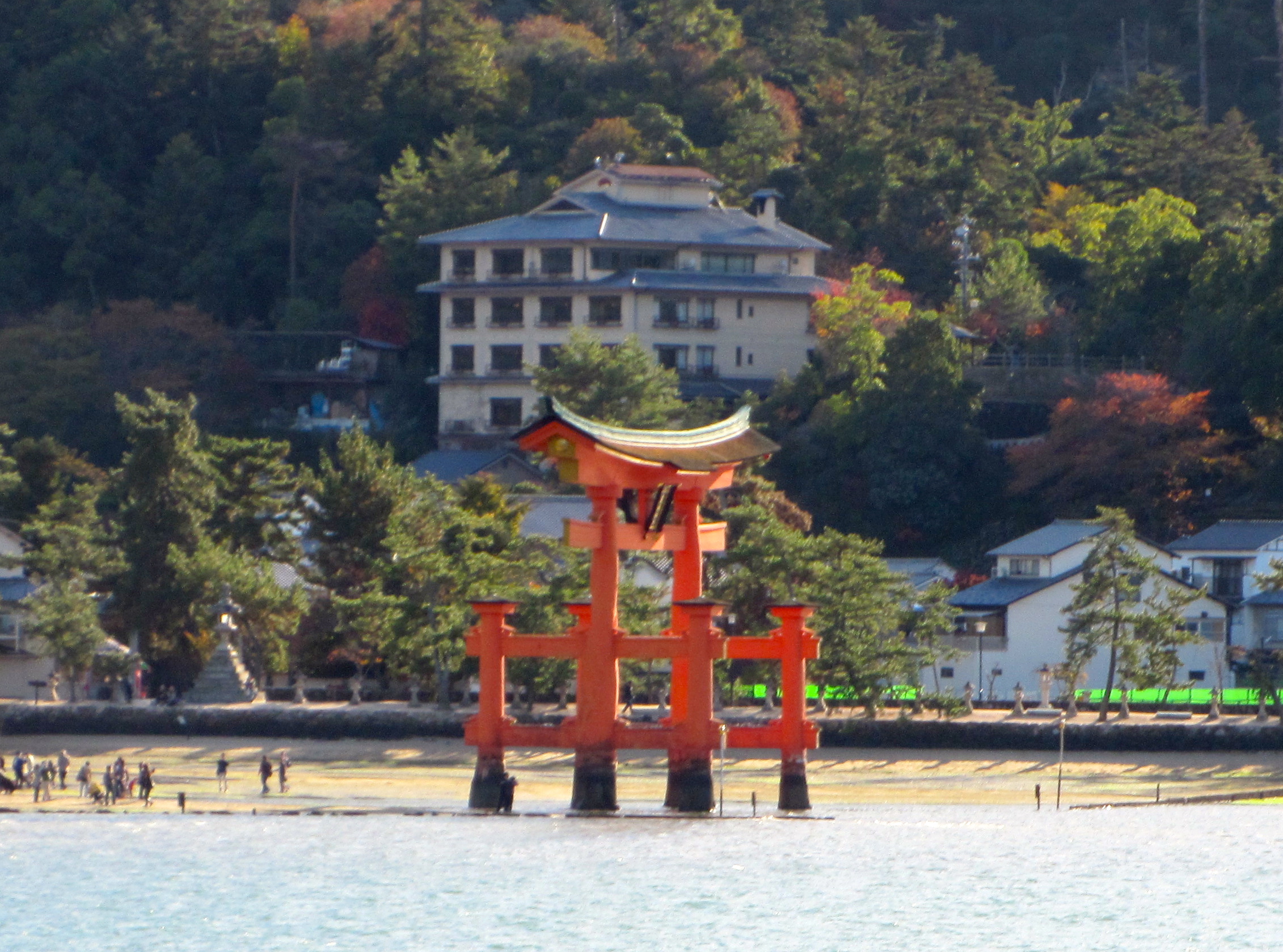
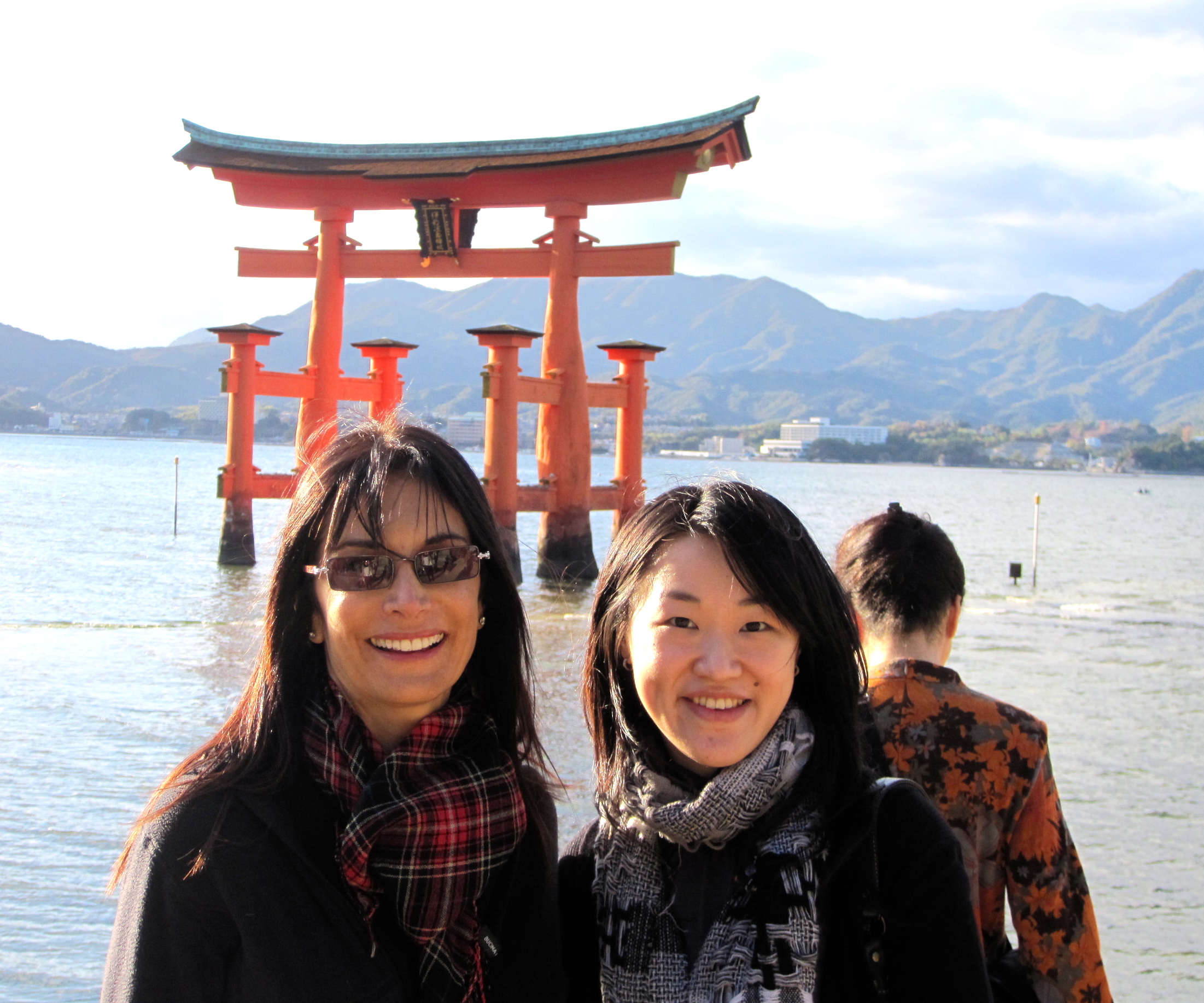
The most famous site in Japan are the floating Torii gates of the Itsukushima Shrine on the island of Myajima in Hiroshima Prefecture. Actually the real name of the island is Itsukushima but people will know what you mean by Myajima (shrine island).
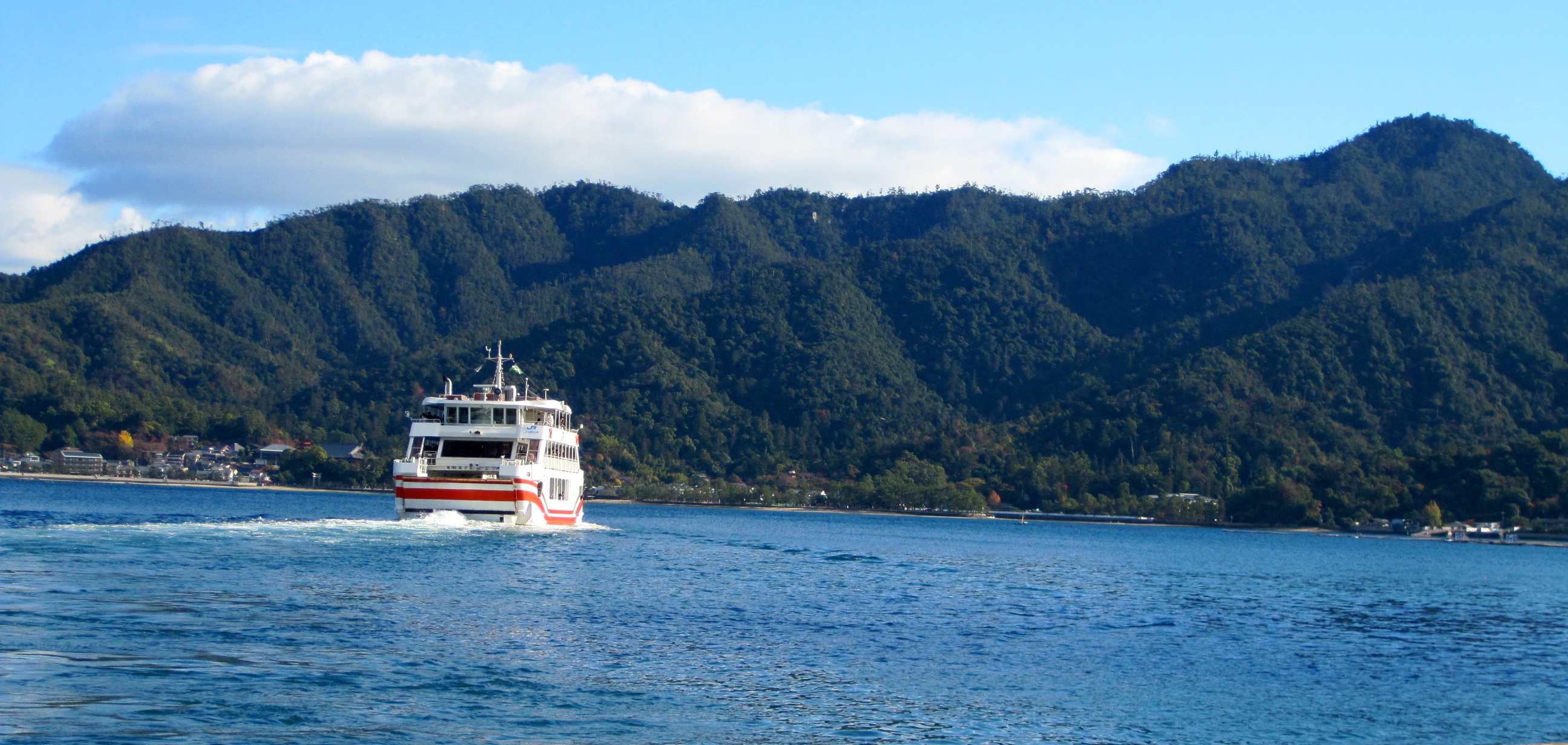
To get to Myajima you take a ferry from Hiroshima. Anago (sea eel) is one of the famous regional foods of the Hiroshima area. It’s especially prominent around the area of Miyajima, and if you go to Miyajima-guchi where you catch the ferry to Miyajima Island, you’ll find several competing restaurants featuring anago.
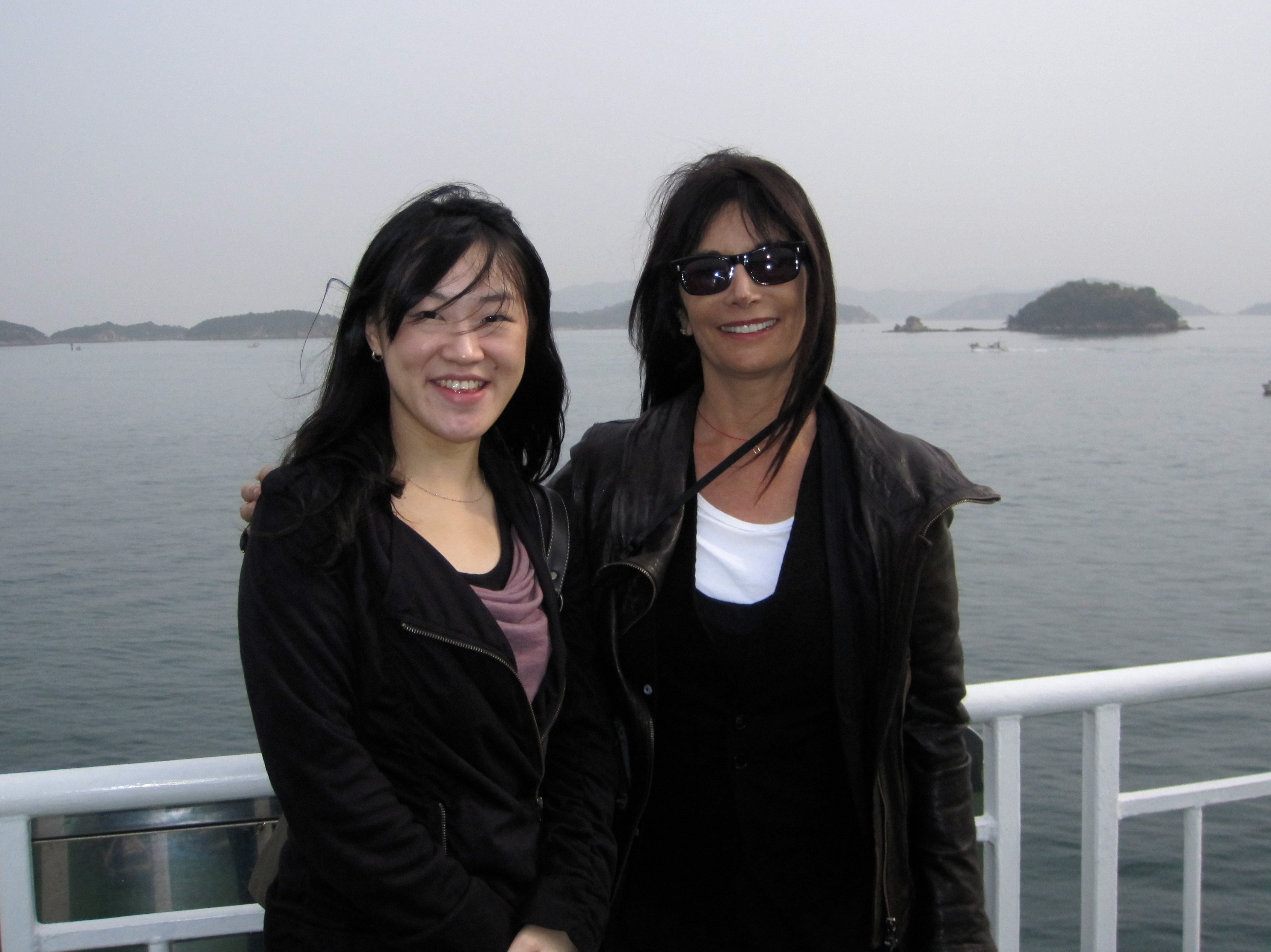
I am not the only one taking pictures on the ferry as the Tori gates come into view.
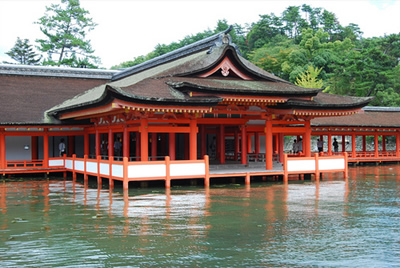
Miyajima is believed to be the island where God dwells. It is said that Itsukushima Shrine is built on the coast because the whole island is God’s body and is sanctified. Itsukushima Shrine was built at the end of sixth century and modified to the present building by Kiyomori Taira, who came into power for the first time as a warrior in 1168. It is located in the sea and has a bold structure because the shape changes by the rising and falling tide. The orange lacquered shrine building, green forest and blue sea symbolizes the Japanese sense of beauty.
The island itself has been considered sacred. In order to keep up its purity, commoners were not allowed to set foot on Miyajima through much of its history. In order to allow pilgrims to approach, the shrine was built like a pier over the water, so that it appeared to float, separate from the land. It existed in a state between the sacred and the ? Not sacred? Damned? Ordinary? Others?
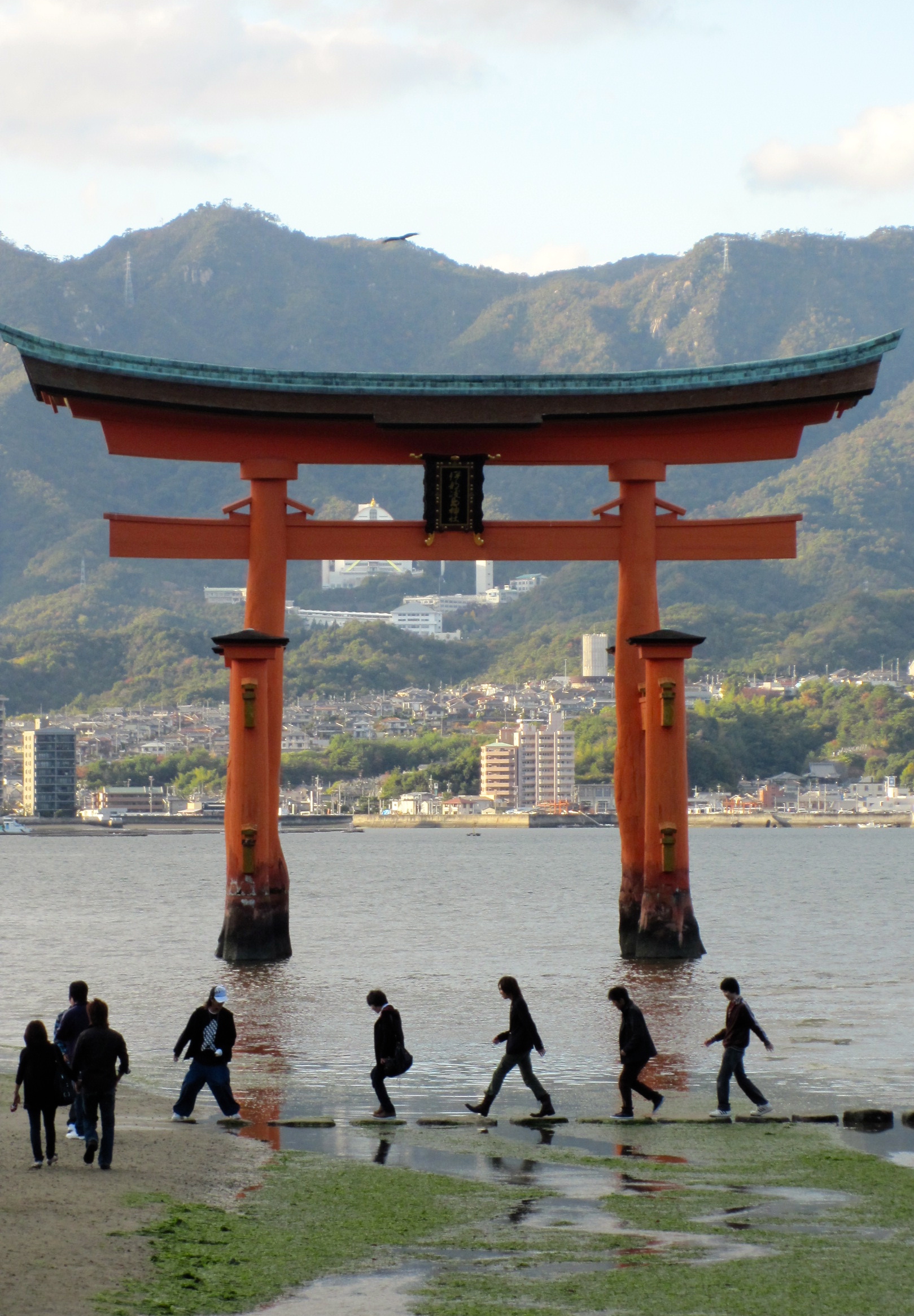
The shrine’s signature orange entrance gate, or torii, was built over the water for the same reason. Commoners had to steer their boats through the torii before approaching the shrine. When the tide is low, you can walk to it.
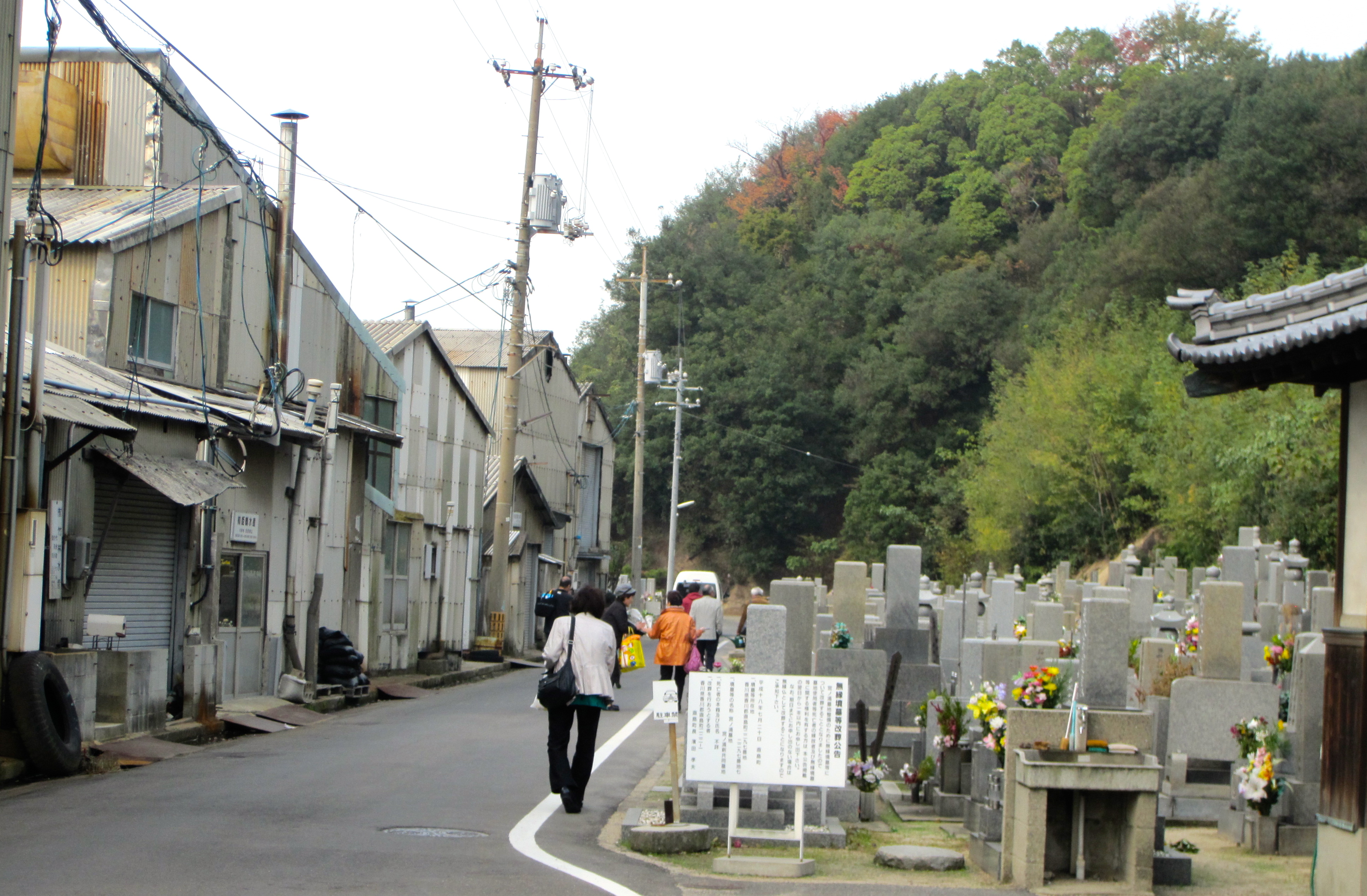
Retaining the purity of the shrine is so important that since 1878, no deaths or births have been permitted near the shrine. To this day, pregnant women are supposed to go the mainland as the day of delivery approaches, as are terminally ill or the very elderly who are near death. Burials on the island are still forbidden. I’m not sure how they control the birth and death thing.
It is both a Unesco World Heritage site and a Japanese National Treasure site.
Omote-Sando is the main street from the port to Itsukushima Shrine. There are a lot of souvenir shops on both sides of the street. You can enjoy souvenir shopping for artwork such as Shamoji, a rice scoop, wooden spoons, well-known Momiji manju, a bun with a bean-jam filling made from maple leaves, and other crafts.
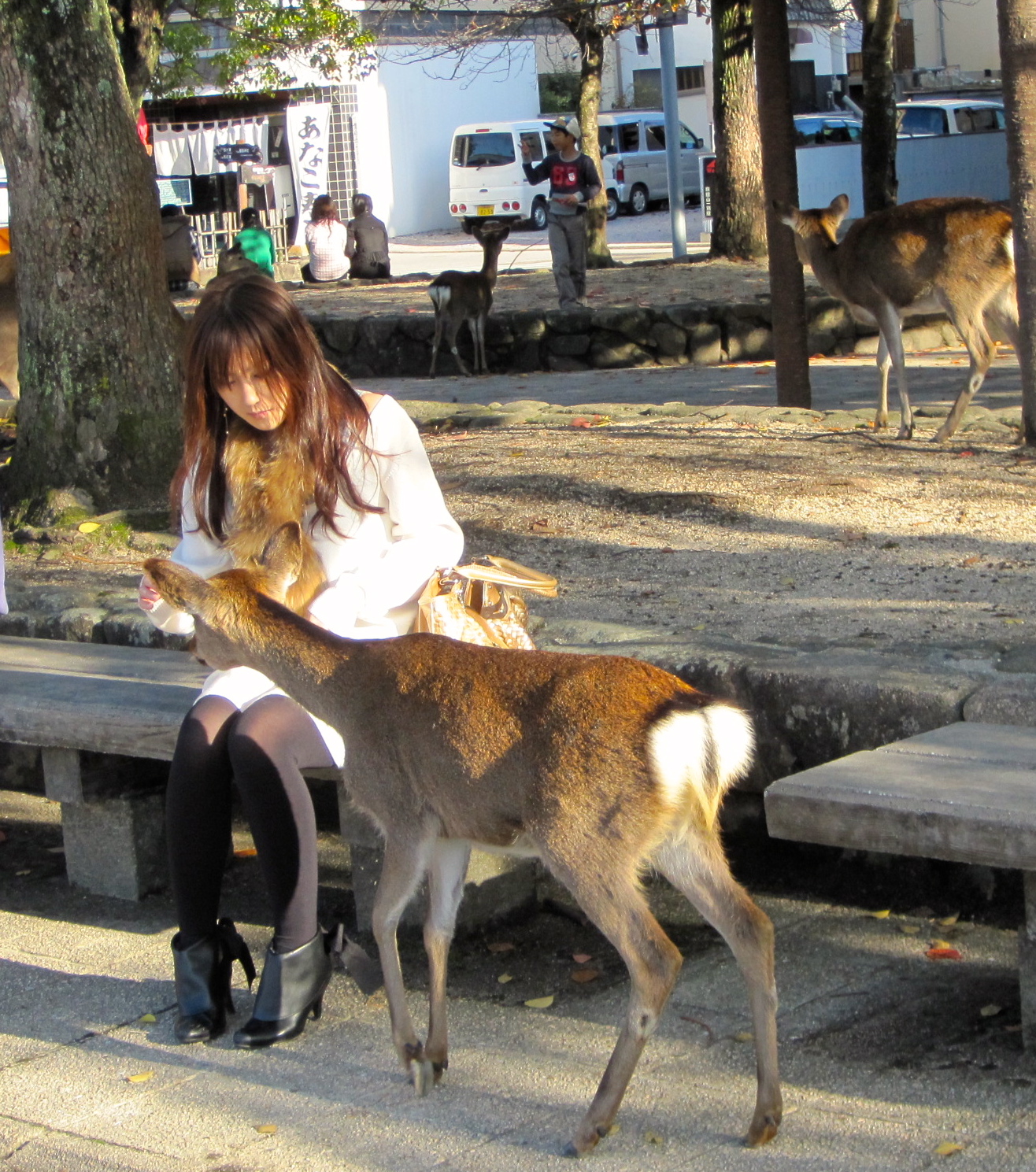
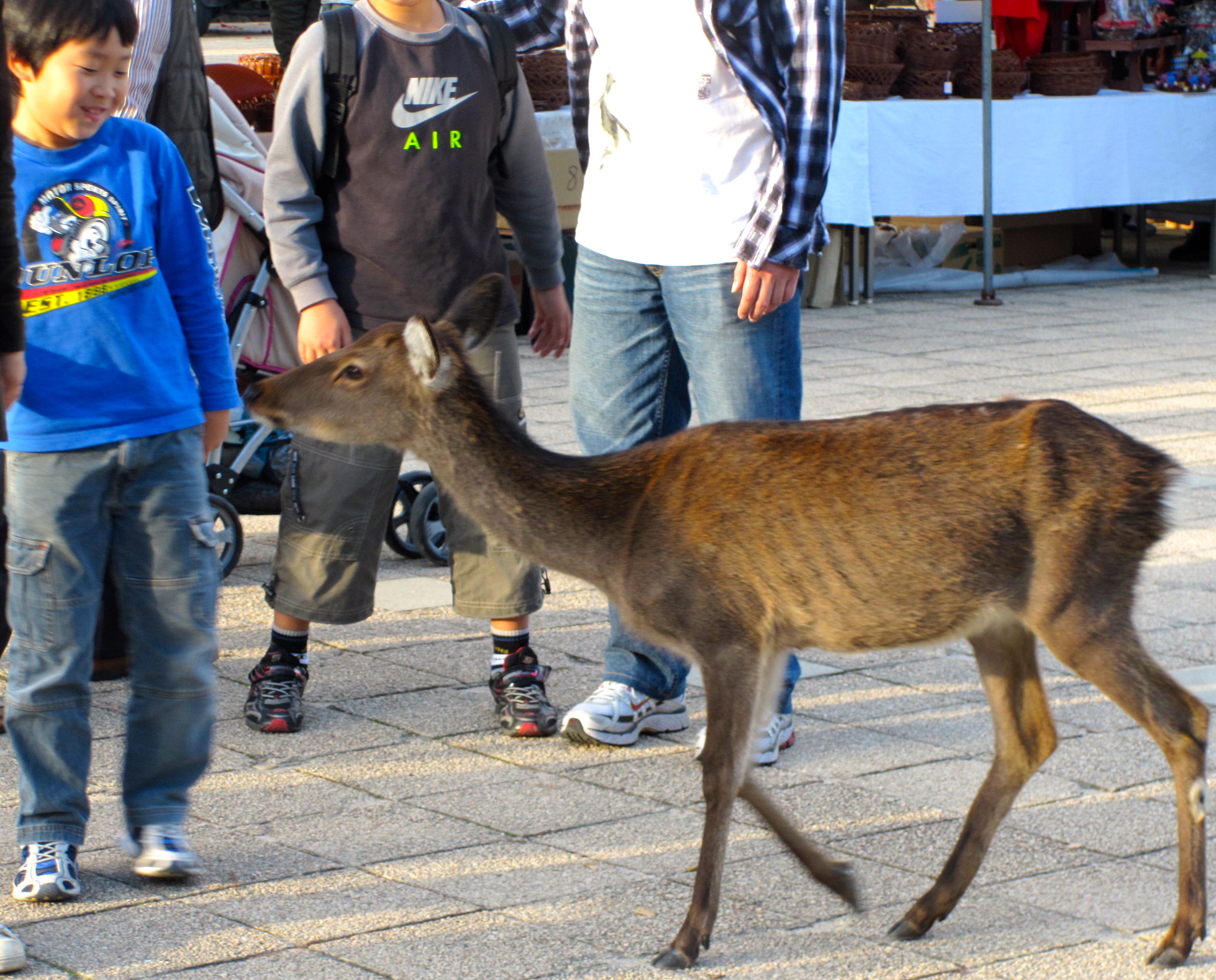
The deer on Myajima are not shy about asking for food and water and just as cute as the ones in Nara Park.
There are many other temples and Buddha statues on Myajima. If you visit these spots you can really feel that Miyajima has been the object of worship for Japanese people throughout time.
“You cant really say what is beautiful about a place but the image will remain vividly with you .” Tadao Ando
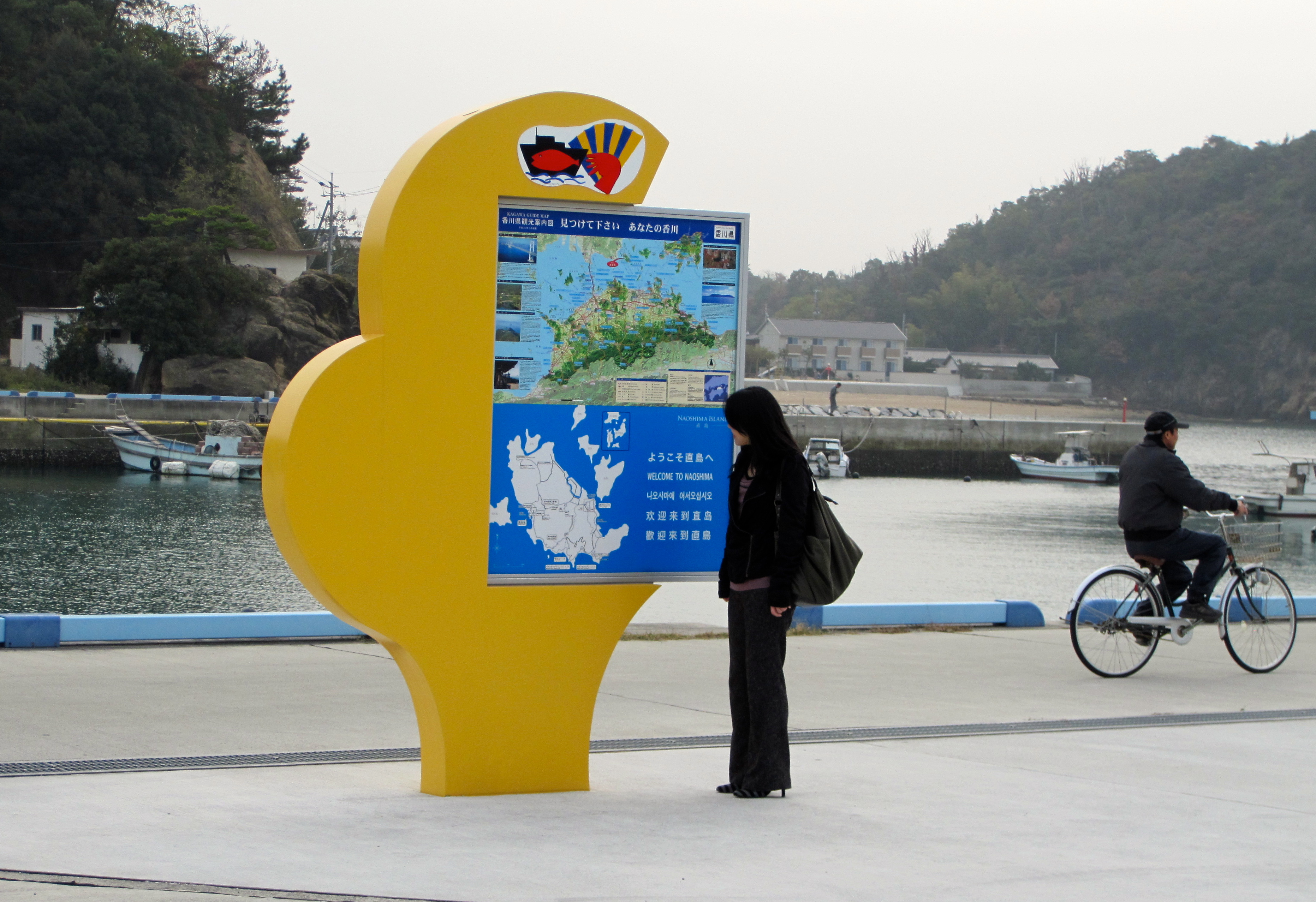
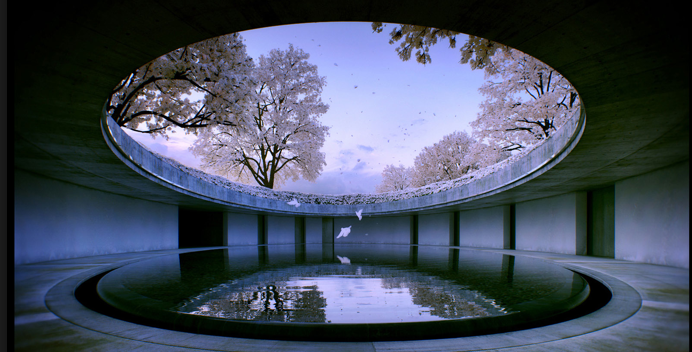
The small fishing island of Naoshima is an unlikely destination for globe-trotting art collectors and my most favorite place in Japan. Tadao Ando’s vision coupled with investments from a large benefactor join art, architecture, nature and life together in an amazing place.
An eccentric billionaire from Okayama and the company Bennesse that he runs, have been slowly transforming the island into open-air museums of contemporary art.
It is located 500 miles south of the Fukushima plant so no worries there. ( I did hear from a physicist who worked on it that it was a self-contained explosion and the radiation did not escape into the universe –but I’m a worrier)
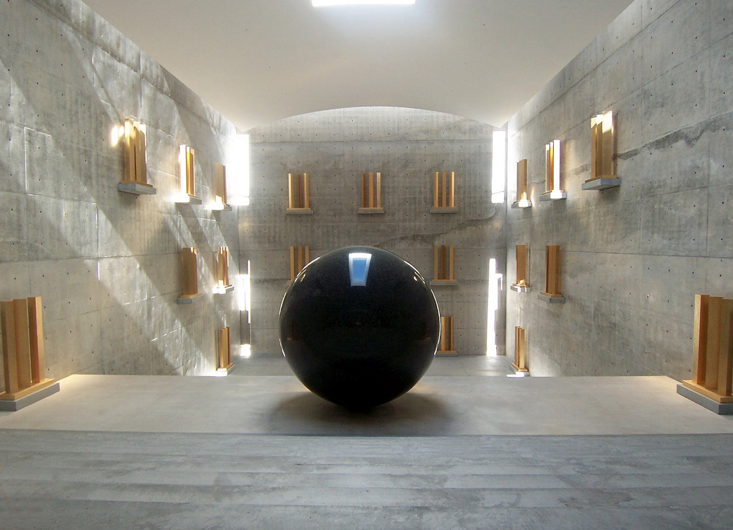
Tadao Ando’s Chuchu Art Museum is entirely underground but doesn’t feel that way with light and skylights at carefully constructed angles. It houses the works of Claude Monet, James Turrell and Walter de Maria.
You are not allowed to take pictures in any of the museums. It is about being in the present moment and experiencing the art.
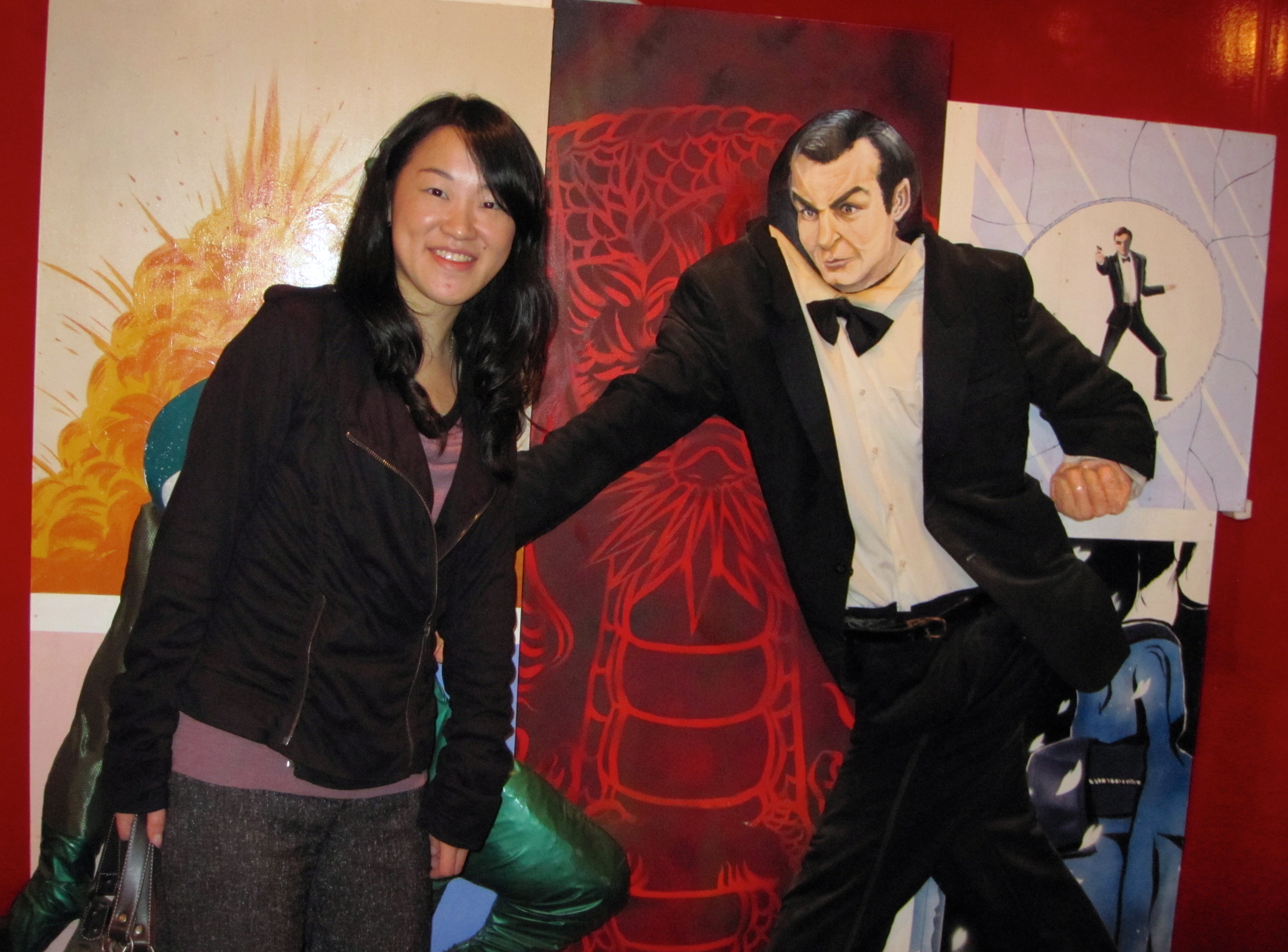
If you are not an art fan (though why would you come here if you aren’t? – it takes three hours from Osaka – Shinkansan (bullet train) plus two more trains and a ferry) you will like the James Bond “Man With The Red Tatoo”Museum.
One of the really interesting things about Naoshima is discovering art in surprise places.
Wandering around on foot will have you discovering outdoor sculptures and art exhibits sometimes cleverly disguised as children’s playgrounds and colorful gardens.
The pumpkins have become the image of the island. There is an Orange and a yellow one on opposite sides of the island. They were made by Yayoi Kusama an artist known for colorful, psychedelic patterns.
People are always taking pictures with them.
The vision behind the Benesse Art Site at Naoshima was ‘to create a physically and mentally rejuvenating haven”.
Benesse House is a unique facility that combines the functions of both museum and hotel.
Four hotel facilities—Museum, Oval, Park and Beach are available. All were designed by Tadao Ando.
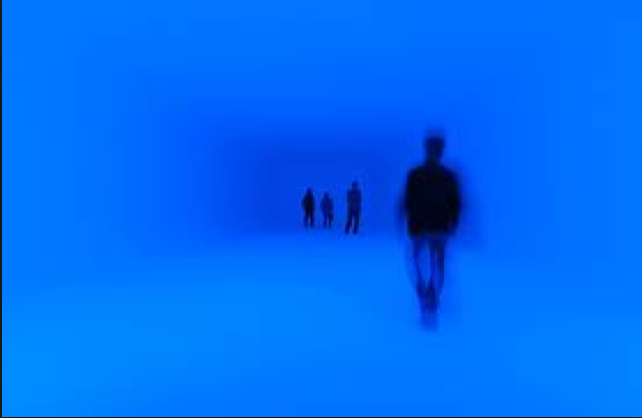
James Turrell presents light in itself as art. The museum has three of his works. Open Sky can be viewed at anytime, but a special sunset viewing is also available.
He makes large rooms and space where light itself becomes the object. You actually step inside his art. It cannot be described, it has to be experienced.
Minamidera is a new structure that pays homage to a temple formerly at this site, which was a spiritual gathering place for the community. It was designed by Tadao Ando for the size of artwork by James Turrell inside.
The Art House Project is really cool. There are eight houses that have been turned into art installations. This interesting concept successfully fuses the history and culture of the island with contemporary art.
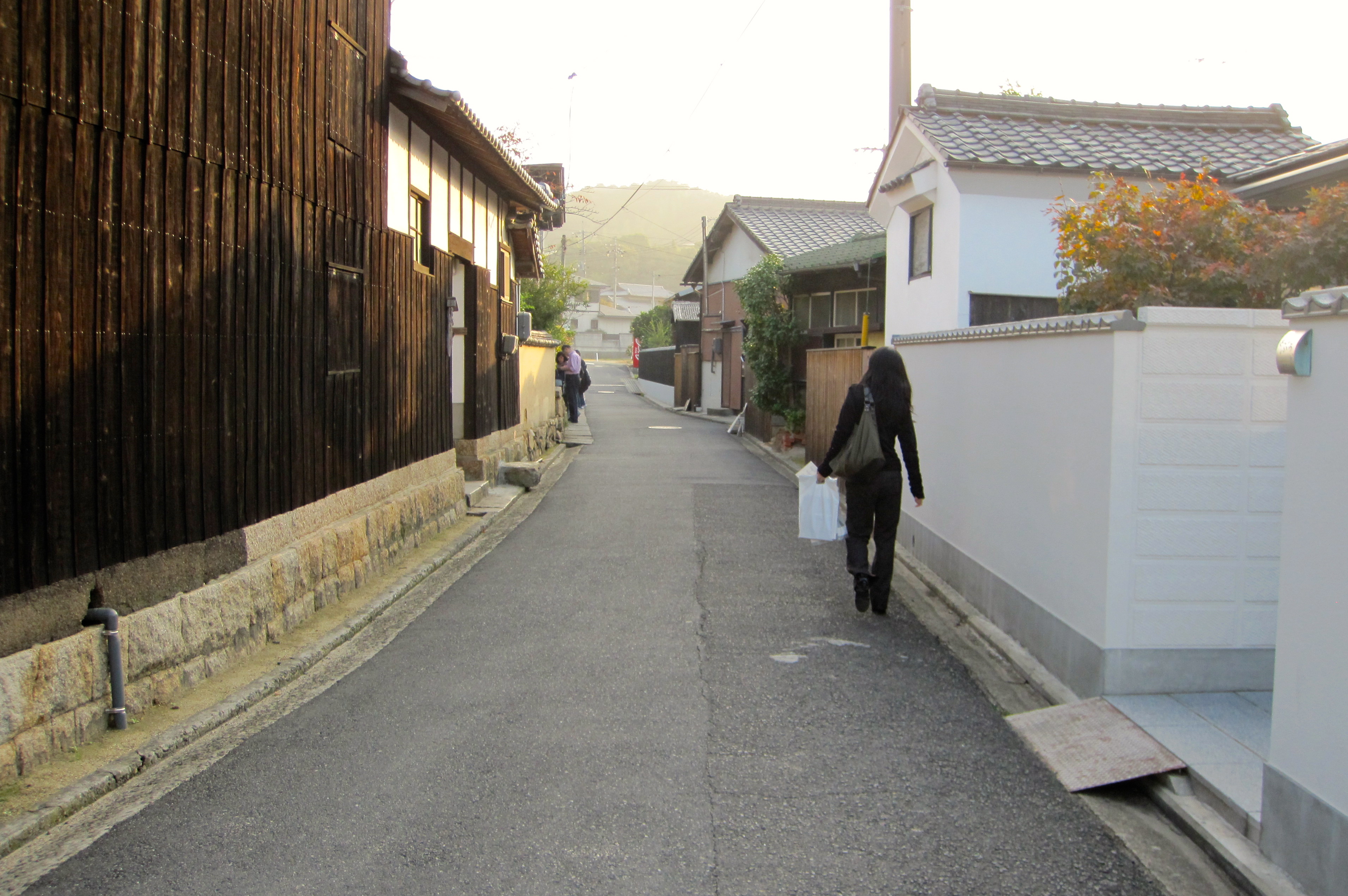
It is a bit like a scavenger hunt trying to find them on the island. If you get lost, follow the cool arty looking people, not the fishermen.
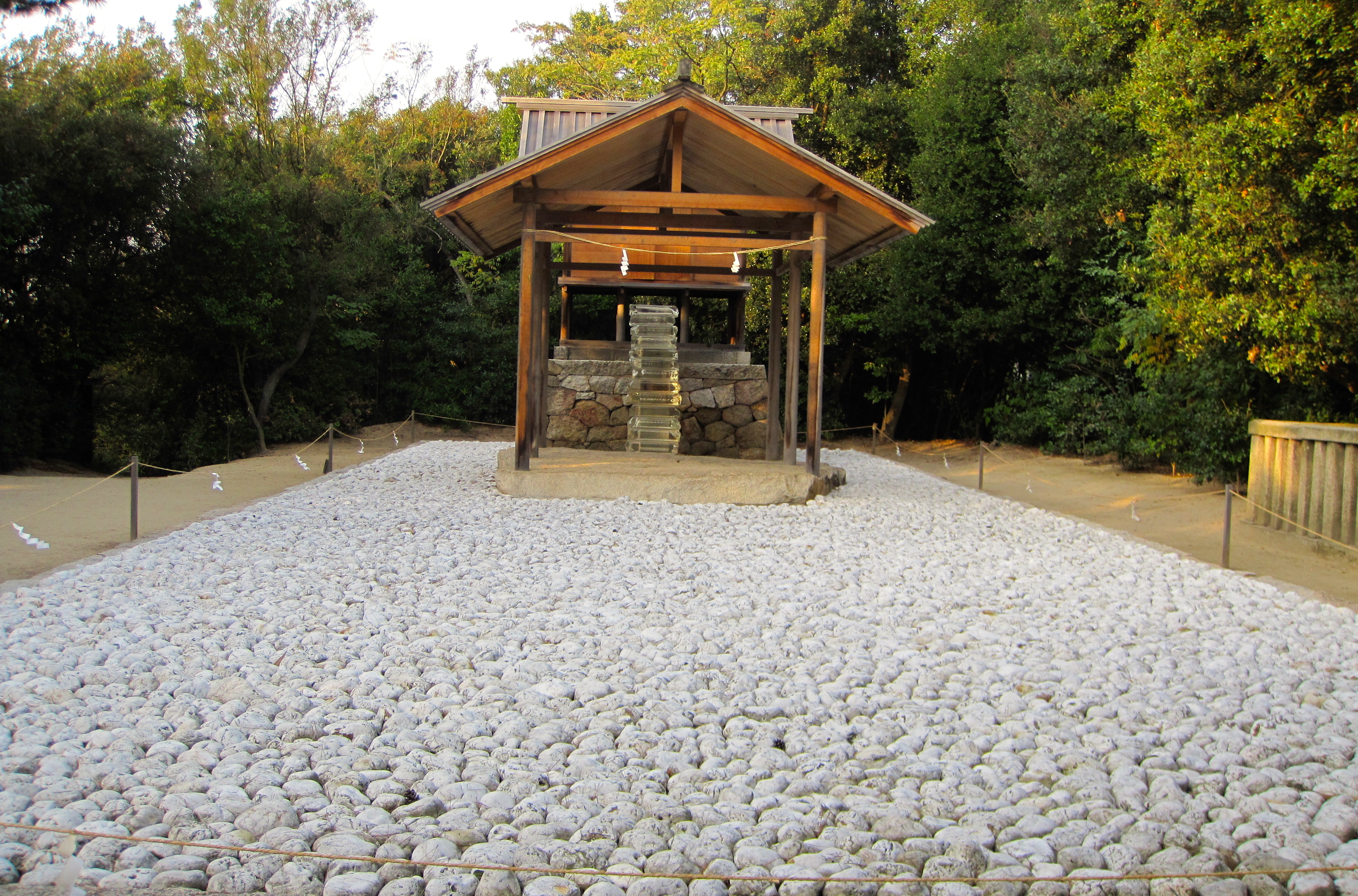
Naoshima is an island that fuses ancient traditions with modern creativity. This blend of styles is due to Tado Ando’s and his insistence on using traditional materials in ultra modern ways. Art, Nature and Japanese food – my three favorite things.
“Just as treasures are uncovered from the earth, so virtue appears from good deeds, and wisdom appears from a pure and peaceful mind. To walk safely through the maze of human life, one needs the light of wisdom and the guidance of virtue.“ Buddha
Buddhist monks were in Japan as early as the third century and came along the silk road. The official date was 552 when a Korean delegation arrived with monks, nuns, statues and sutras. Acceptance as with any new thing was slow. But the ruling class took up the faith and encouraged others to join. (I guess that is what Christian Science and Kabbalah hoped Hollywood would do for them)
Buddhism has had an enormous impact on the art and culture of Japan. Japanese Buddhism is the search for fulfillment and ultimate truth, not in any transcendental sphere, but within the structure of secular life, neither denying nor repressing man’s natural feelings, desires or customs. Many traditional arts such as garden design, tea ceremony, flower arranging, and even martial arts developed into the forms they have today because of the religion.
Nara was the first permanent ancient capital of Japan.There are many Unesco World Heritage sites in Nara.
Many of the temples are in Nara Park.
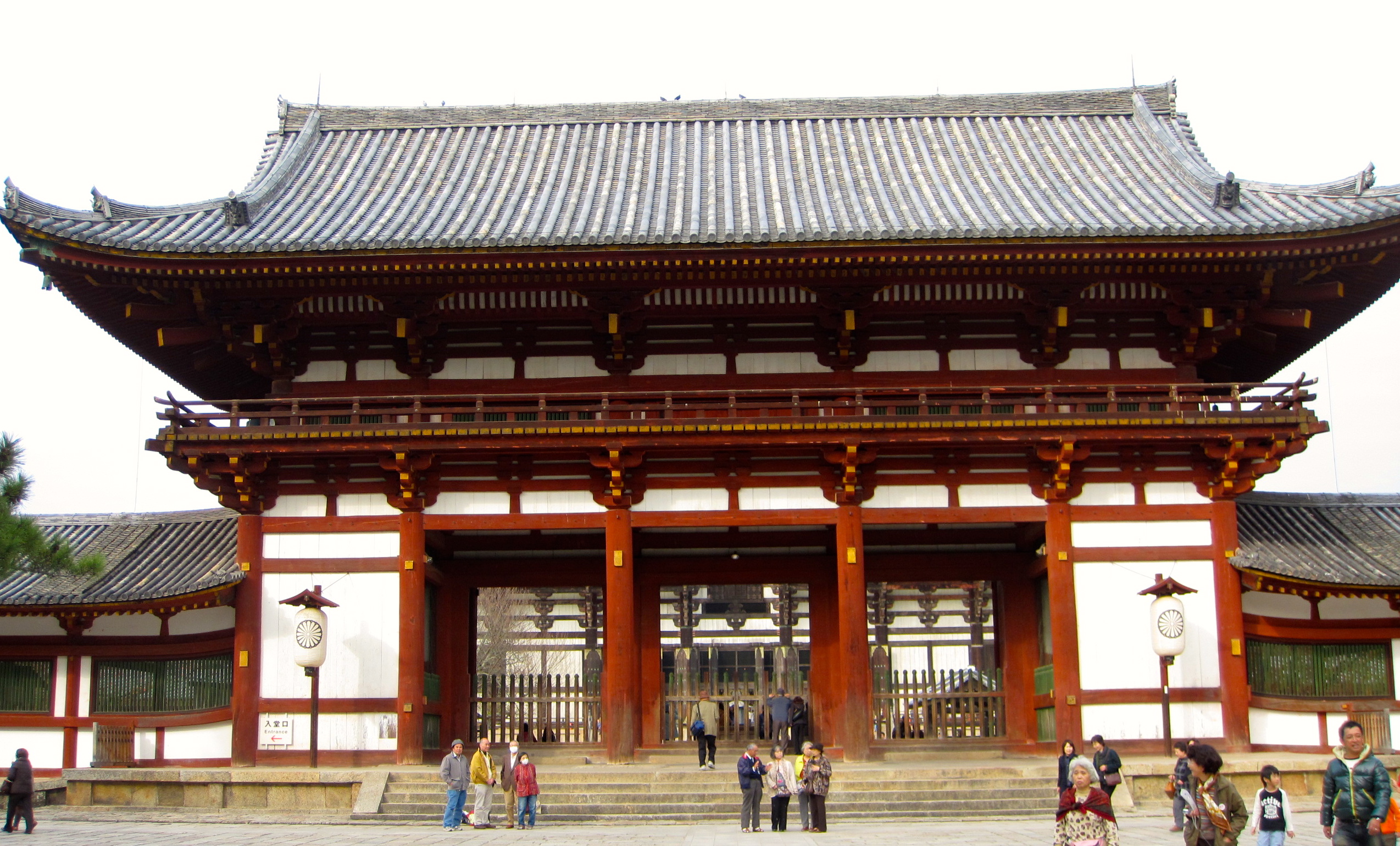
The Toda-ji temple gate is the entrance to Toda-ji which is considered to be a very important temple in the Buddhist world.
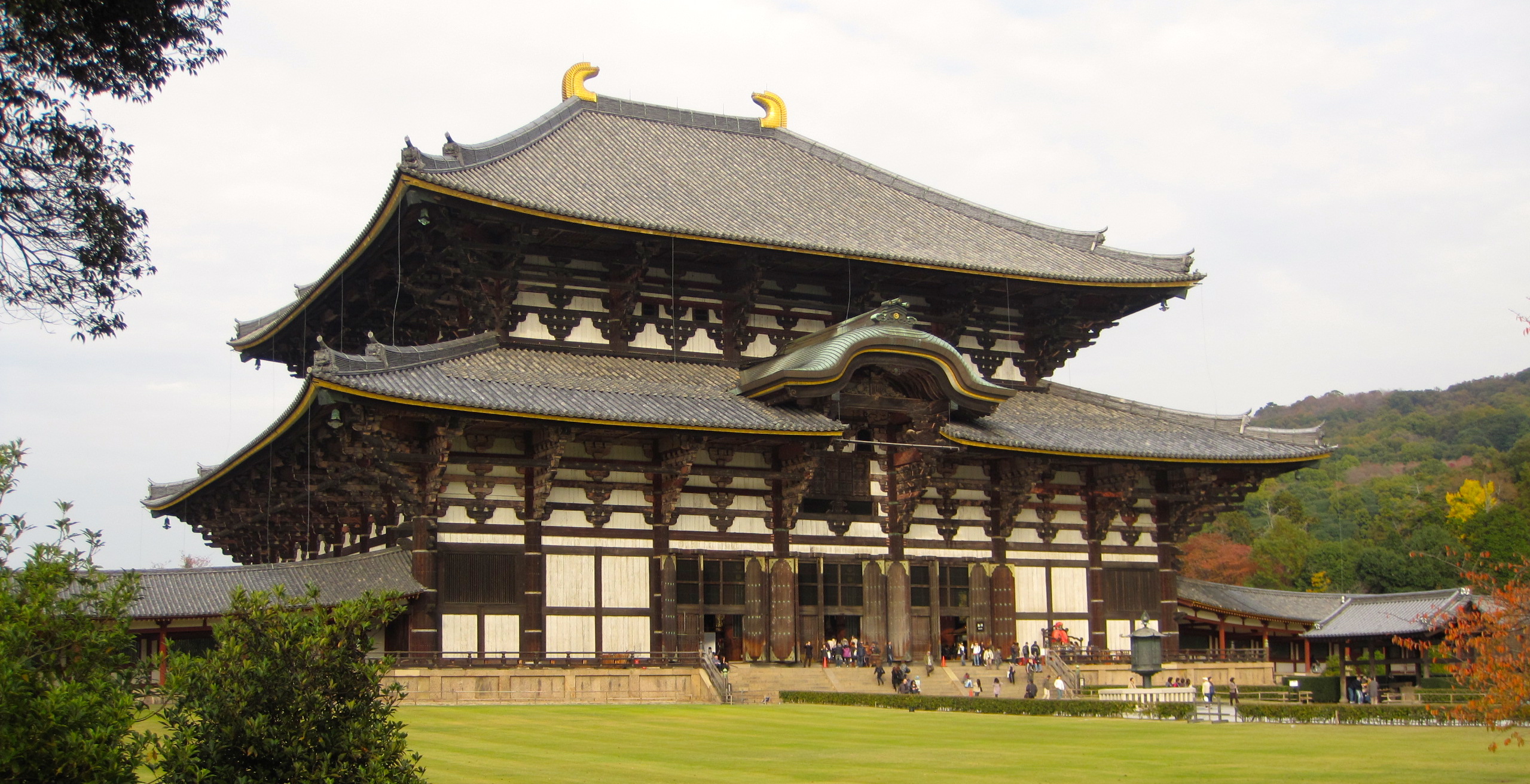
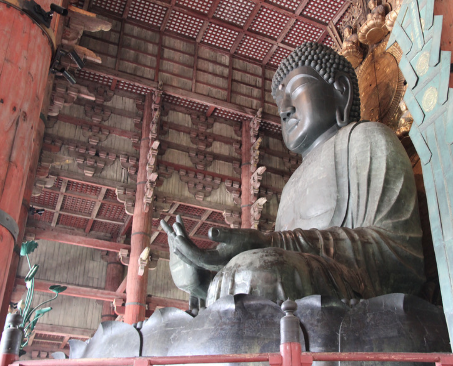
Toda-ji Temple presides over the park and is the world’s largest oldest standing wooden building. It was constructed in 752 and houses a Daibutsu-the largest Buddha in Japan.
The hanging bell of Nara though not the oldest or largest or heaviest is still quite impressive.
Hokkedō, also known as Sangatsudō is located at the eastern edge of the Tōda-ji complex. Hokkedō is the oldest building in the Tōdai complex.
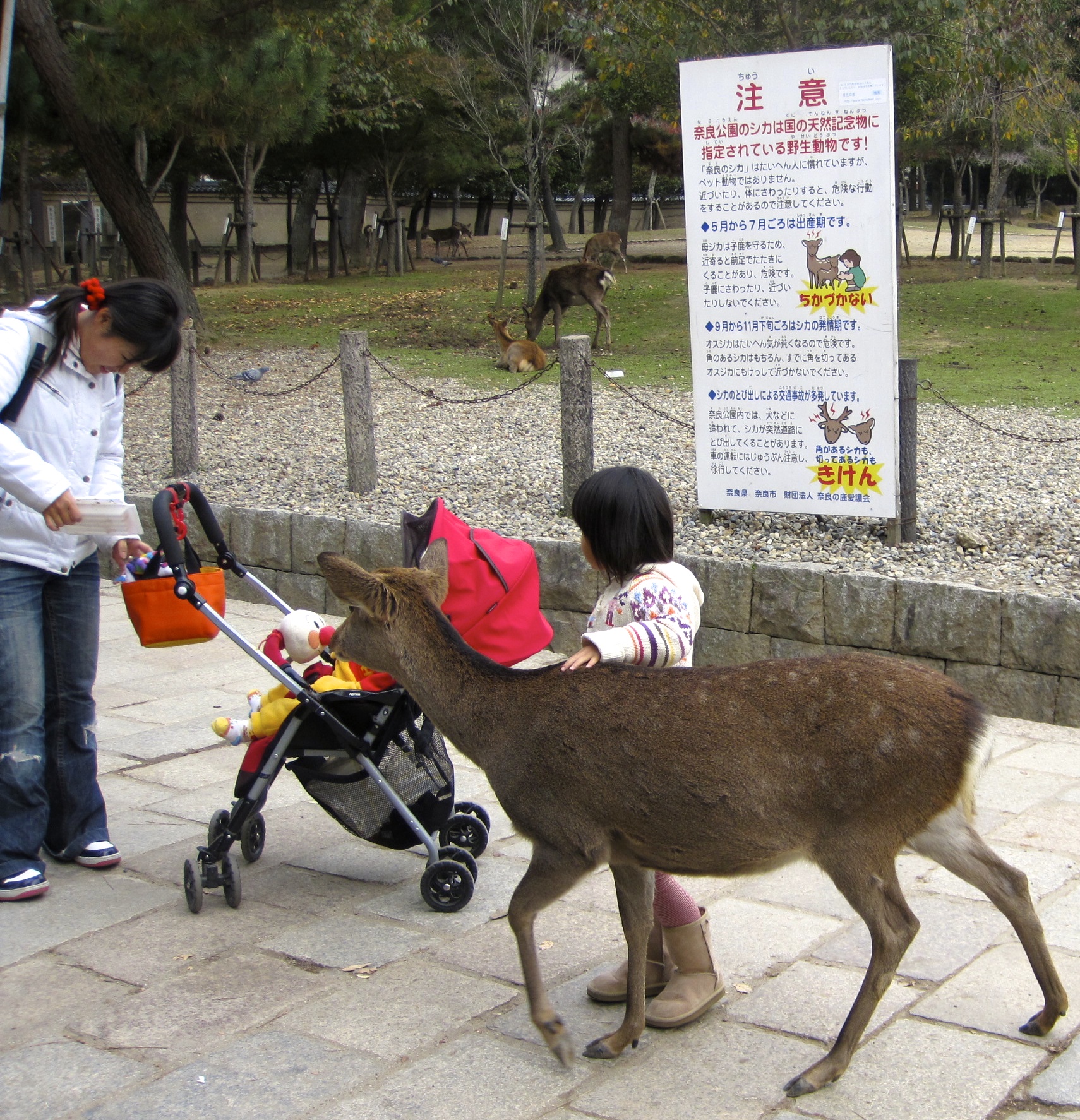
It is said that Buddha came to earth on the back of a deer. The Sika Deer are considered to be messengers from God and run free in Nara Park. They are very hungry messengers from God and if you start to feed them you will be surrounded by many aggressive ones. ( but of course everyone does)
We stop at a teahouse before going to more temples.
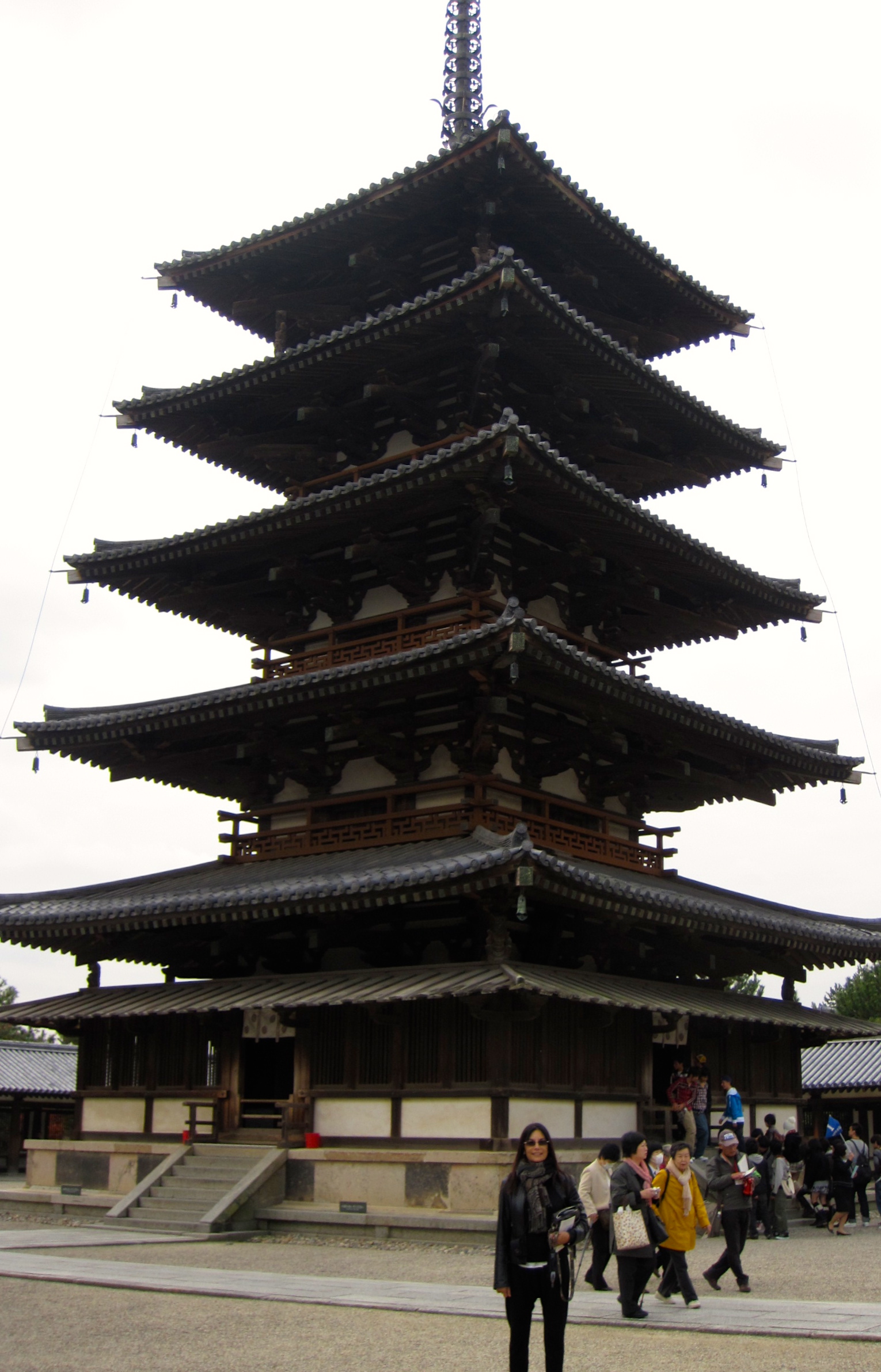
Kofuku–ji Temple built in 669 and dismantled was moved to Nara in 710. It features a five-story pagoda and many Buddhist treasures. Today only a handful of the temple’s 175 buildings remain standing, most of which date from the 15th century. The five-story pagoda is the second highest pagoda in Japan.
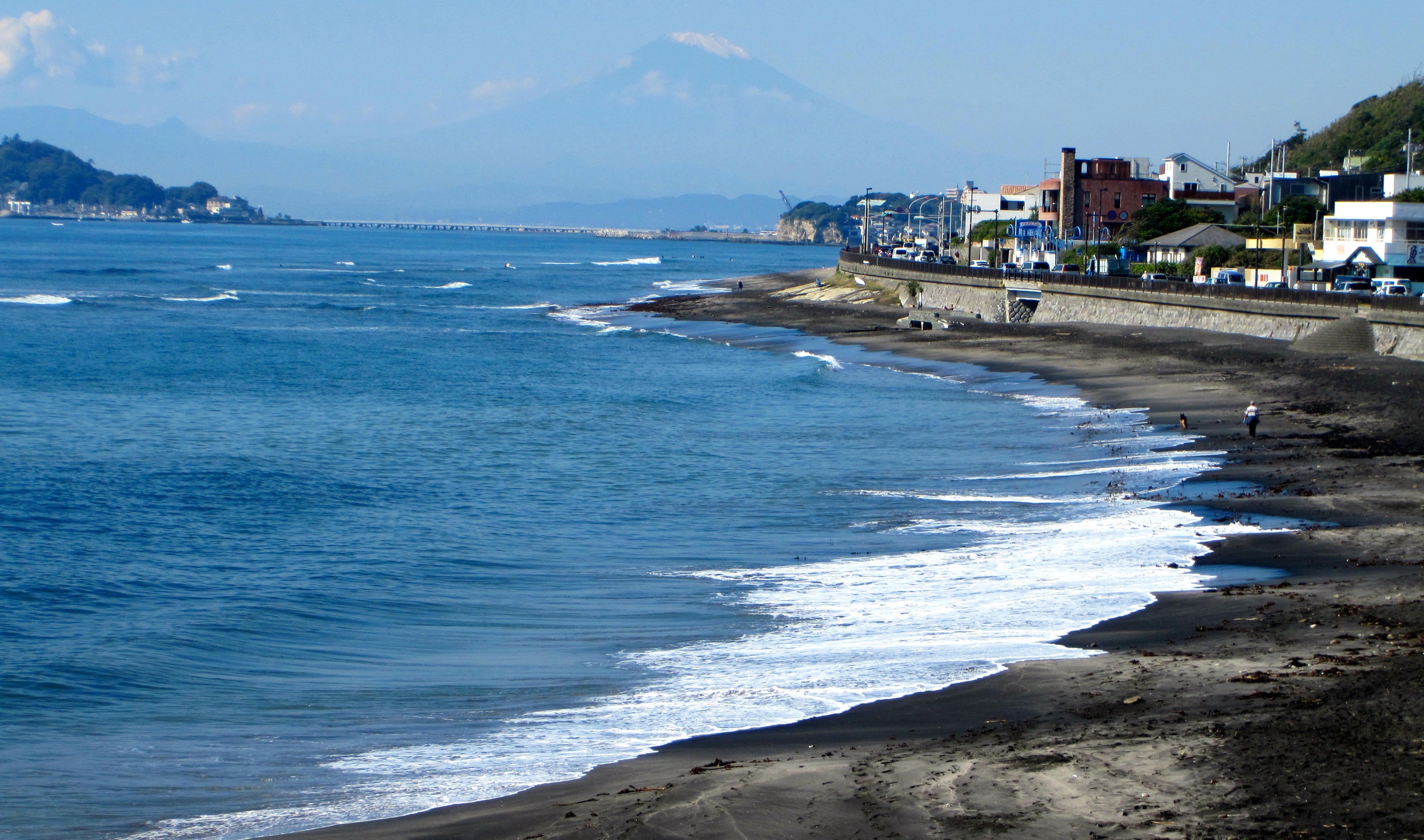
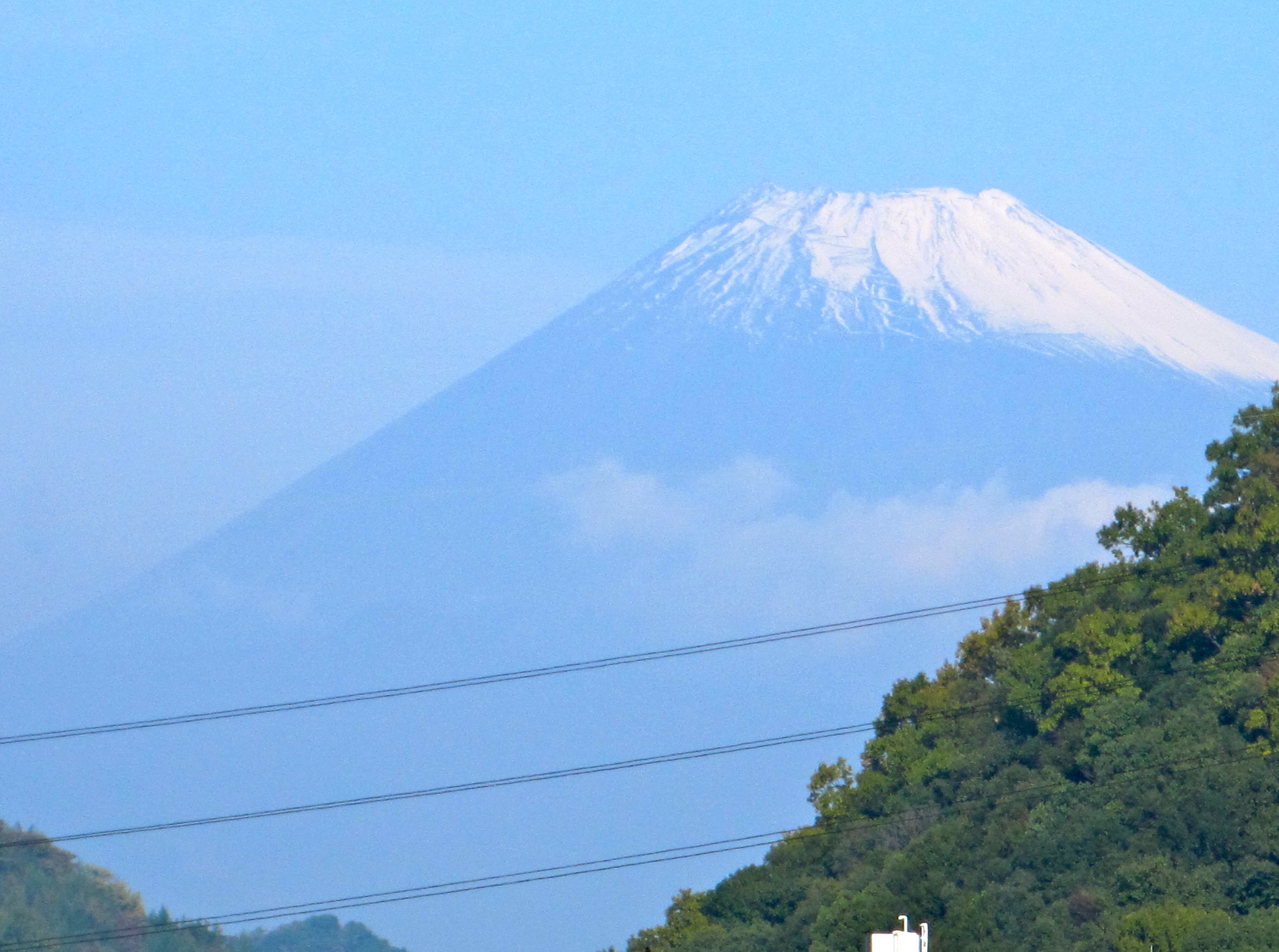
Kamakura is a small city and a very popular tourist destination. Sometimes called the Kyoto of Eastern Japan, Kamakura offers many temples, shrines and other historical monuments. In addition, Kamakura’s sand beaches attract large crowds during the summer months. (Mt Fuji is in the background. It is good luck to see Mt Fuji)
The Great Buddha of Kamakura (Kamakura Daibutsu) is a bronze statue of Amida Buddha, which stands on the grounds of Kotoku-in Temple. with a height of 13.35 meters. It is the second tallest bronze Buddha statue in Japan, surpassed only by the statue in Nara’s Toda-ji temple. ( indoor Buddha statue above)
The statue was cast in 1252 and originally located inside a large temple hall. However, the temple buildings were destroyed multiple times by typhoons and a tidal wave in the 14th and 15th centuries. Since 1495, the Buddha has stood in the open air. This is the destination even the Obamas had on their Japan bucket list.
Jufuku–ji is the oldest Zen temple in Kamakura. Although very small now, in its heyday the temple used to have as many as fourteen buildings. Myoan Eisai was a Buddhist priest who was brought to head the temple after it was built. He was credited with bringing Zen Buddhism and green tea from China to Japan.
A little Zen Buddhist Luck. (Japanese love luck. Who doesn’t?)
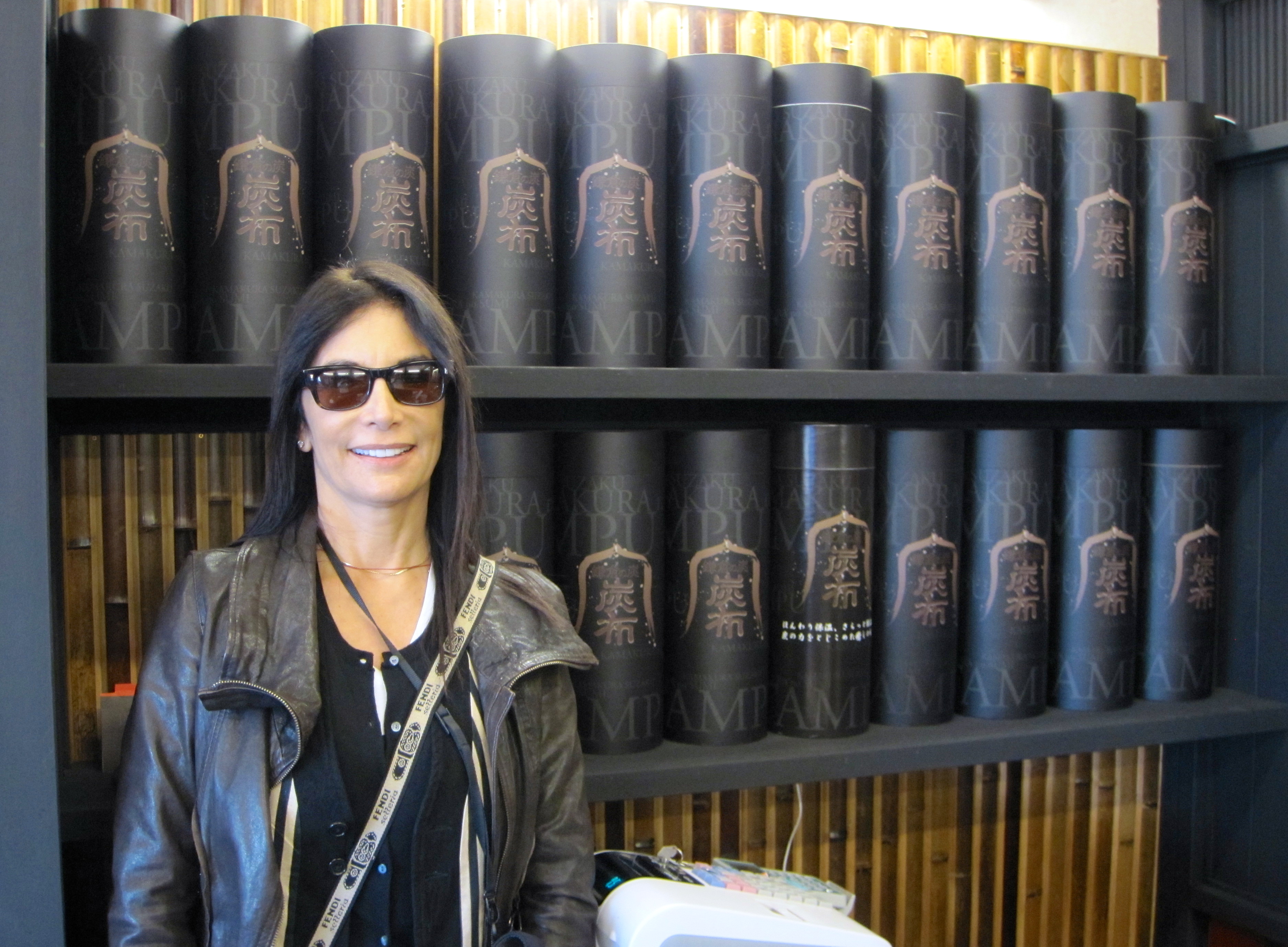
The main shopping street is Komachi-dori. It is a tiny alley with both authentic and touristy crafts and Japanese food. Snack your way around the pickle shop (radishes, carrots, seaweed, anything) and pick up exquisitely wrapped chestnut candies in the confectioner’s shop. (charcoal store)
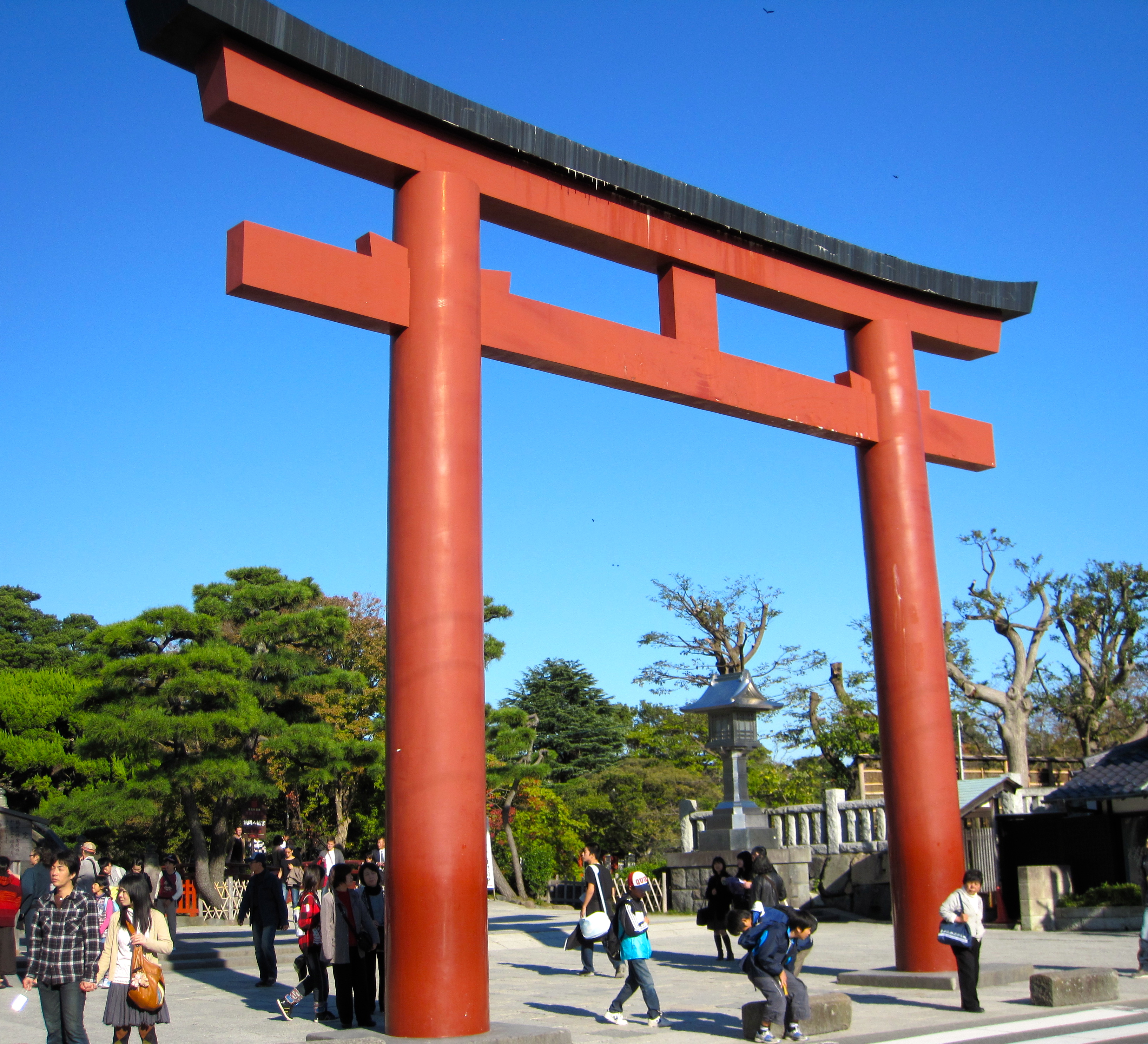
Hachimangu shrine is the most important shrine in Kamakura. The shrine is dedicated to Hachiman, the patron god of the Minamoto family and of the samurai in general. The shrine is reached via a long, wide approach that leads from Kamakura’s waterfront through the entire city center, with multiple torii gates along the way.
These are two different days. Nara and Kamakura are different cities. Kamakura is forty minutes outside Tokyo. Nara is an hour away from Osaka. After a long day of temples, you can enjoy the local Japanese custom of sleeping on the train home.
“Do not dwell in the past, do not dream of the future, concentrate the mind on the present moment.” Buddha
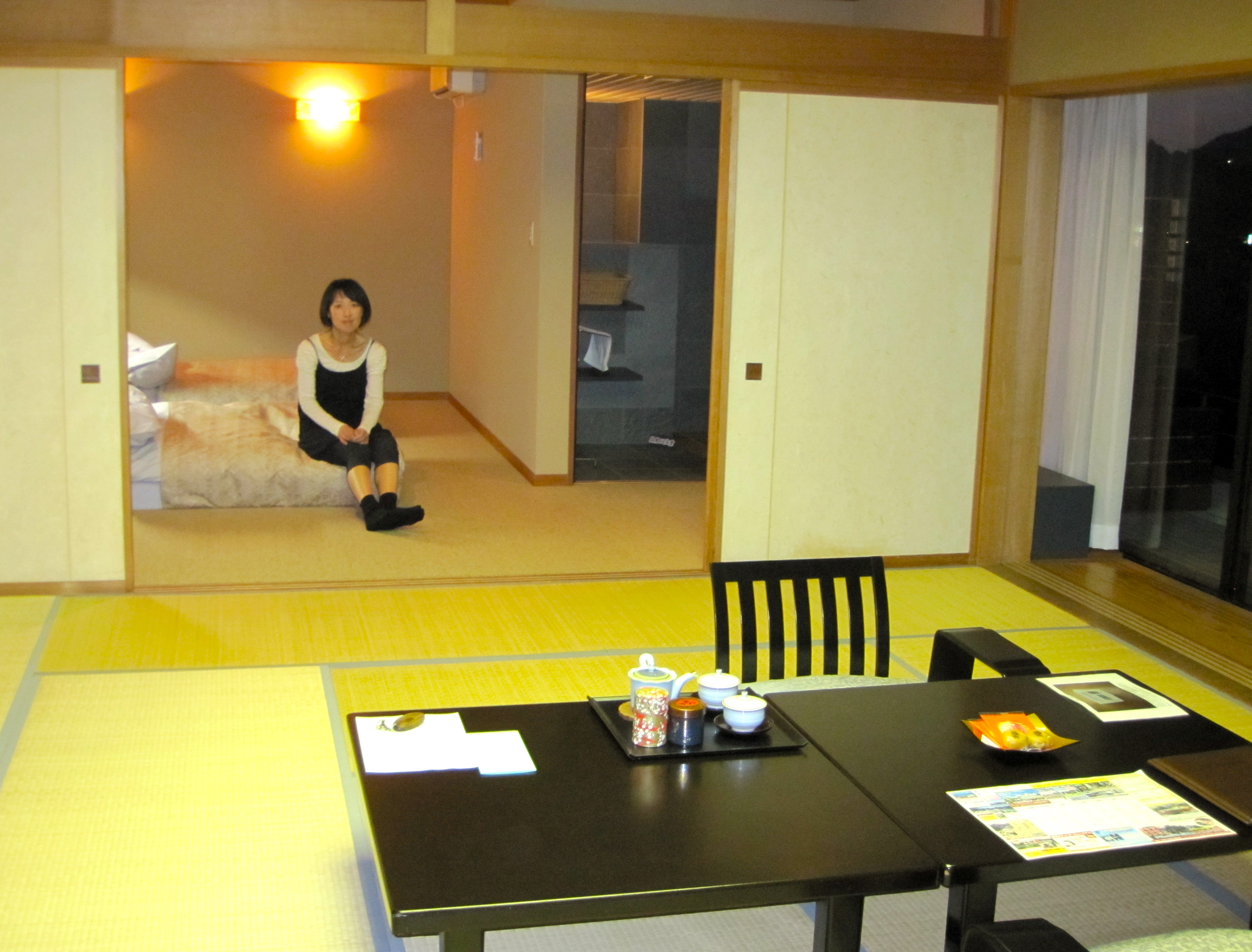
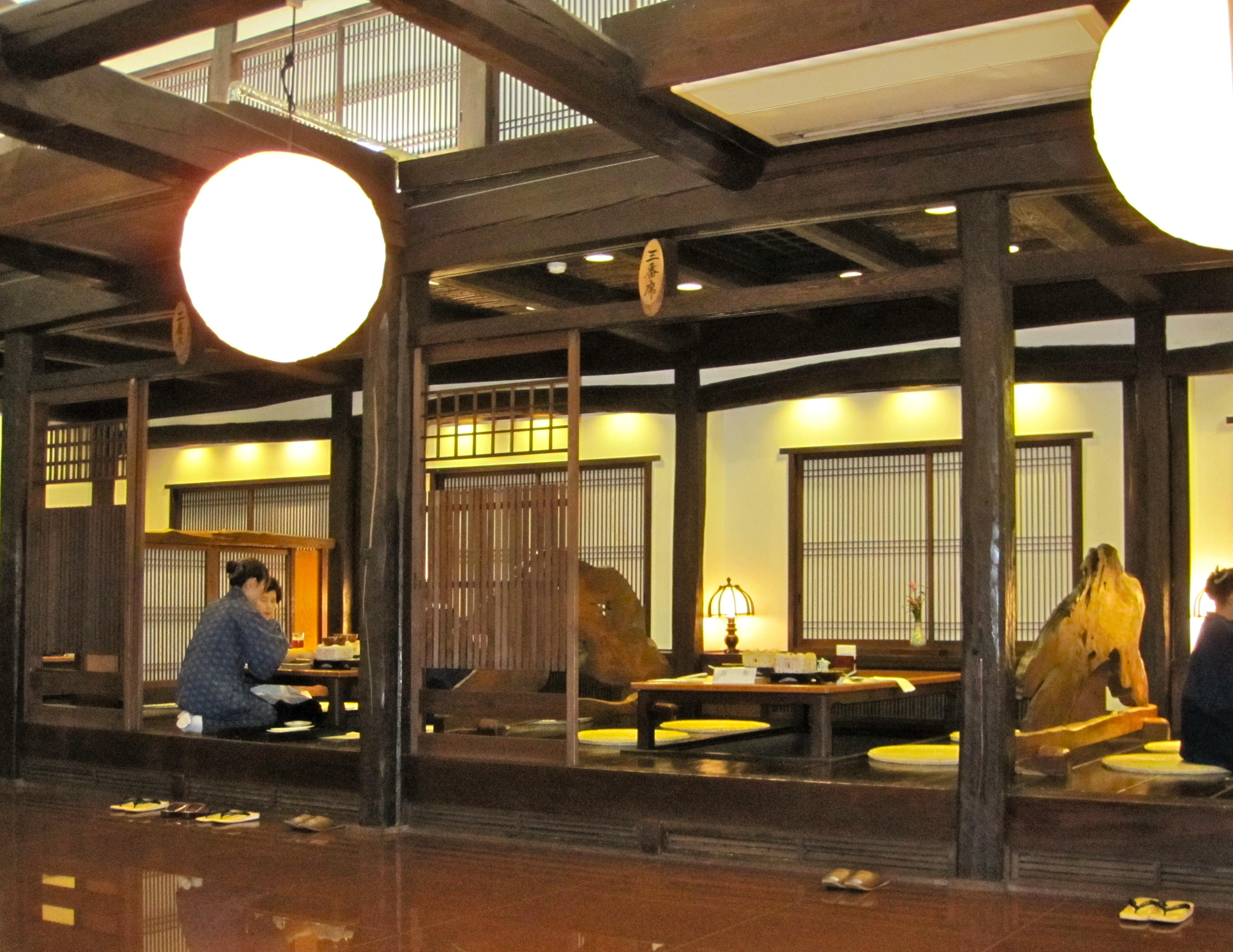
Ryokan are Japanese style inns found throughout the country, especially in hot springs resorts. Ryokan are a traditional Japanese experience, incorporating elements such as tatami floors, futon beds, Japanese style baths and local kaiseki ryori (eight course typical Japanese meals with local and seasonal specialties).
There are many different kinds of ryokan, varying greatly in terms of size, cost and style. Some ryokan are small, family run establishments with just a few rooms, while others are large, hotel-like facilities with hundreds of rooms. Ryokan also range from no-frills, budget varieties to costly establishments catering to the very wealthy.
Ryokan are special and relaxing experiences with an emphasis on traditional style.
I am usually the only American at the ones I have been to. – not only there but in the town. I go with my Japanese friend and she picks the ryokans that Japanese people go to. No one speaks English. It is good because I get to practice my hand motions and have a cultural immersion experience. . It is bad because I live in fear of walking into a men’s bath by mistake since I cant read the signs.
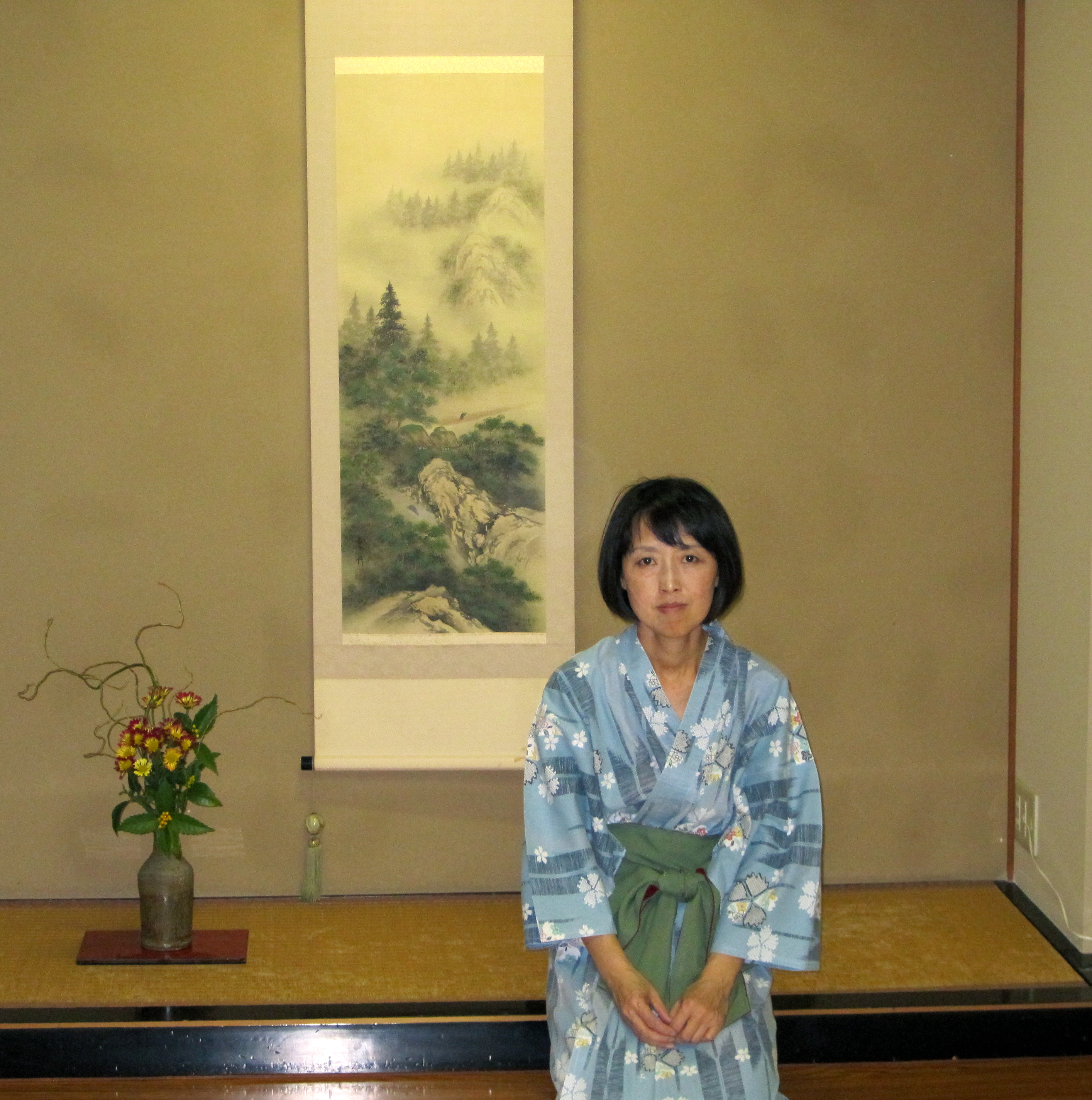
Upon arrival you pick out your kimono robes, sash, socks and slippers which you wear the entire time. No easy feat to keep putting that on and off. There are a lot of rules to wear it correctly.
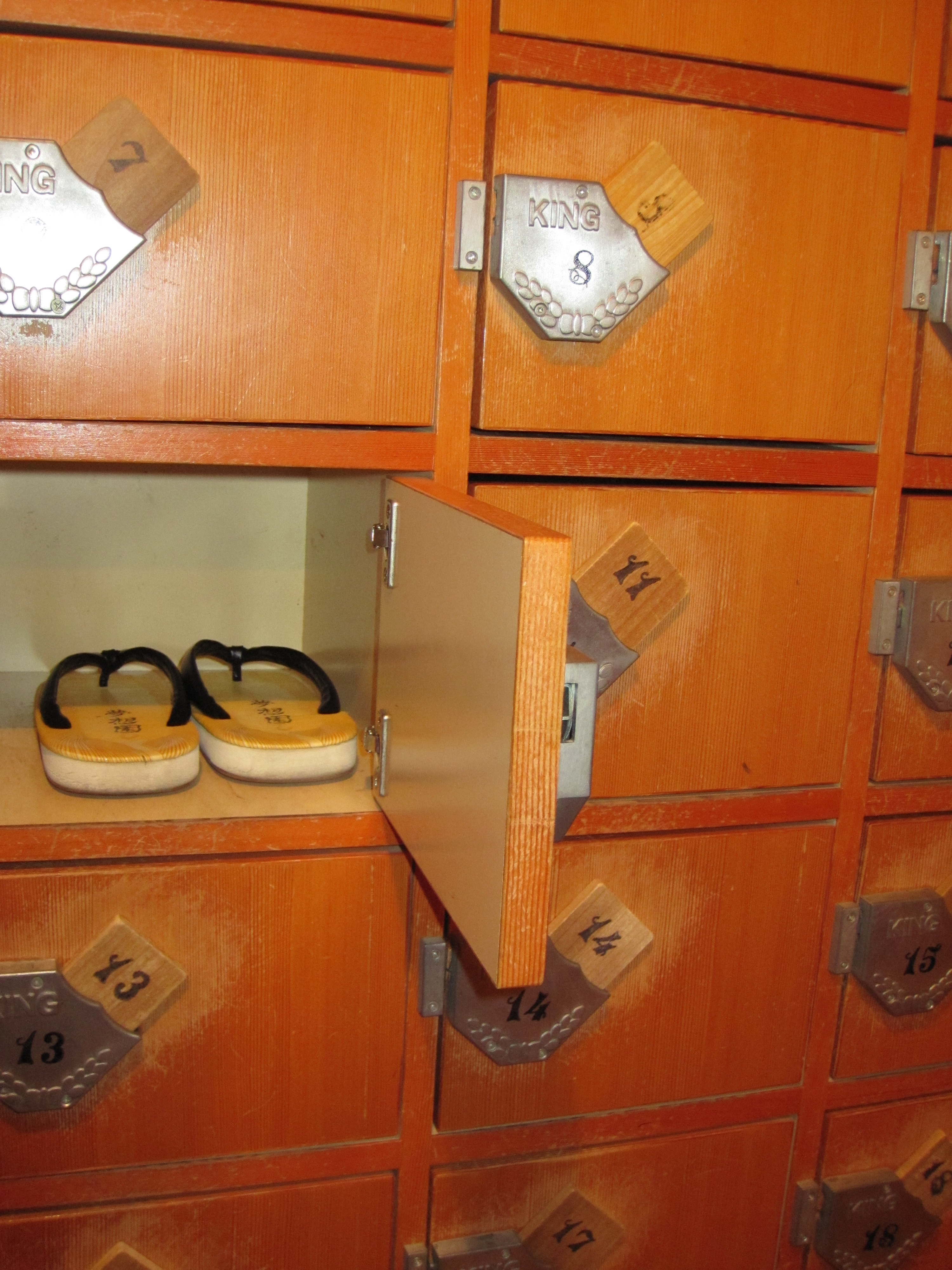
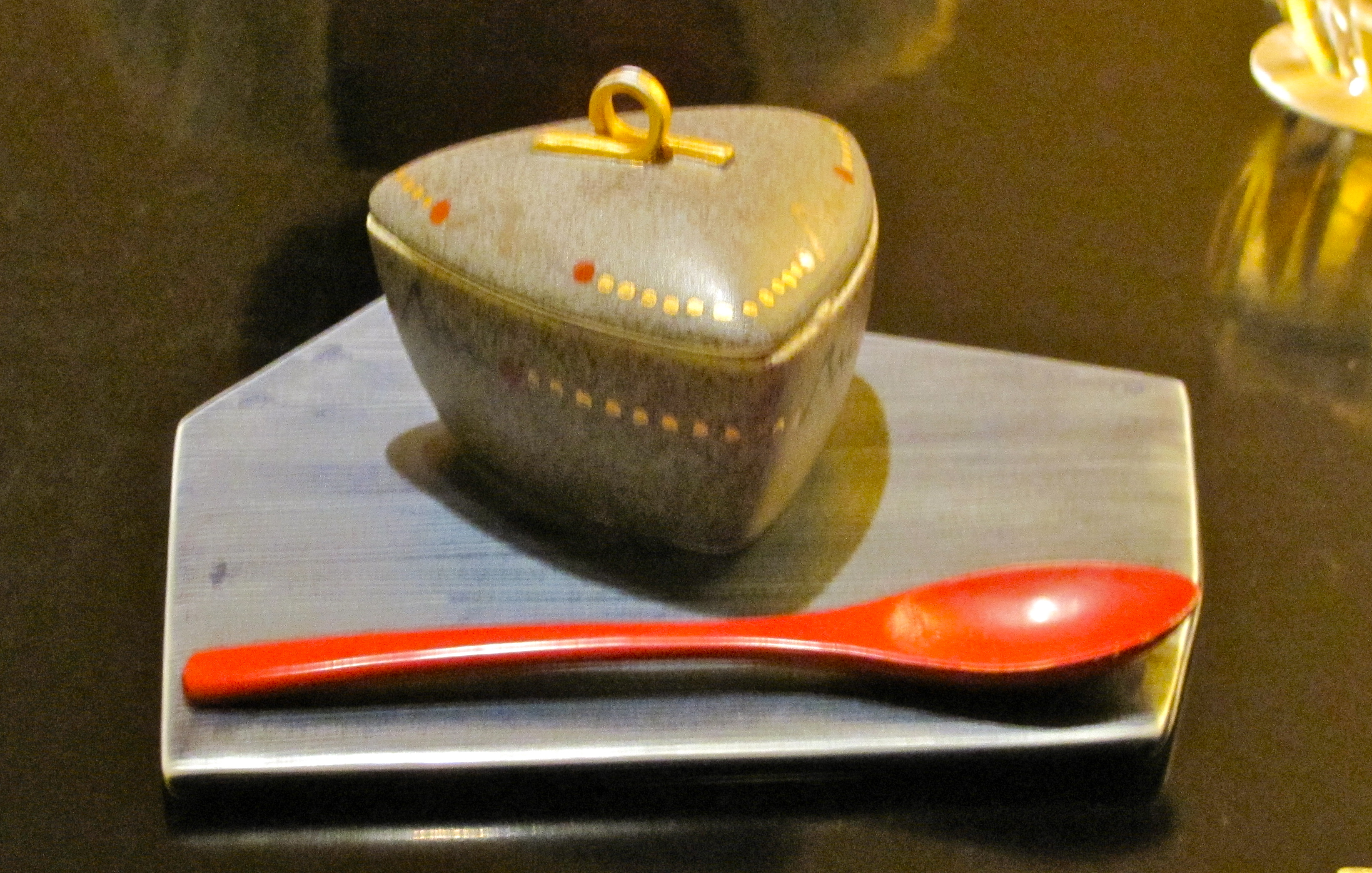
You are shown to your traditional style rooms. Remember to always keep your shoes by the door. Stepping on a tatami mat with shoes is like spitting in public. Hot green tea and a red bean paste sweet are ready in your room when you arrive.
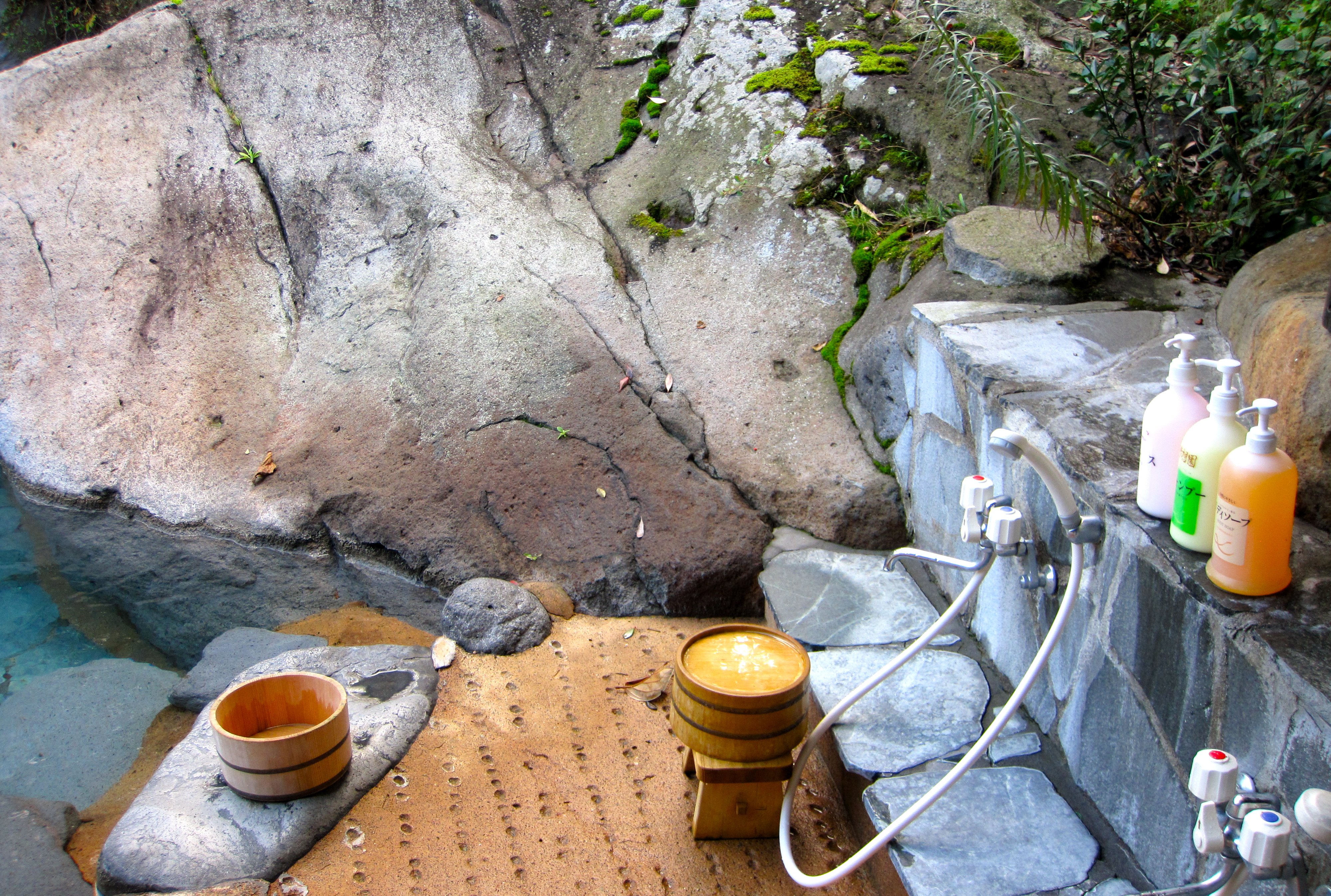
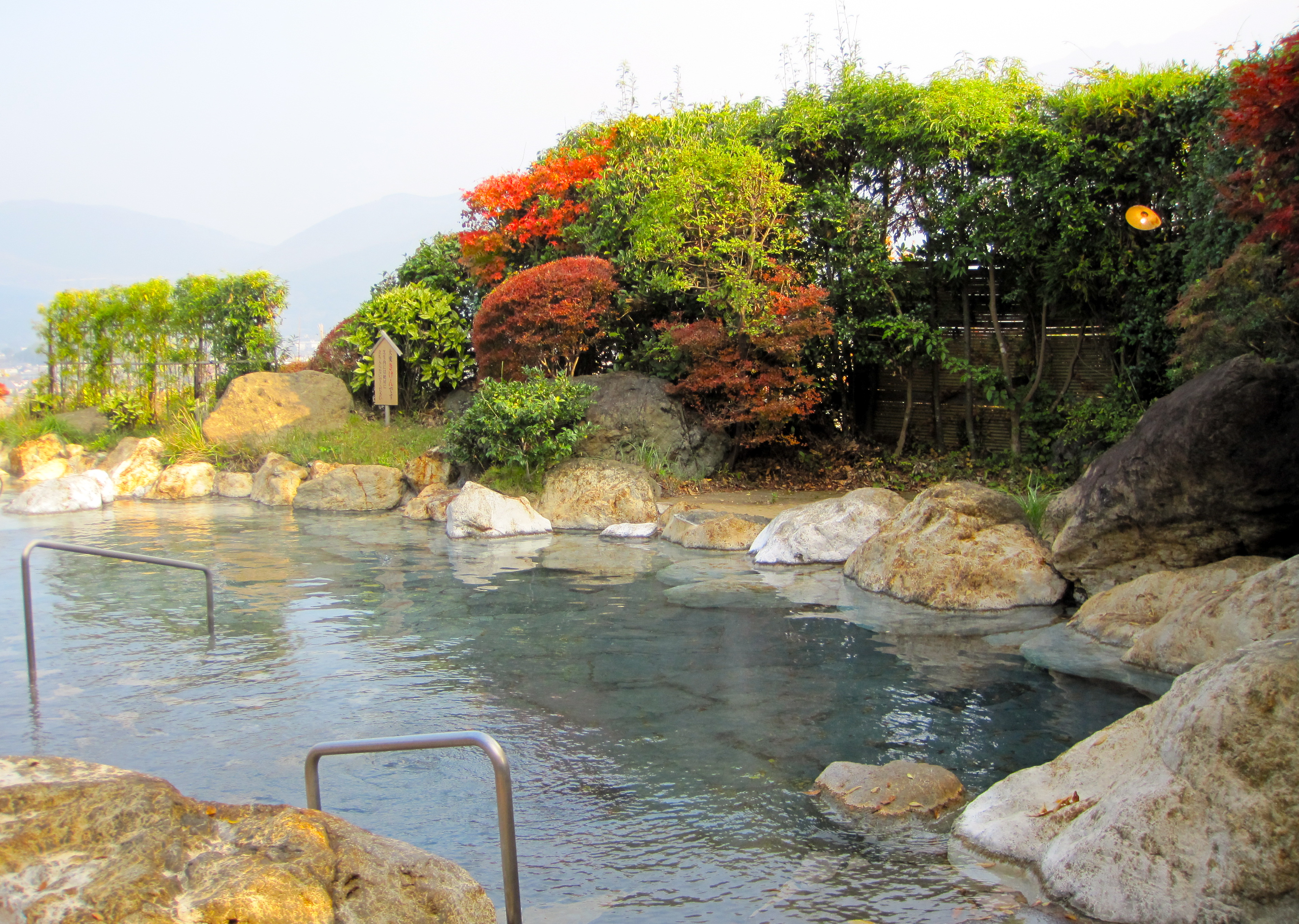
The main activity besides eating is bathing. The geothermal springs located throughout the country( onsens) provide hot mineral-rich water for indoor and outdoor baths. Onsen etiquette is based on Shinto influence. You must get clean before you go in the water. There are always showers or faucets and buckets. You cannot get into the onsen while dirty or soapy. ( Ok I did it once. I can’t lie on the internet. No one does that. It was just too cold to wash with cold water outside. )
Everyone has a small white hand towel which is usually placed on the head or by the side of the bath. It is called the modesty towel – and could be a bit larger with that name. Try not to let the towel fall in the water as the goal is to keep the water clean. (how many times and at how many different onsen, do you think my towel fell in?) Many onsen do not allow bathers with tattoos — especially if they’re large — as these were traditionally associated with the yakuza, or mafia.
The chemistry, temperature, pressure and buoyancy of thermal baths have curative properties used to treat skin conditions such as dermatitis, inflammation-related conditions such as arthritis and musculoskeletal conditions such as lower back pain.
The sulfur and magnesium found in hot springs promotes skin health, while the heat of these baths can reduce inflammation and pain, and boost the immune system.
Bathers are expected to go quietly into the onsen. Bathing in Japan is about the contemplative experience, not washing.
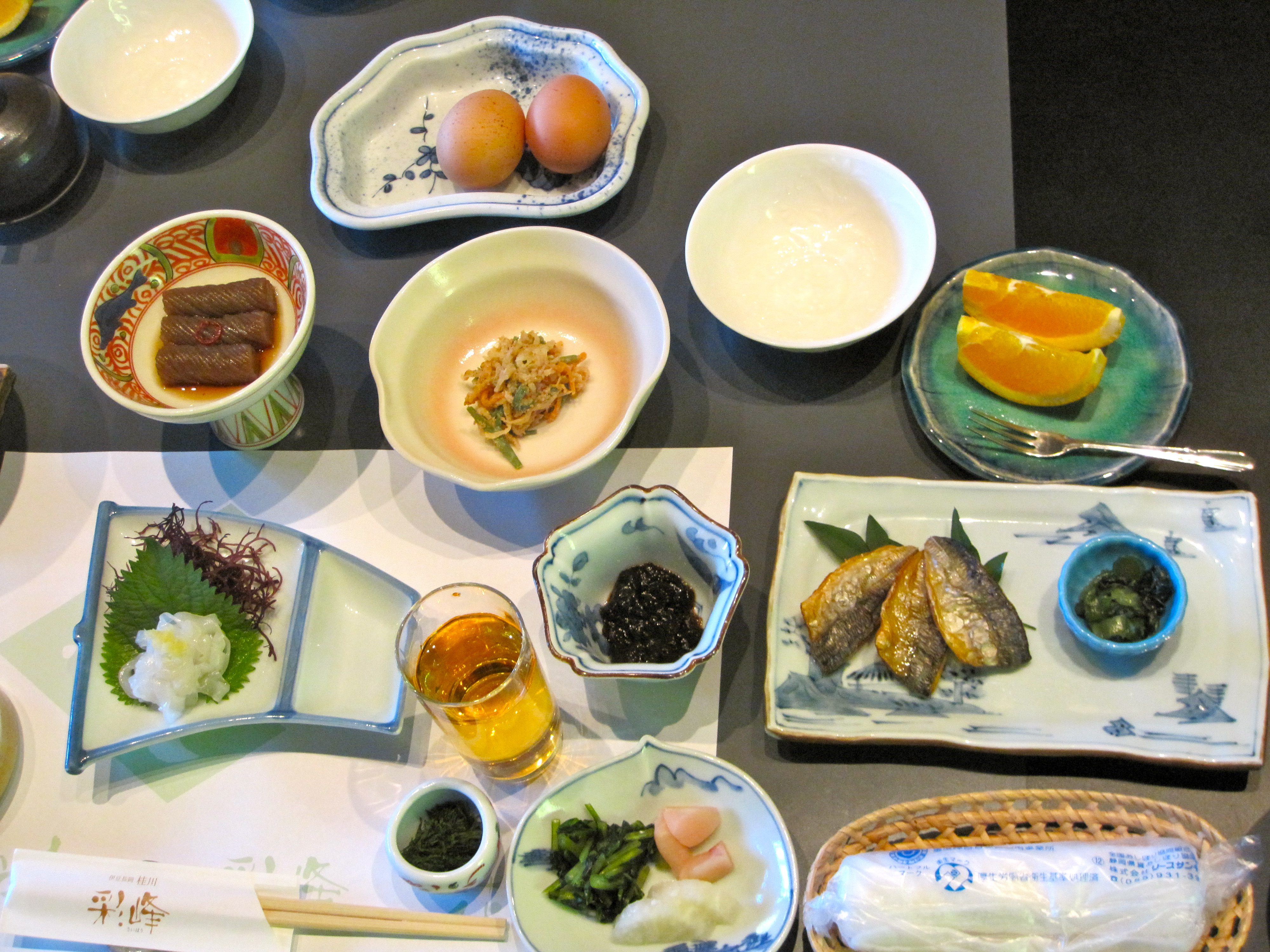
The meals exhibit all that is beautiful about Japanese culture. Kaiseki is a multi course meal rooted in the Buddhist idea of simplicity. It has developed into an exquisite set meal with a succession of small dishes made of seasonal produce where every element is balanced to ensure that the taste, texture, appearance, smell and color of the food captures a sense of the moment within a season.
In kaiseki there is a defined set of aesthetics and principles that everyone adheres to. These rules help define the preparation, order of dishes and serving, including the type and look of a utensil used for service. These principles have evolved over the centuries to maximize the sensory experience.
The restaurant environment in Japan is also very different. The majority of kaiseki restaurants offer private rooms for their guests to entertain and the décor is always very simple, whether it is a shared room or private. Often the only decoration will be one artwork, underneath which will be a beautiful flower arrangement – both chosen to capture the mood of the season and the food. The diner is there to focus on the food and savor the moment, rather than to watch or be watched by others.
When you return to your room, after dinner the bed is made up of many pillows and futons (quilts) and is quite comfortable. Sometimes the pillows are filled with rice – which is surprisingly not uncomfortable. Don’t sleep face down as you will wake up with rice marks. It isn’t pretty. If you would like a massage, a massage girl will come to your room.
Breakfast can be a problem if you stay at a typical Japanese ryokan. To the untrained eye (mine) breakfast looks like the same food from the night before but prepared differently. It will always include fish soup and steamed rice and raw eggs. If you mix the raw egg with rice and soy sauce, it tastes ok but not my thing. I see salmonella. Some ryokan will give you coffee in tiny tiny cups and some won’t.
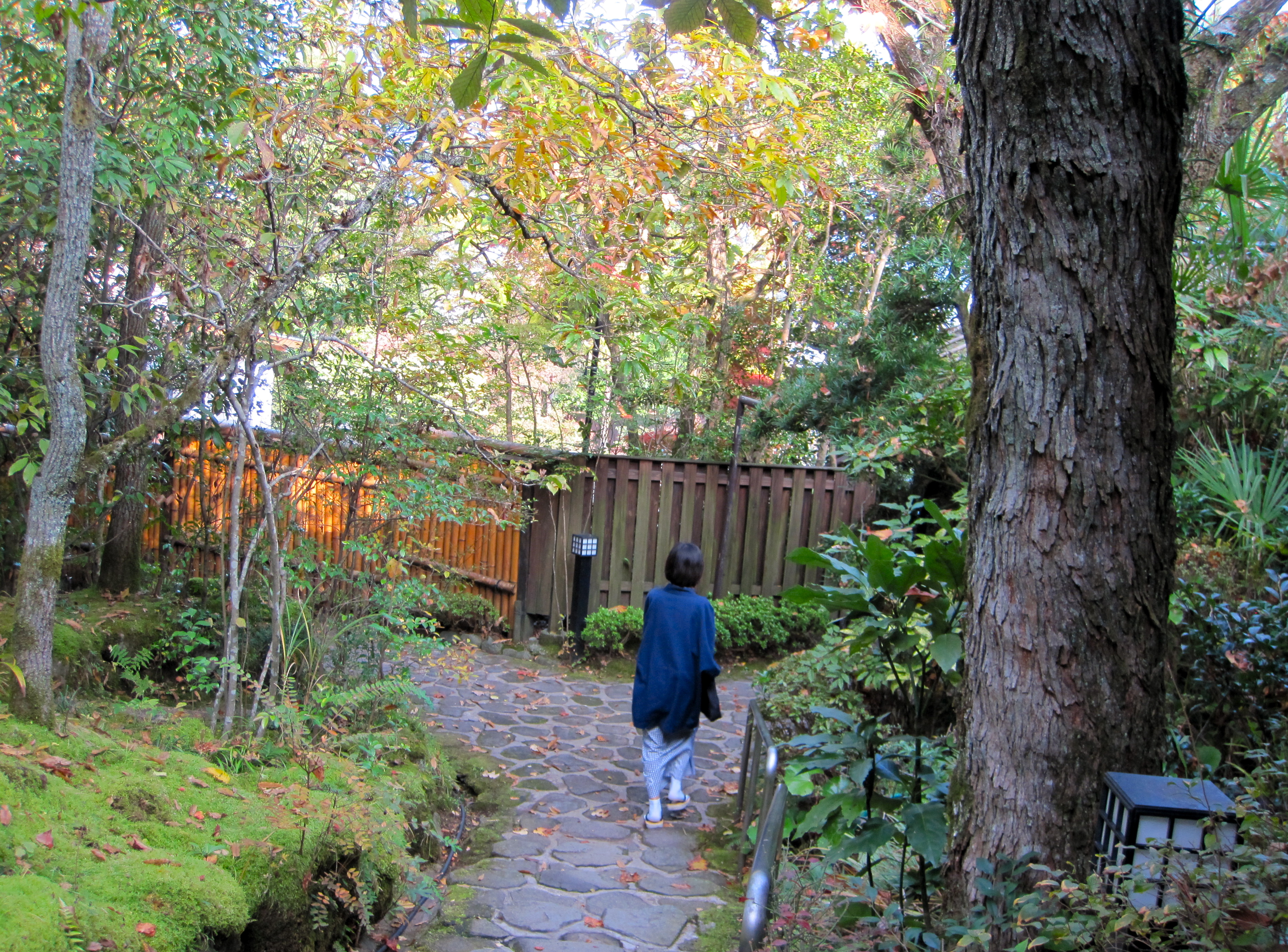
The onsen towns are picturesque rural settings. It is nice to walk around during the day.
In Yufuin, in the Kyushu islands, I went to the dentist, ate Jidori chicken which is raised there, bought Yuzu preserves and walked around the town with all the Koreans who apparently just take a ferry across.
In Izu Nagaoka (we could see Mt Fuji from our room),
The Izu Penninsula is one of the pilgrimage sites of the seven temples for the seven gods. Like the rest of the world, the Japanese are obsessed with the number seven. The Shichifukujin 七福神 are an eclectic group of seven deities from Japan, India, and China. Only one is native to Japan (Ebisu) and Shinto tradition . Three are from the Hindu-Buddhist pantheon of India and three from Chinese Taoist-Buddhist traditions (In Japan. They travel together on their treasure ship and visit human ports on New Year’s Eve to dispense happiness to believers. Each deity existed independently before Japan’s “artificial” creation of the group. Today, images of the seven appear with great frequency in Japan. By the 19th century, most major cities had developed special pilgrimage circuits.(Ebisu, the fisherman god number one on our pilgrimage)
.We were given a map and set out to find them. If you find all of them, you get a prize. We were about half way into the forest and had found half the temples until we met someone who said the next one was pretty far and he had driven. We went for sushi.
When leaving the ryokan , the staff will see each guest off in a smiling, bowing, waving ceremony at the street door. A small gift may be presented, and the inn’s brochures will be distributed. – Ryokan Katsuragawa Saihou (Nagaoka, Izu Peninsula) phone: (dial local) 055-948-3106, Ryokan Musouen, Add: 1251-1 Kawaminami Yufuin-cho Yufuin Oita, Japan 879-510
These are the places I miss most in Japan. The good things always make you remember them.
“The way is not in the sky. The way is in the heart.”
~ Buddha
Kyoto is the headquarters of Nintendo.
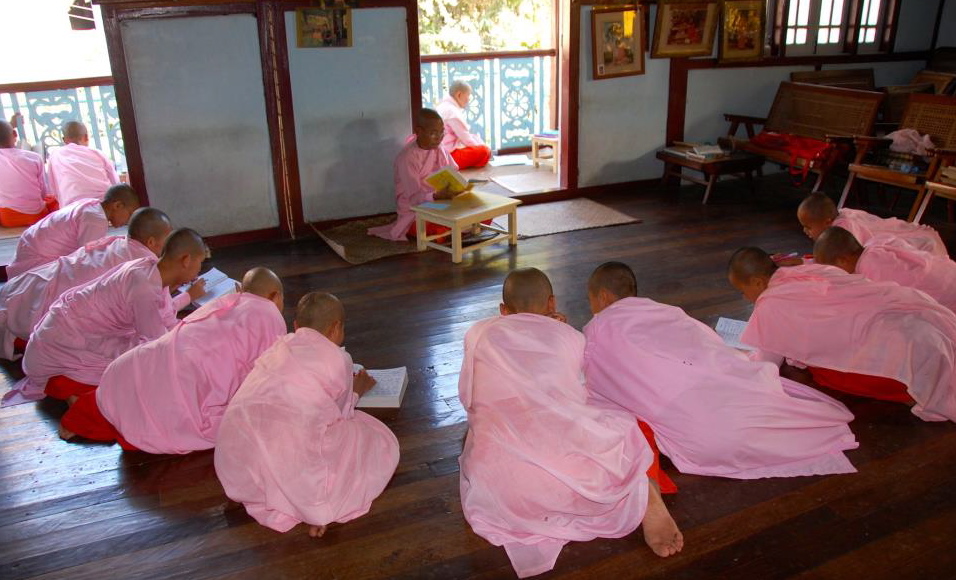
Kyoto has almost 2000 Buddhist and Shinto shrines and temples. I haven’t seen them all – yet. ( female monks )
Sanjusangendo is a 12th century temple (partly rebuilt in the 13th century after a fire) and it has 1000 identical life-sized Buddha statues arranged in 10 rows by 100 columns. In front and around some of these columns there are also 28 unique statues of guardian deities. Directly in the centre of these 1000 statues there sits an impressive giant Buddha statue covered in gold. Don’t go if you happen to be allergic to smoke. It also has a thousand candles.
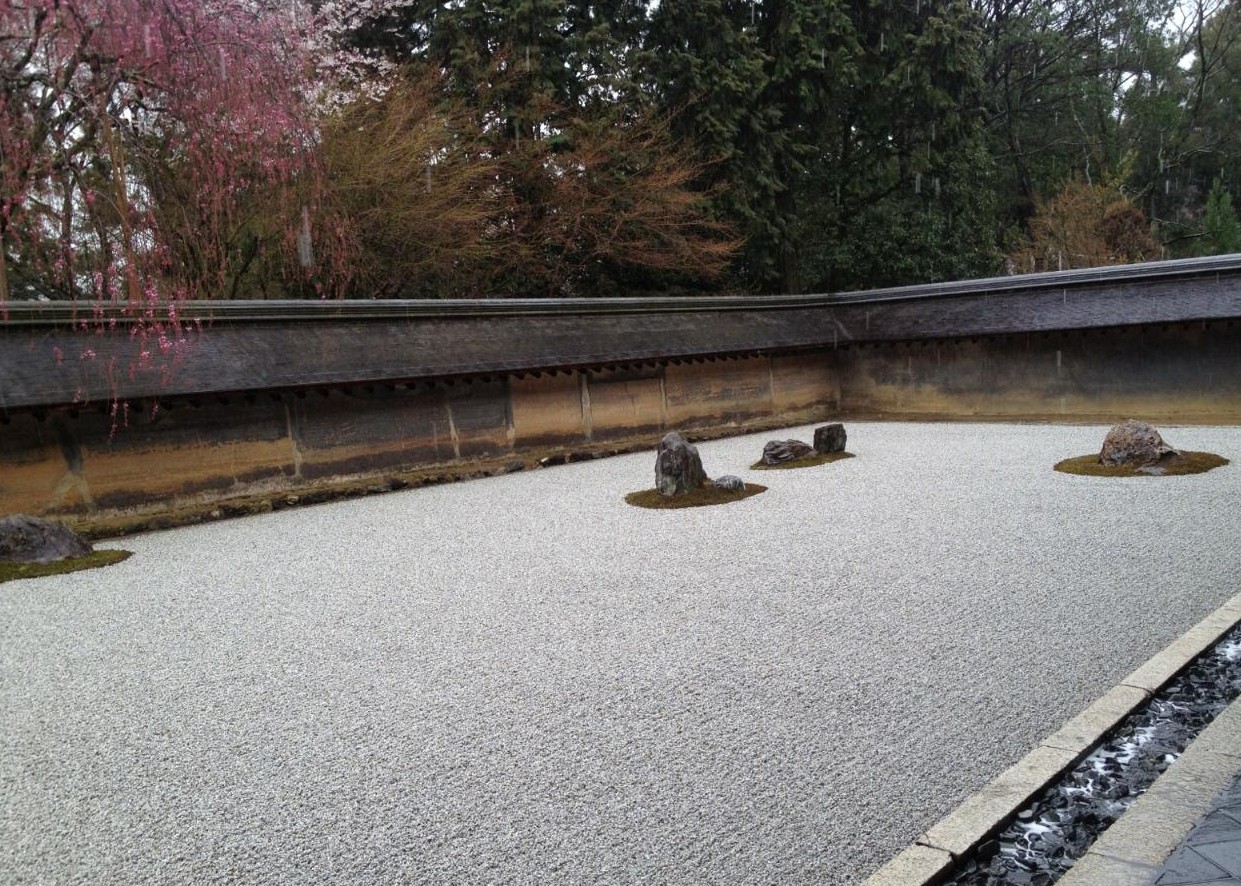
Ryoan-ji Temple’s dry rock garden is a puzzle. Nobody knows who designed it or what the meaning is of the 15 rocks scattered across its expanse of raked white gravel. Some academics say they represent a tiger carrying a cub across a stream; others believe they depict an ocean accented with small islands or the sky dotted with clouds. There’s even a theory that the rocks form a map of Chinese Zen monasteries. The only thing scholars do agree on is that Ryoan-ji is one of the finest examples of Zen landscaping in the country. You could stay there for years quietly contemplating the garden’s riddles and still get no nearer to an answer, and maybe that’s the point.
Downtown Kyoto is quite ugly.
Uji is known for the production of high quality green tea. It has many tea houses and is a great place to sample green tea, green tea desserts, green tea mochi, green tea cakes, green tea soba and green tea ice cream. Byodo-in Temple is there and is also on the back of the ten yen coin.
Many stores and restaurants in Uji are closed on Monday which makes it the time to go ( not crowded) and not to go. (looking for a restaurant)
Kyoto was never bombed during World War Two. You can still find 100-year-old streets and lots of old wooden buildings. Some of the structures have withstood earthquakes and have no nails.
Kyoto is Japan’s craft capital, where skills are still passed down through generations. Tiny specialty shops in Shijo Dori, Kawaramachi Dori and the Kyoto Handicraft Center have Yuzen-dyed fabrics,wooden combs, fans and everything you need to host a tea ceremony. Shinmonzen Dori and Furumonzen Dori and are filled with antique shops and galleries selling woodblock prints. The department stores around Shijo Kawaramachi intersection and Kyoto train station are good places for lacquerware and kimonos.
The 7-5-3- festival occurs around Nov fifteenth. Five-year-old boys and seven or three-year-old girls are taken to the local shrine to pray for their safe and healthy future. This festival started because of the belief that children of certain ages were especially prone to bad luck and hence in need of divine protection. Children are usually dressed in traditional clothing for the occasion and after visiting the shrine many people buy chitose-ame (“thousand-year candy”) sold at the shrine.
The most famous Buddhist temples in Kyoto are Ginkaku -ji and Kinkaku -ji (the gold and silver pavilion). I bet they are a lot more beautiful when it isn’t raining.
Kinkaku-ji is a Zen Buddhist temple . it is the Gold Pavilion. The garden complex is an excellent example of a Muromachi period garden. The Muromachi period is considered to be a classical age of Japanese garden design. The correlation between buildings and its settings were greatly emphasized during this period. It was a way to integrate the structure within the landscape in an artistic way. The garden designs were characterized by a reduction in scale, a more central purpose, and a distinct setting. A minimalistic approach was brought to the garden design, by recreating larger landscapes in a smaller scale around a structure.
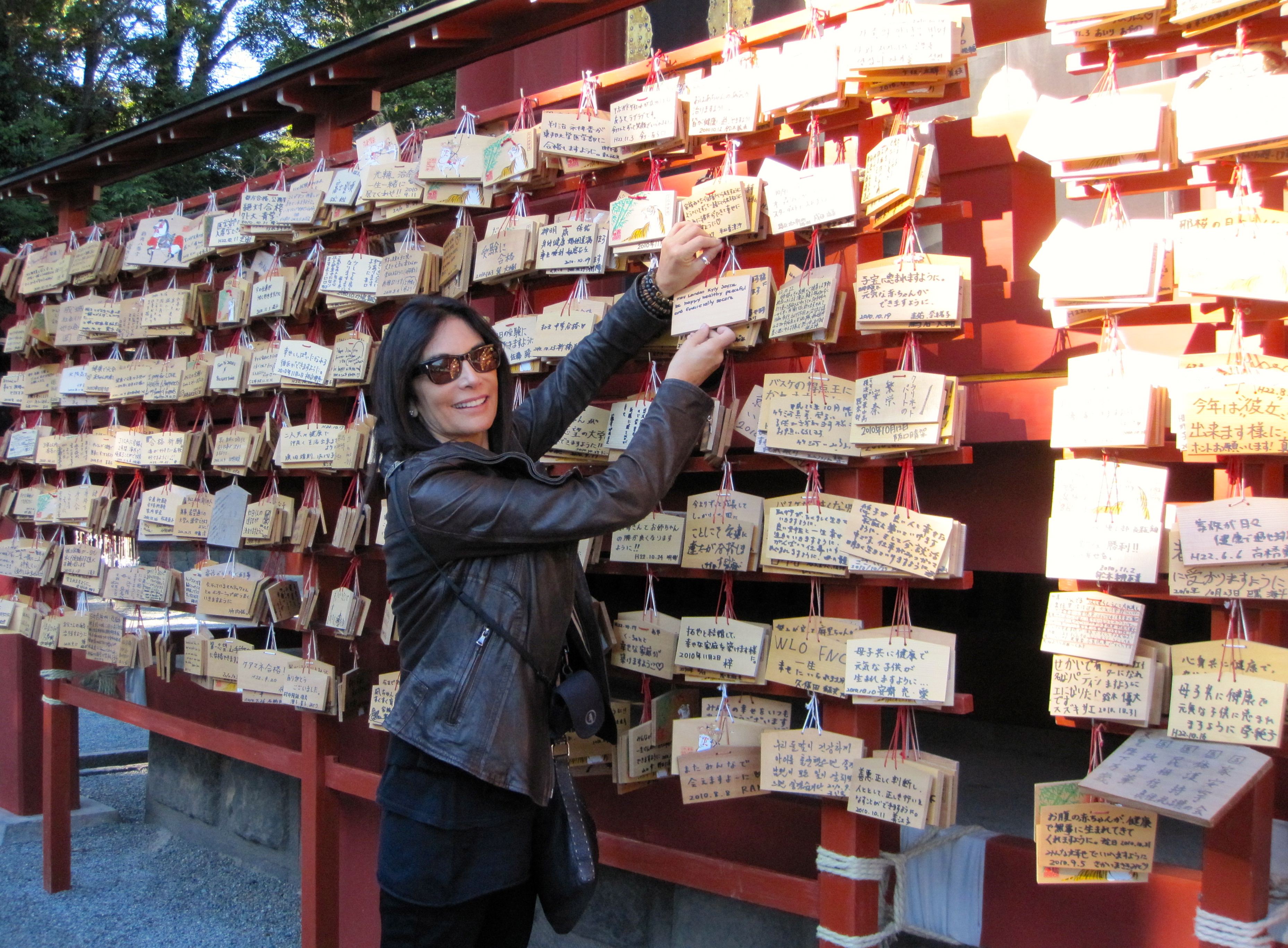
The Golden Pavilion was built to house some of Buddha’s ashes..There you’ll witness the flow of Japanese people of all ages praying, paying homage, writing their wishes on colorful ema boards, and buying special charms called omamori in hopes that their aspirations of finding a spouse or succeeding in an exam will someday be fulfilled. (i see my ema board it is one of the few non japanese ones!!!!)
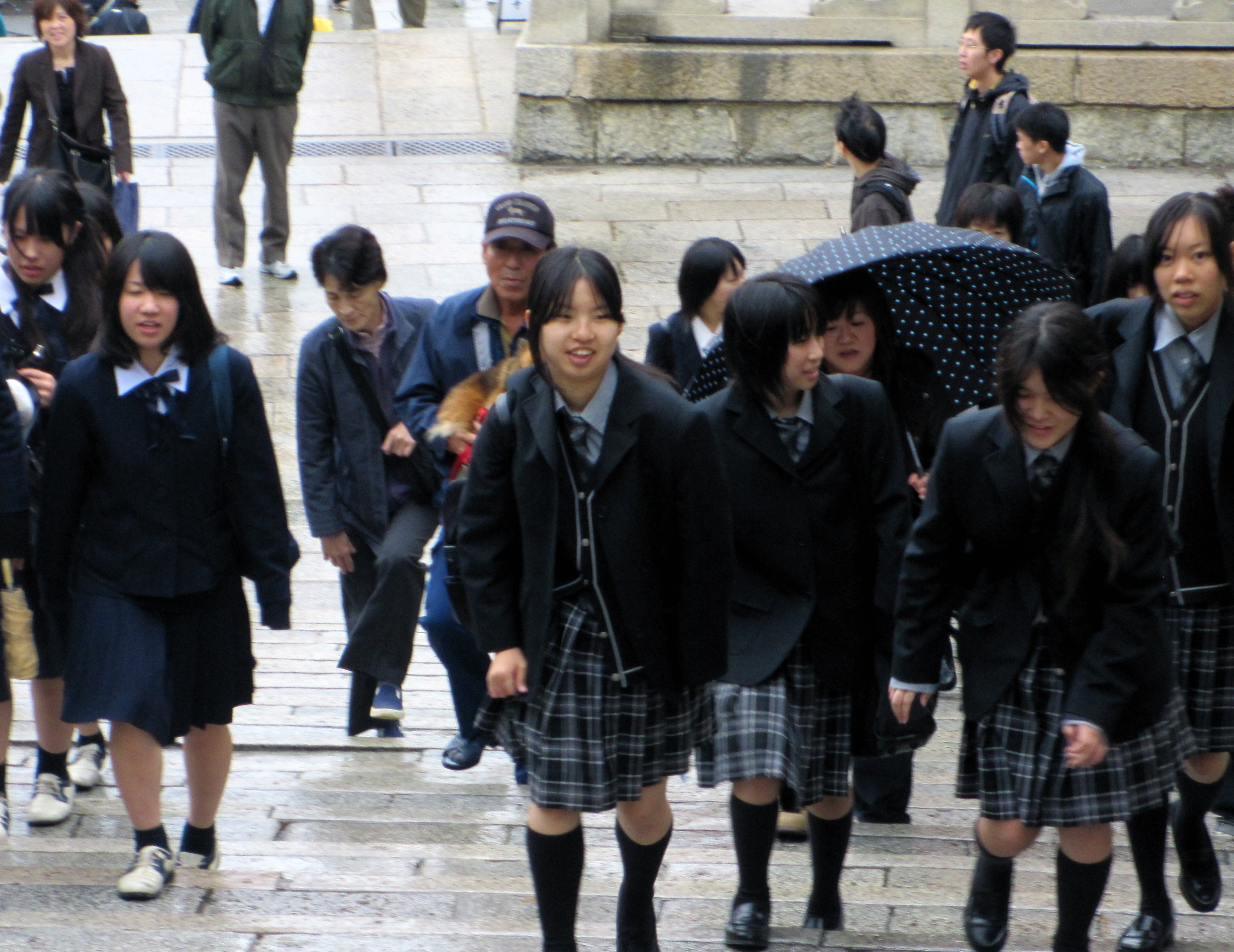
You will see a lot of school children with their classes at all the temples in Kyoto in November. It is the time for luck and they are all praying for good grades.
Ginkaku-ji is the Silver Pavilion.. The tea ceremony is said to have originated here. The exterior of the pavilion was originally going to be covered in silver foil, in emulation of the Golden Pavilion (14th century) at Kinkaku – ji. Without ever having enjoyed a coating of silver, the Silver Pavilion is one of the most graceful structures ever built.
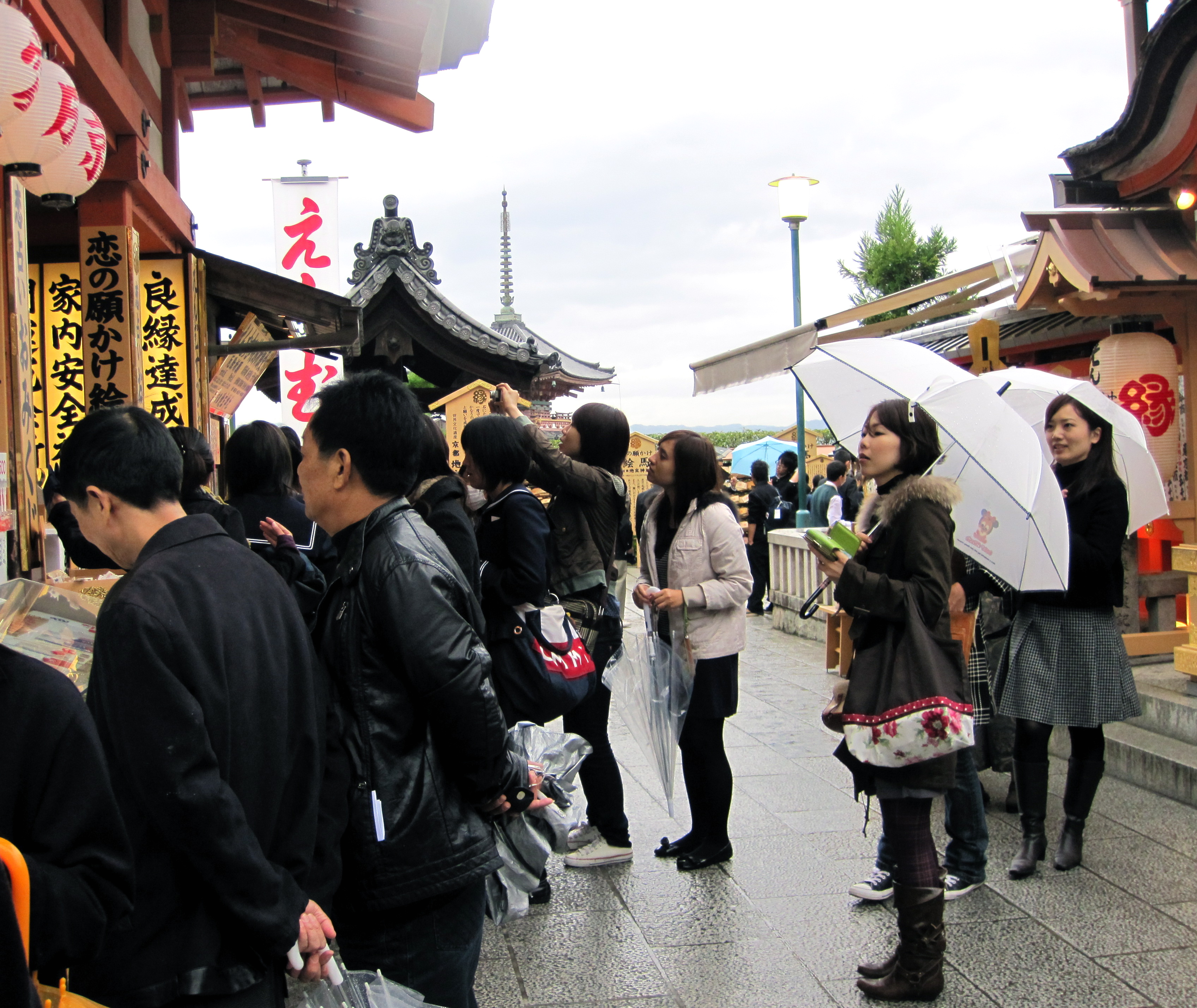
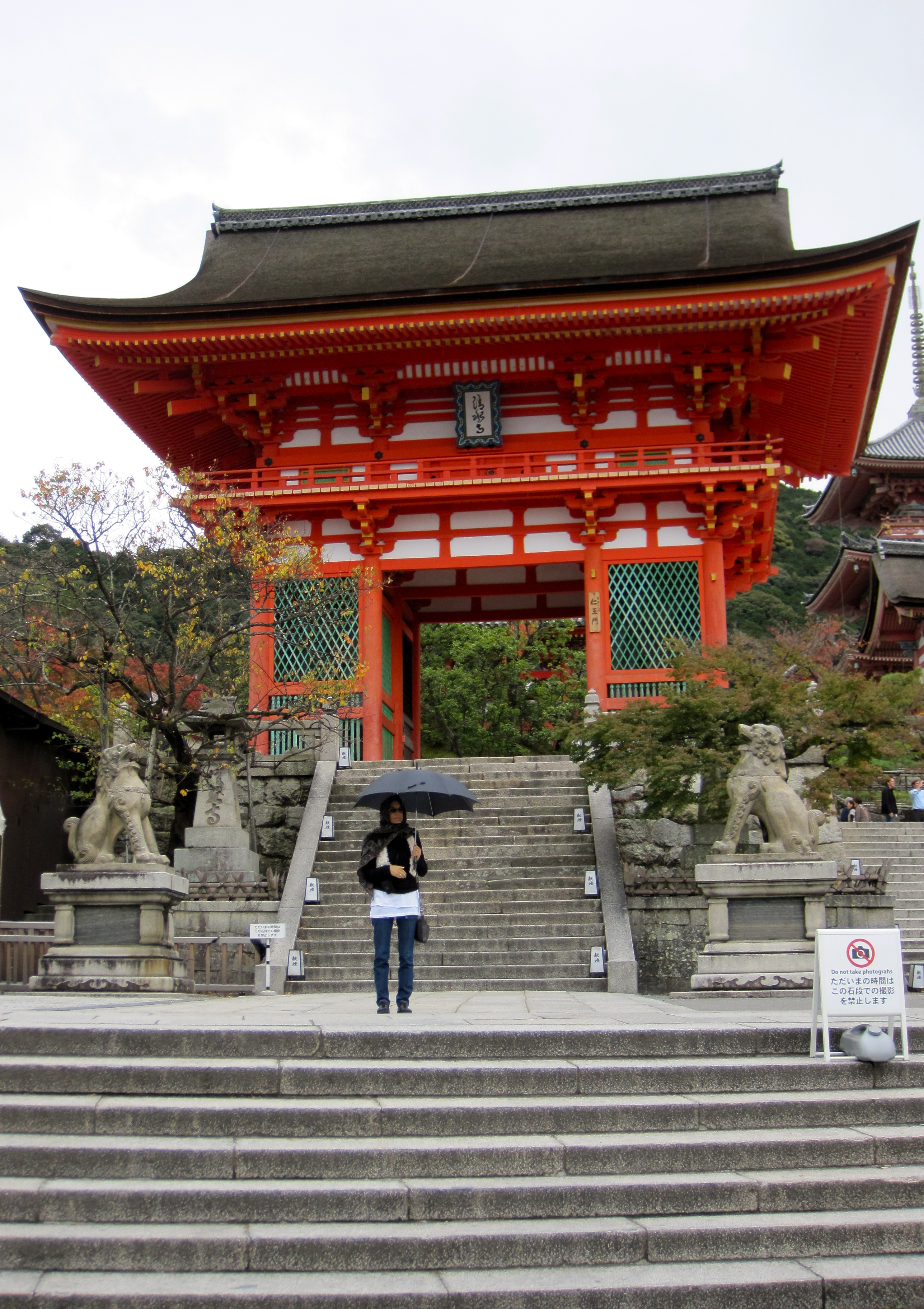
Kiyomizudera Temple contains several other shrines, notably Jishu-Jinja, dedicated to Okuninushino-Mikoto, a god of love and “good matches”. Jishu-jinja possesses a pair of “love stones” placed 18 meter apart, which lonely visitors attempt to walk between with their eyes closed. Success in reaching the other stone, eyes closed, is taken as a prediction that the pilgrim will find love. One can be assisted in the crossing, but this is taken to mean that an intermediary will be needed. The person’s romantic interest can assist them as well.
It is the highlight of the yearly school trips to the temples for luck in exams.
Here is the famous love stone.
It’s not the only geisha district left in Japan, but Gion, a collection of streets defined by its old wooden buildings, tea houses and exclusive Japanese restaurants, is by far the most famous. Spend an hour wandering the area and chances are you’ll glimpse a geisha or two shuffling between tea houses in their cumbersome zori sandals and exquisite kimono. Much to their annoyance, you’ll probably see camera-happy Japanese tourists stalking them too.
You get free tofu refills with an eight course tofu dinner – so delicious. ( Tousuiro 075-561-0035 )
Few museums are as hands-on as this old elementary school turned shrine to manga, or comic books, and its collection of some 300,000 comics and manga-related exhibits. Visitors can read any piece of manga they want at the Kyoto International Manga Museum from the towering wooden bookcases that line every wall and hallway. Some read propped up against the walls or sitting crossed legged on the floor; others hunker down with a coffee at the museum’s wood-decked outdoor café. The eclectic and universally transfixed crowd is a testament to how much a part of mainstream Japanese culture manga has become. http://www.kyotomm.com/english/
French Japanese food served by beautiful girls with strong knees is tres bien. ( Takumi Okamura, Gion 075-541-2205 )
It’s touristy, and tacky, but dressing up as a samurai and watching TV actors hamming it up on set does hold a certain charm. Eigamura or Kyoto Toei Studio Park to give it its English name, is a working TV and movie set that doubles as a theme park, where besides dressing up in period costume you can wander around a mock-up Edo-era samurai town and take in exhibitions of the well-known TV series and films shot here.It’s the live studio performances, however, that steal the show. The sword fights are extravagant, the facial expressions and body language overly dramatic, and the dialog at times delivered about as convincingly as an elementary school end-of-year play. It’s Japanese kitsch at its finest. Quentin Tarantino would love it. http://www.toei-eigamura.com/en/
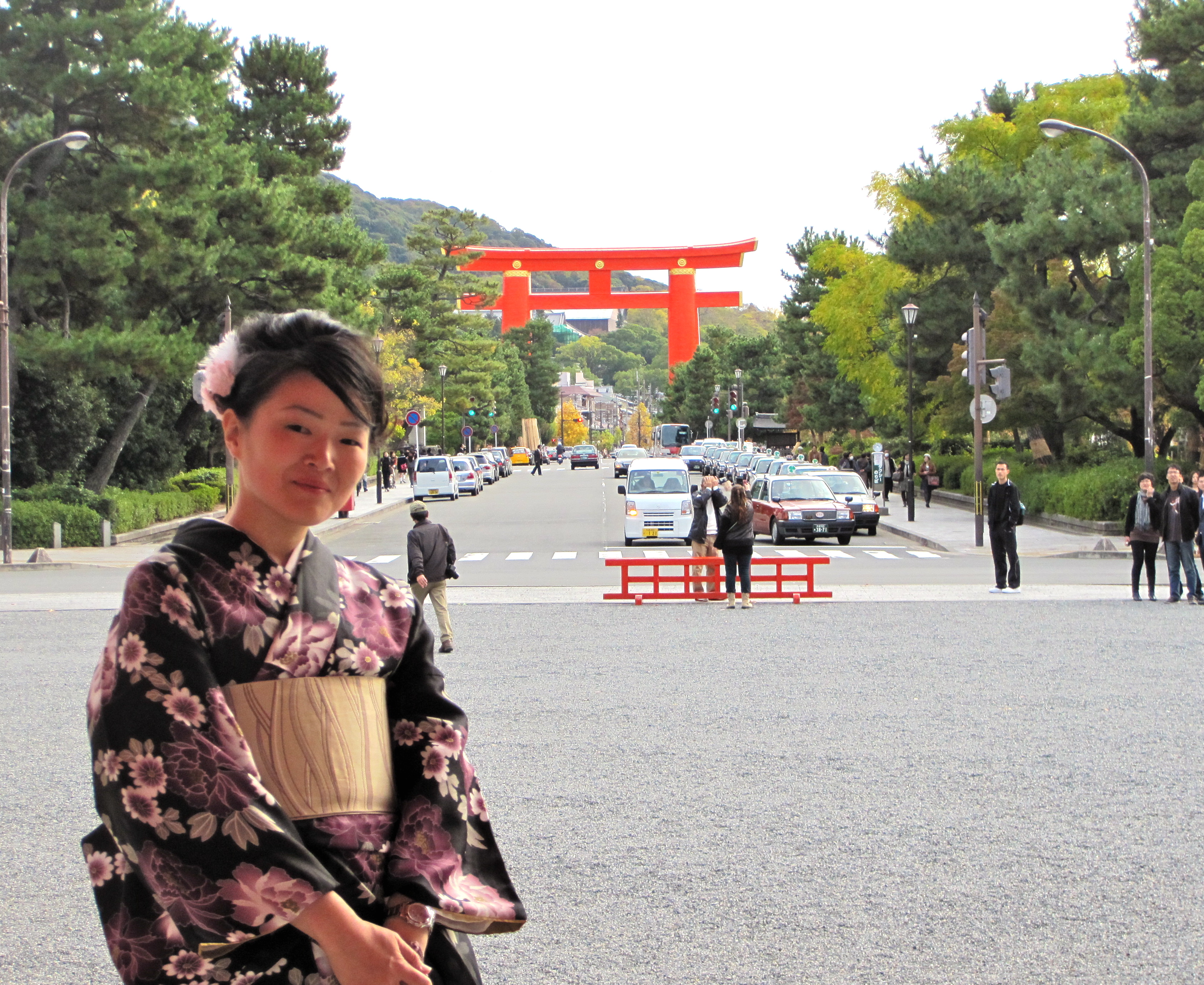
(Heian Jingū) Heian Shrine was 1895 and is dedicated to the spirits of the first and last emperors who reigned from the city, A giant torii gate marks the approach to the shrine, The real shrine grounds themselves are very spacious, with a wide open court at the center. The shrine’s main buildings are a partial replica of the original Imperial Palace from the Heian Period built on a somewhat smaller scale than the original.
Behind the main buildings there is an attractive, paid garden with a variety of plants, ponds and traditional buildings. The garden’s most striking feature are its many weeping cherry trees which bloom a few days later than most other cherry trees, making the garden one of the best around the tail end of the season, which is usually around mid April.
Omikuji are paper fortunes that can be bought at both shrines and temples. The fortunes range from great good luck to great bad luck. There are trees to tie the fortunes to avert the bad luck if you are unlucky enough to draw that fortune.
One of my fortunes is framed in my house. The others might be on a tree. The thing about luck is that it always changes.
“By the old Moulmein Pagoda, lookin’eastward to the sea, There’s a Burma girl a-settin’, and I know she thinks o’ me; For the wind is in the palm trees, an’the temple bells they say: ‘Come you back, you British soldier’; come you back to Mandalay!’ Rudyard Kipling ‘Mandalay’. (Bagan)
Things I Have Learned in Myanmar (Burma)
In 1989 the military government officially changed the name of the country from Burma to Myanmar. It is a contested issue. Many countries and opposition groups in Burma do not recognize the new name. The US, UK and Canada do not recognize it. The United Nations does.
In Burma the greeting is Mingalaba. It means may all auspicious luck fall to you.
Homosexuality is not allowed in Burma.
Air Bagan is the preferred airline of the Military Junta in Burma.
There are no federally regulated airlines in Burma.
Spending money in Burma is not easy. They don’t accept credit cards and only accept flat crisp money-mostly in one hundred-dollar bills. If you have that kind of money you can go to the official money exchange. If you don’t, you must go to the unofficial one. This entails going up a betel nut stained staircase to a fifth floor walk up dwelling. Your friends with the good money wait in the car. I ask the tour guide if he has been here before and he says no but the driver knows him.
The Military Junta was officially dissolved in 2011 following an election in 2010 and a nominally civilian government installed. They still keep enormous influence.
There is no ATM, 7-11 or cell phone service. ( or at least there wasn’t a year ago)
The economy is one of the least developed in the world, and is suffering the effects of decades of stagnation, mismanagement, and isolation. Key industries have long been controlled by the military, and corruption is rife. The military has also been accused of large-scale trafficking in heroin, of which Burma is a major exporter.
The iconic sight of Inle Lake is the leg rowing Intha fishermen. The traditional fisherman still use this technique. They stand at the stern and wrap one leg round an oar whilst gripping the hull of the boat with the other foot.
Burma is the most religious Buddhist country in terms of the proportion of monks in the population and proportion of income spent on religion.
Hillary Clinton made a landmark visit to Burma in December 2011 – the first by a senior US official in 50 years – during which she met both President Thein Sein and Aung San Suu Kyi. President Obama followed suit in November 2012, signaling Burma’s return to the world.
Aung San Suu Kyi is the Burmese opposition politician and chairperson of the National League for Democracy in Burma. She remained under house arrest in Burma for almost 15 of the 21 years from 20 July 1989 until her most recent release on 13 November 2010. She now holds an elected seat in the Parliament. She would be unable to be elected president because of a new ruling about foreign-born children. Aung San Suu Kyi was awarded the Nobel Peace Prize in 1991 while under house arrest and was unable to give her acceptance speech. Here is the beginning of her speech which was given in 2012. You can view the whole speech on youtube .
Burma ranks the lowest for health care.
If you are going to Burma, do something to help. There are many orphanages and schools. Teach English for a day or bring things to the orphanages or hospitals or schools. If you do some research, you will find many opportunities –or just wait till you get there and ask.
Burmese traditionally eat with their hands. Chopsticks and knives and forks are becoming more popular. The meal is served on a low table and the Burmese sit on mats on the floor.
The Burmese are snackers. ( and who isn’t?) There are many stalls selling snacks on the streets.
Burma is known for its legendary golden Buddhist pagodas. The Schwedegon Pagoda in Yangon is the most famous. The stupa sours 100m into the air and can be seen from far away. The seven tiered crown has 5000 diamonds and 2000 rubies.
In the poorer Shan and Chin states, insect larvae, ants and grasshoppers are added to the traditional rice and curries, cooked vegetables, lentils and spicy salad.
The Burmese women wear thanaka on their faces. It is a yellowish white paste and is used as a skin protection and sun screen and often applied with designs..
Try to stay in privately owned hotels and eat in privately owned restaurants. Do your shopping at personal businesses. This way you are helping the Burmese people and not the military junta.
When I was there, (almost year ago but I wasn’t a blogger) the Burmese were willing to talk about Aung San Su Kyi and point out the street where she was under house arrest. The consensus was then if she leaves that she wont be allowed back. (this was before she was elected –things have changed.)
Burmese spelling is easier than Thai spelling or even English spelling.
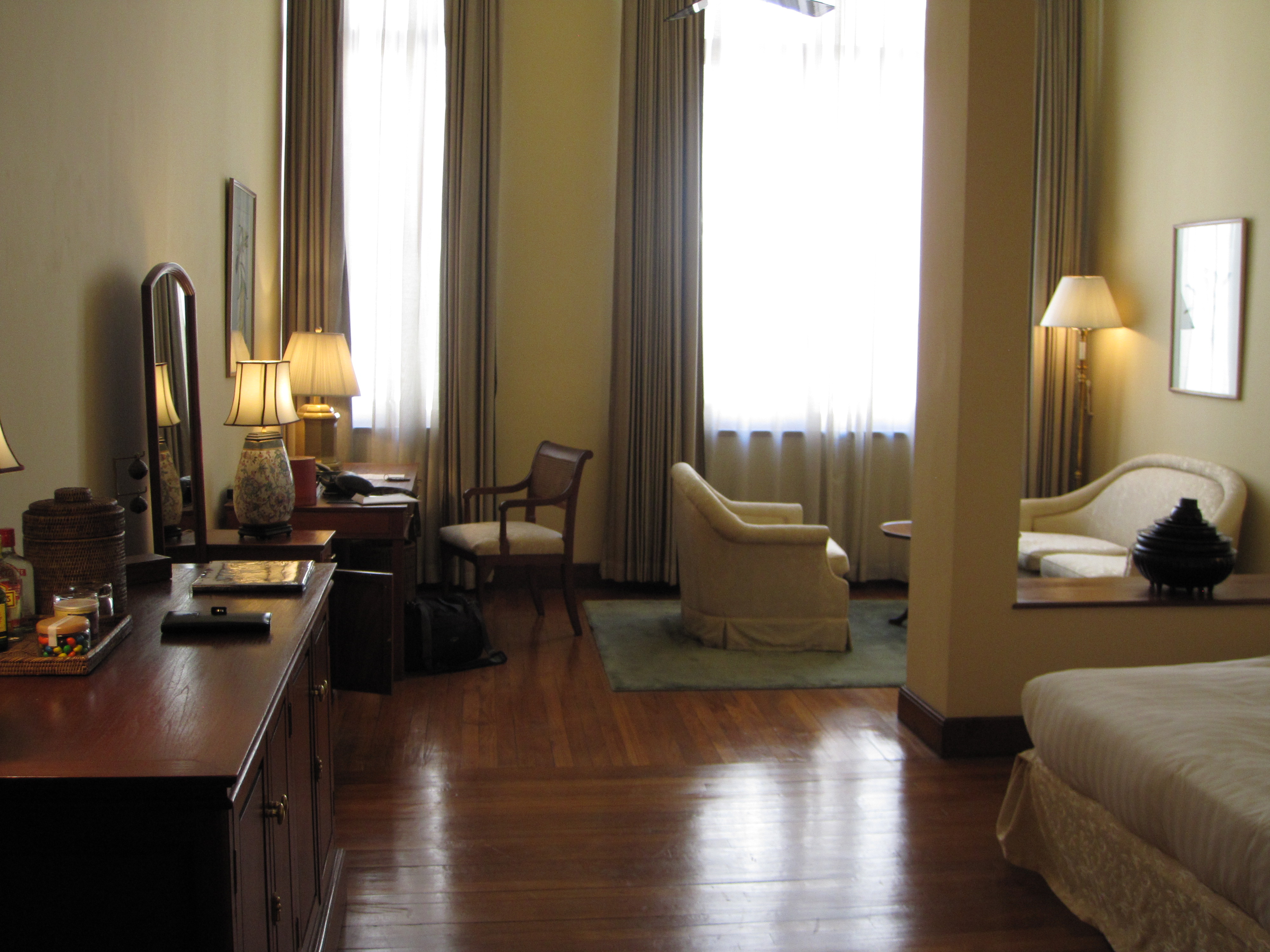
The Strand Hotel in Yangon Myanmar, home to Somerset Maugham and Rudyard Kipling when it was Rangoon, Burma, looks exactly the way you picture it.
There is internet in the Strand Hotel in Yangon, Burma though we were told there wouldn’t be, it works better than the internet in the Penninsula Bangkok.
There is a half hour time difference from Thailand to Burma.
At some point in your trip to Burma, you will be followed.
There is no freedom of speech and press for residents and tourists in Burma.
You are not allowed to take any pictures of the military in Burma even if they are just guarding a monument.
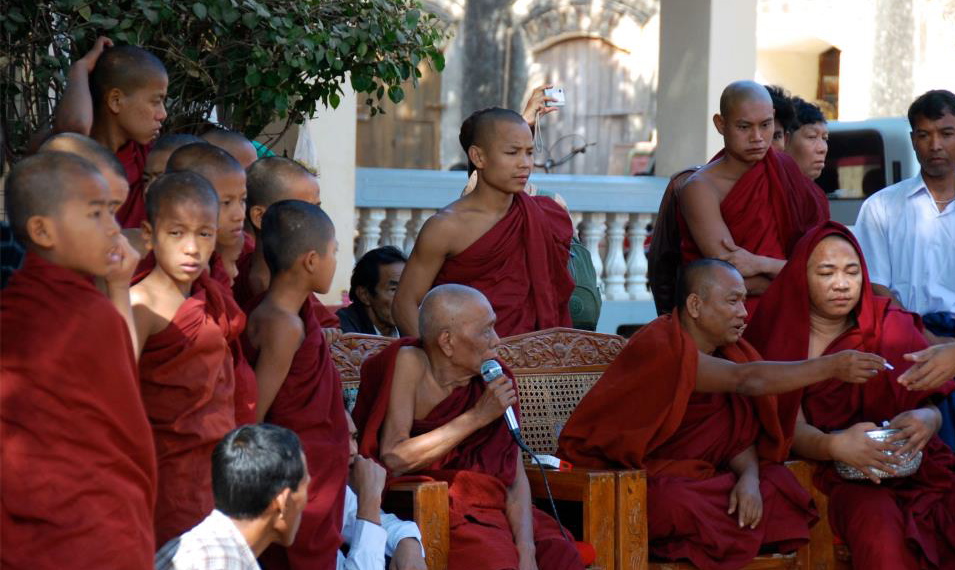
Photographing monks is allowed if you ask first or you happen to be one.
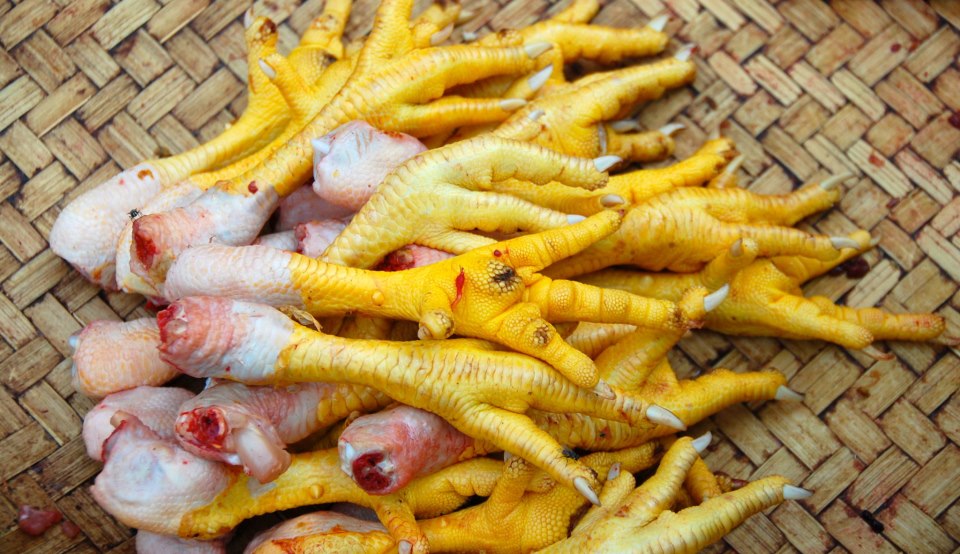
In Burma they say that “anything that walks on the ground can be eaten” such as barbecued pig organs on a stick, fried crickets, ( take off the head peel off the wings and gulp), fried beetle (suck out the stomach and chew the head) and insect larvae ( best eaten raw because it is good for the stomach). (this would be chicken feet)
In Southeast Asia people chew on the betel nut ( still very prevalent in Yangon and sold on the streets) –mixed with the leaf and lime it acts as a mild stimulant. The ancient lacquer boxes show how socially acceptable having black teeth and red gums and stained floors from spitting is. You can see the dark red stains in stairwells and streets all over Yangon.
There are rules to wearing longyis ( sarongs worn by both men and women. There are rules for the placement of the knots and folds. They are different for men and for women. Sexual orientation is also shown by the placement of the knots.
Myanmar ( Burma) has the largest children’s army in the world. No, we didn’t see that. There are black zones that you are not allowed to cross into.
Burma is the second largest country in Southeast Asia.
A Burmese person asked me if I thought that the Burmese people had done bad things in another life to have such a difficult life now. I was thinking of my own karma at the time wondering the same about myself, having to leave trip of a lifetime and it brought me back to reality. I thought that individually they were good people but maybe there was a time when things were wrong with the world and it was a collective karma. I know karma is a very strong theme for these very Buddhist people so I felt I had to answer like that. It is so hard to understand so much cruelty and hardship in such a strong Buddhist culture. He thanked me for my answer and I thanked him for his question.
for more info go to https://havefunflysafe.wordpress.com/2012/11/23/how-to-leave-myanmar/
“If your mind is happy, then you are happy anywhere you go. When wisdom awakens within you, you will see truth wherever you look. It’s like when you’ve learned how to read — you can then read anywhere you go.” Phra Ajarn Chah (Thai Buddhist monk)
Bangkok has the longest city name in the world; written out it’s actually: Krung Thep Mahanakhon Amon Rattanakosin Mahintharayutthaya Mahadilok Phop Noppharat Ratchathani Burirom Udomratchaniwet Mahasathan Amon Phiman Awatan Sathit Sakkathattiya Witsanukam Prasit.
In Thailand, it is required to stand for the national anthem when it is played (in the street, in the cinema, in the airport, in the train station, in the bathroom or at the beach etc, (Phu Quoc island location of “The Impossible”)
The first case of HIV Aids was reported in Thailand. Thailand has the highest prevalence of HIV Aids in Asia.
Thailand has one of the worst child sex trafficking records in the world.
In Thailand it is deemed impolite to ask someone their age or salary.
Thailand is home to the world’s largest gold Buddha, the largest crocodile farm, the largest restaurant, the longest single-span suspension bridge, and the world’s tallest hotel.
Several years ago, Bangkok was named the hottest city in the world by the World Meteorological Organization. Stay hydrated.
You can be jailed for not wearing underwear in Thailand.
Every Thai male has to become a monk at some point in his life even if only for a short period, and at almost any age between completion of school and the beginning of a career or married life. it is a period of about three months. The reason being is to do it for your mother so when she died she would hold on to your monk’s robe and go to heaven.
In Thai tradition, touching the head is severely looked down upon. The Thai people believe that the soul resides in the head, which makes it an extremely sacred place that should not be touched.
The Kings head is on all Thai currency, therefore if you step on a banknote or coin, it is considered to be kicking the king in the face. They love this king. His face his everywhere.
All Buddha images, no matter how small, tacky or ruined are sacred and should never be used as a backdrop for your photo. (Ayuthetta)
In Thailand, the left hand is used for going to the bathroom and the right hand is used for eating and greeting. Unfortunately, I am left-handed so I am rude in Thailand.
Thai boxing has a spiritual and ritualistic part. There is music and sacred clothing decorated with Buddhist symbols, There are different significant bows and a dance. Then they try to beat the crap out of each other.
In Thailand, the children do everything for the parents. They are grateful to them for being born, for giving them food , clothing, shelter and education. In America, the parents do everything for the children. They are grateful to them for being born and give them food, clothing ,shelter and education.
The ‘King and I “ is banned in Thailand. Anyone caught smuggling in the “King and I” will be arrested.
The gold stupa in the Emerald Temple in Bangkok has a monkey and a giant on it to carry the world. Everyone must carry their own burdens in this world but the giant and the monkey also carry all the human burdens.
It is cheaper to buy Chang Mai hillside tribe products in Chatuchak weekend market in Bangkok (biggest market ever) than it is in Chang Mai.
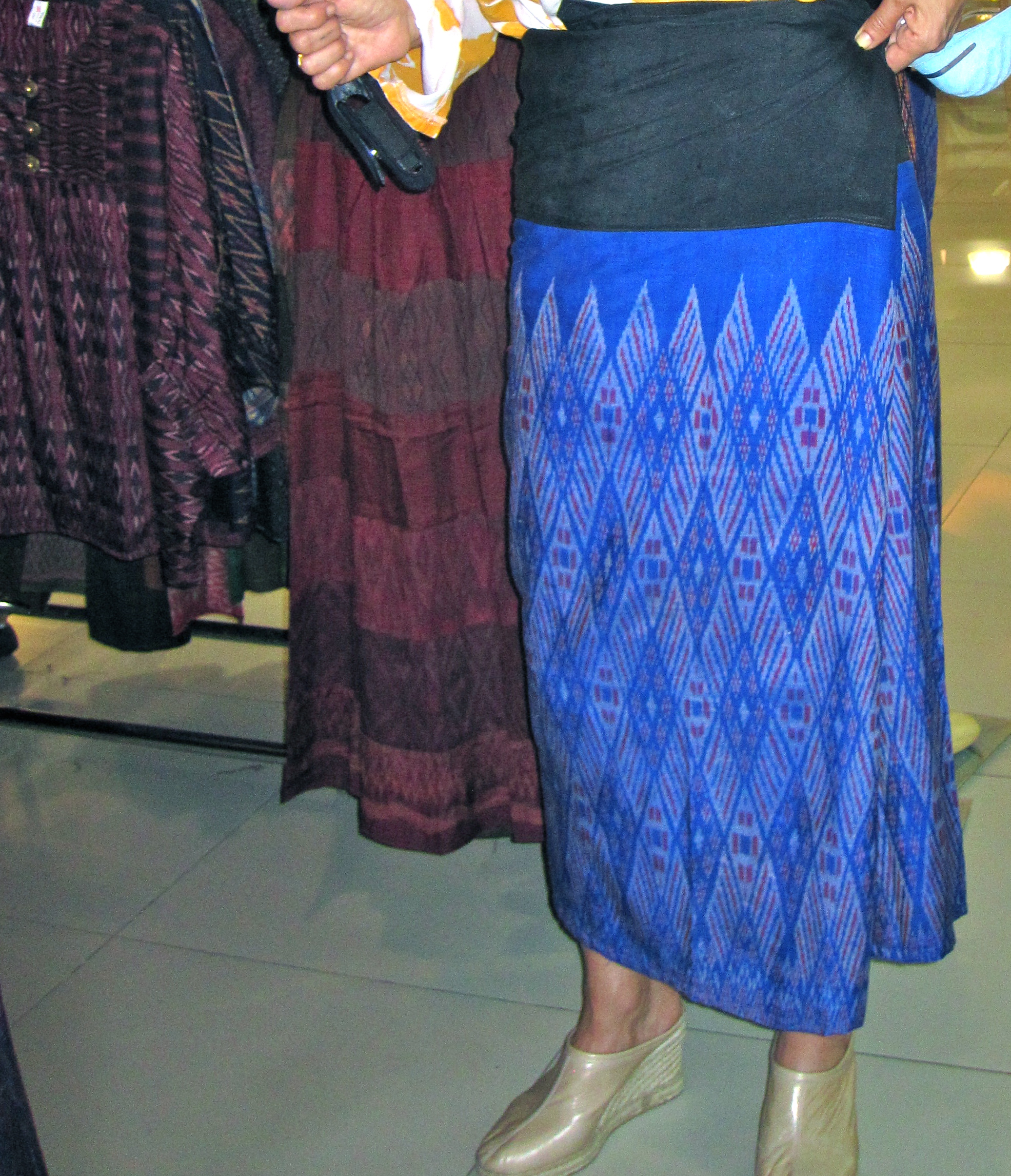
Putting on sarong pants is more complicated than it looks. There are rules for the placement of the knots and folds. They are different for men and for women. Sexual orientation is also shown by the placement of the knots.
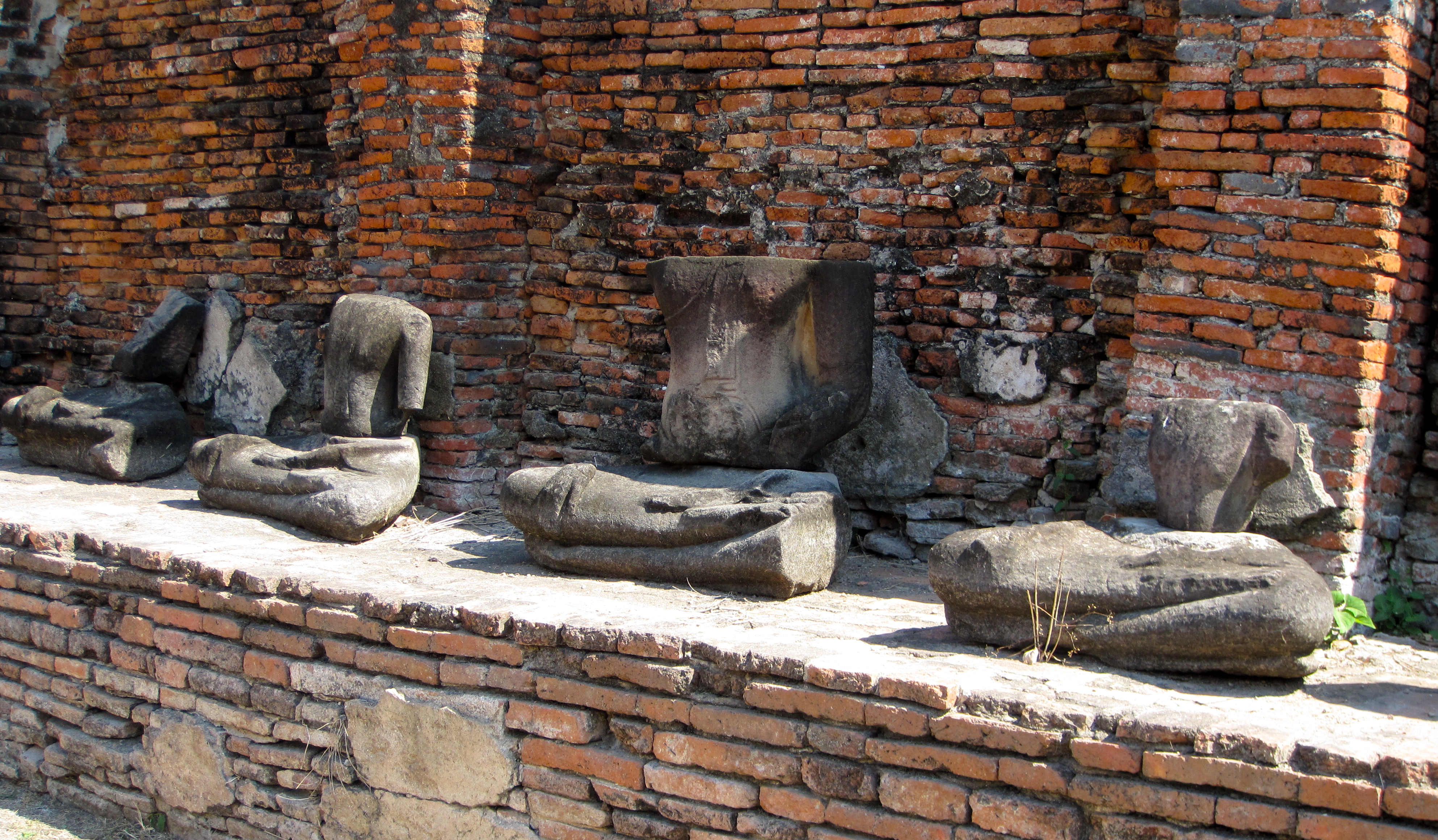
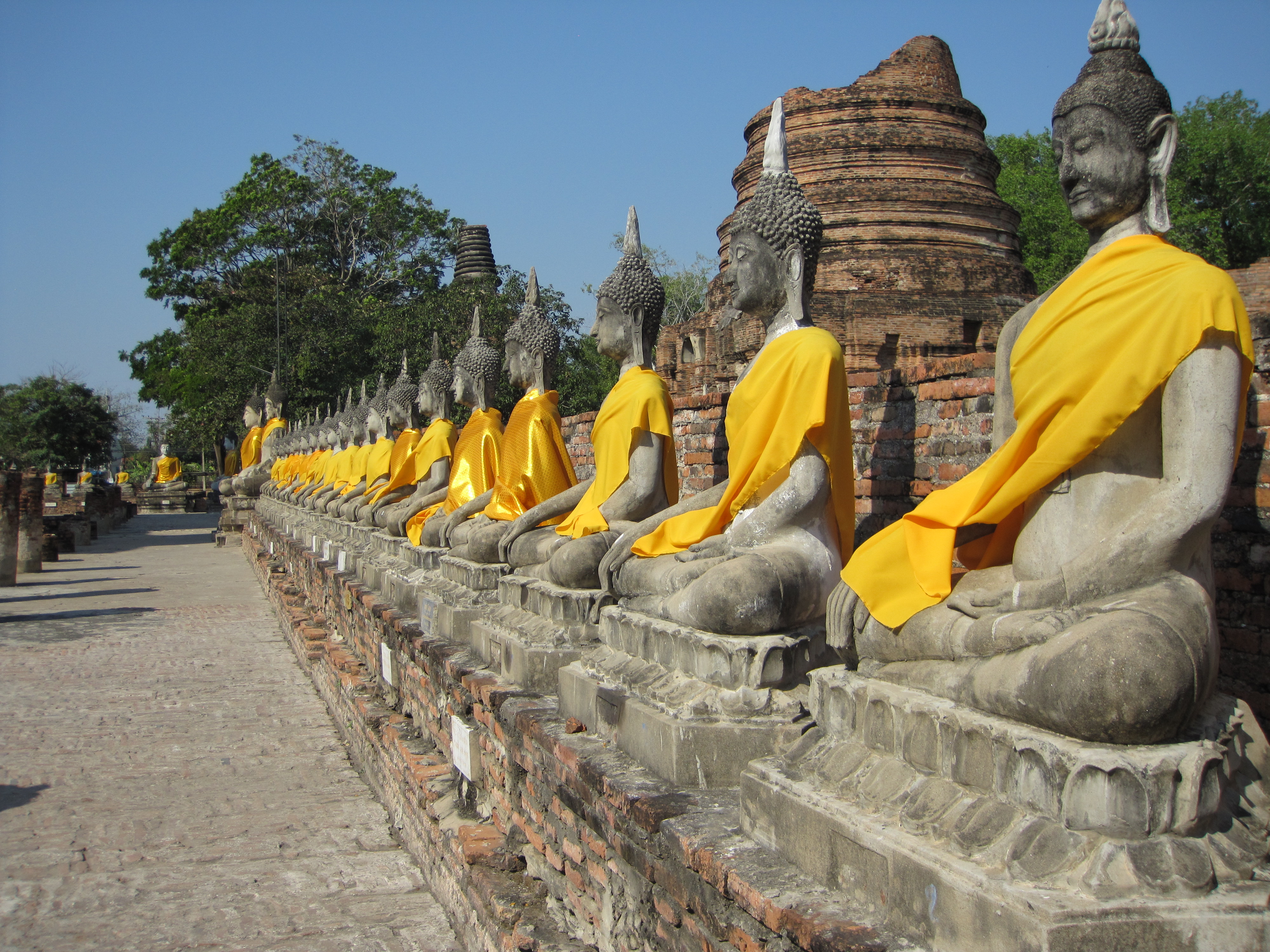
Ayutthaya was the old capital of the Thai kingdom resembling a graveyard of temples and headless Buddhas (beheaded by the Burmese in the thirteenth century) and ruins showing what it might have looked like.
Thai people greet and bow in the traditional way with palms touching. Most people great each other in this way and say “sa wat de kah” It is based on the ancient Thai culture. They were always working in the rice fields and their hands were dirty so this became the most polite greeting.
Thailand is the only country in Southeast Asia that has never been under foreign control. Burma and Malaysia were part of the British empire. Laos and Cambodia were under French control. (Putthaya)
Condensed milk is a staple in Thailand and Thai coffee. You can find it in every Seven Eleven and in bulk at Tesco.
An ice cream sandwich in Thailand is ice cream between two pieces of white bread. They don’t serve bread with meals but rice instead.
Thai is a tonal language which means one word can have many meanings depending on how it is pronounced. Thai people think is very funny the way we pronounce Kwai in Bridge on the River Kwai. Apparently the way we say it, it means male sex organ.
Thai people eat most of their food with a spoon in their dominant hand and a fork in the other. Chopsticks are only served for soup..
95 per cent of the people are Buddhists.
Thailand was called Siam until 1939.
Shopping at Siam Paragon and MBK are just like shopping in any other huge shopping mall.
The first Thai massage school was started 417 years ago at the Pho temple in Bangkok. People today still learn the same techniques and the original drawings show that each part of the body has a meaning.
In Bangkok, “best quality fakes” are near “best quality hotels.” It does involve hidden stores behind other stores up staircases in back alleys but one block from the Shangri La Hotel and Penninsula ferry stop.
In ballet, the shape of the feet is important, in Thai dancing it is the shape of the hands, the length of the fingers and if they are double jointed, that is the most important.
It is often nicknamed as the “Land Of Smiles,” because of the perceived gentleness of its people. The country is really populated by smiling, inviting, and receiving people. Thais are really gentle, polite, soft-spoken, friendly, and hospitable human beings. (great tour guide Gift www.privatetourthailand.com)
“If all difficulties were known at the outset of a long journey, most of us would never start out at all”. - William F. Buckley, Jr.
How To Leave Myanmar
There are very flew airlines that fly to Myanmar and flights are booked months in advance.
You will be taken to the airport by an English speaking guide and a driver. They will not be allowed into the airport.
Wait on line for two and a half hours. A line means that any foreign tour guide carrying fifty passports will be waved in front of you. Airline personnel from any airline can bring random people and large familes in front of you at all times.
Just because the concierge at your hotel (right out of a Somerset Maugham novel) tells you that he has gotten you a seat on the morning flight, doesn’t mean that it will be true when you get to the airport desk.
Talk your way into getting a seat on the evening flight. Make sure to get a confirmation number. Otherwise this same scenerio will repeat in the evening.
Everyone will be rude to you.
Spend day alone in Yangon, Myanmar without friends or English speaking tour guide.
Driver is waiting to take you back to the hotel. “Schwedegon?” he says. He has decided to take me to the most important Buddhist Temple in Myanmar. He knows that I did not go the day before with my friends. I decide that he doesn’t look like a terrorist or serial killer and say ok. I walk around with him and his friend ( who appears at the temple) for an hour on the grounds of this exquisite temple. I wondered when I became a person who walked alone in Burma with two young men in longyi (sarongs) who did not speak English. I rely on my vast knowledge of gestures and hand motions. I hope I am not doing the Macarena or the Hokey Pokey.
.Everyone at the hotel knows that you didn’t get on the flight. They have a room waiting for you and your luggage is quickly whisked away. The concierge unasked says he cannot find an English speaking tour guide . Instead he has found a car and driver who speaks English for twenty dollars for the afternoon. By English, it means he knows a few words.
You decide to go back to Scott Market to shop since you wont be going to the local areas. It doesnt look as strange today. You run into the young girl monk who you took pictures of yesterday. She is so happy to see you and brings you to her friend’s shop. You buy a painting from a kid. Word spreads that someone is buying art. You are surrounded by kids and paintings. They are not supposed to take folded money in Myanmar but they take it in the market. You run into your English speaking tour guide with a new group . He has been worrying about you and is happy to see that you are fine. The driver is more of a body guard/package carrier. He is only a bit happier than my son to be shopping but has good humor about it. He laughs when I tell him that I will let his wife know what a good shopper he is . He shakes his head.
.You leave the market on a very long narrow street. The car in front of you is stuck. Three very skinny people get out and push the car very slowly down the street. Everyone is teasing them. We follow very slowly behind them.
The tour sends another English speaking tour guide and driver to take you to the airport. He turns out to be the person that your travel doctor in LA has told you to contact to find his aids orphanages to help. He knows all the best Buddhist teachers in Burma.
This time , the driver is allowed in to the airport to help you with your luggage. The girl at Security waves hello and says welcome back.
Everyone is nice to you.
The man who this morning was bringing everyone in front of me smiles and says “I remember.” He takes my luggage. He points to a chair. He puts up ten fingers. In ten minute he comes over to get me. My luggage is already up on the counter. A woman is standing there with fifty passports. He waves me in front of her. That is Myanmar.
Tar Tar ( from British rule – Ta Ta) and Fly Safe,
“If I had known they were going to do this, I would have become a shoemaker.”
Albert Einstein
Things I Have Learned in Okinawa and Hiroshima
Driving on the Okinawa Expressway in the rain is like driving anywhere else in the rain.
Japanese Navigation
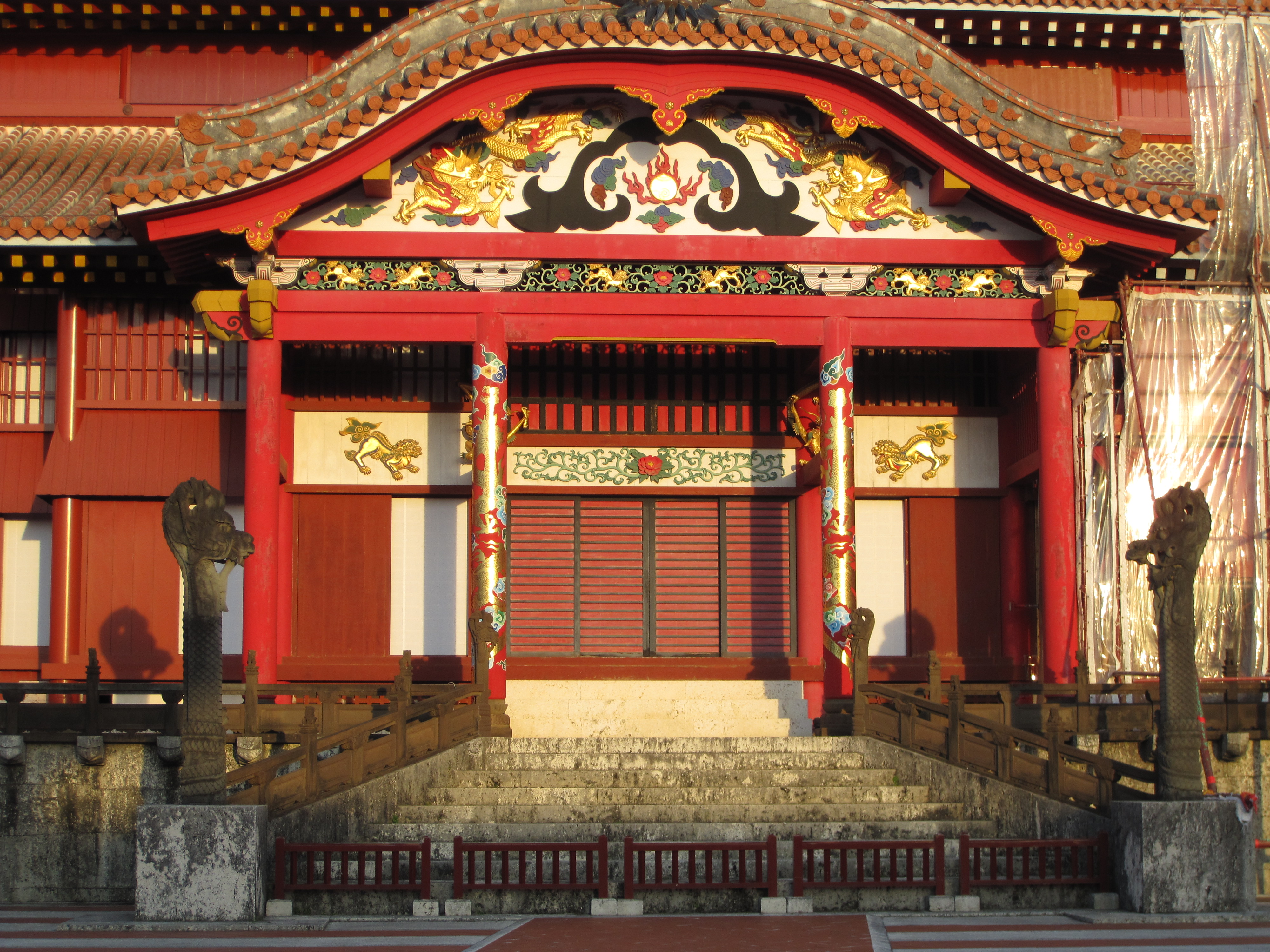
Touring Shuri-jo Palace in Okinawa one must follow the signs that say “usual route.” What is the unusual route?
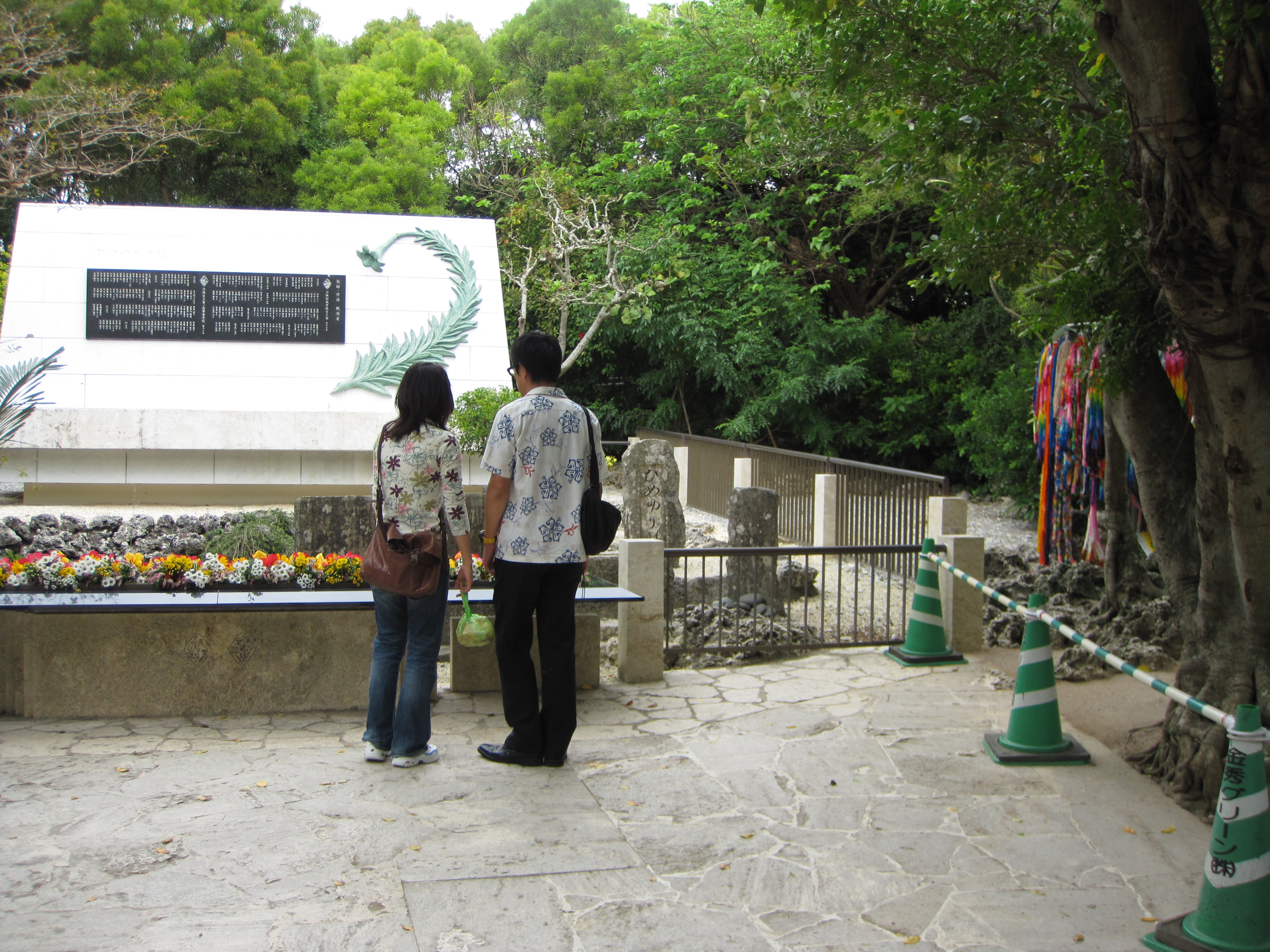
One of the hardest things to see was the Himeyuri Peace Museum in Okinawa.In the face of the American invasion, the Japanese forces stepped up the nurse training in the local high schools. Three hundred and two high school students (mostly girls) and twenty one teachers were deployed to the front. They were told they would be working in hospitals but ended up in hospital caves with very bad conditions. There was no legal basis in Japan to use young girls for military purposes. On June 18th 1945 the Japanese forced the young girls out of the caves to fend for themselves against the American attack. On June 23 the Japanese resistance ended. In those five days, 219 of them were killed. The museum is a model of one of the high schools that the girl’s came from. High school students from all over Japan come to pay their respects.
I was the only foreigner in the museum with alot of high school kids from Japan. I was looking at the photos of the girls and was standing next to an old woman. She started to talk to me but I didnt understand so I found someone to translate. (not so easy to do in this museum). We were standing in front of a picture of her daughter. Two strangers became two mothers looking at the ultimate tragedy.
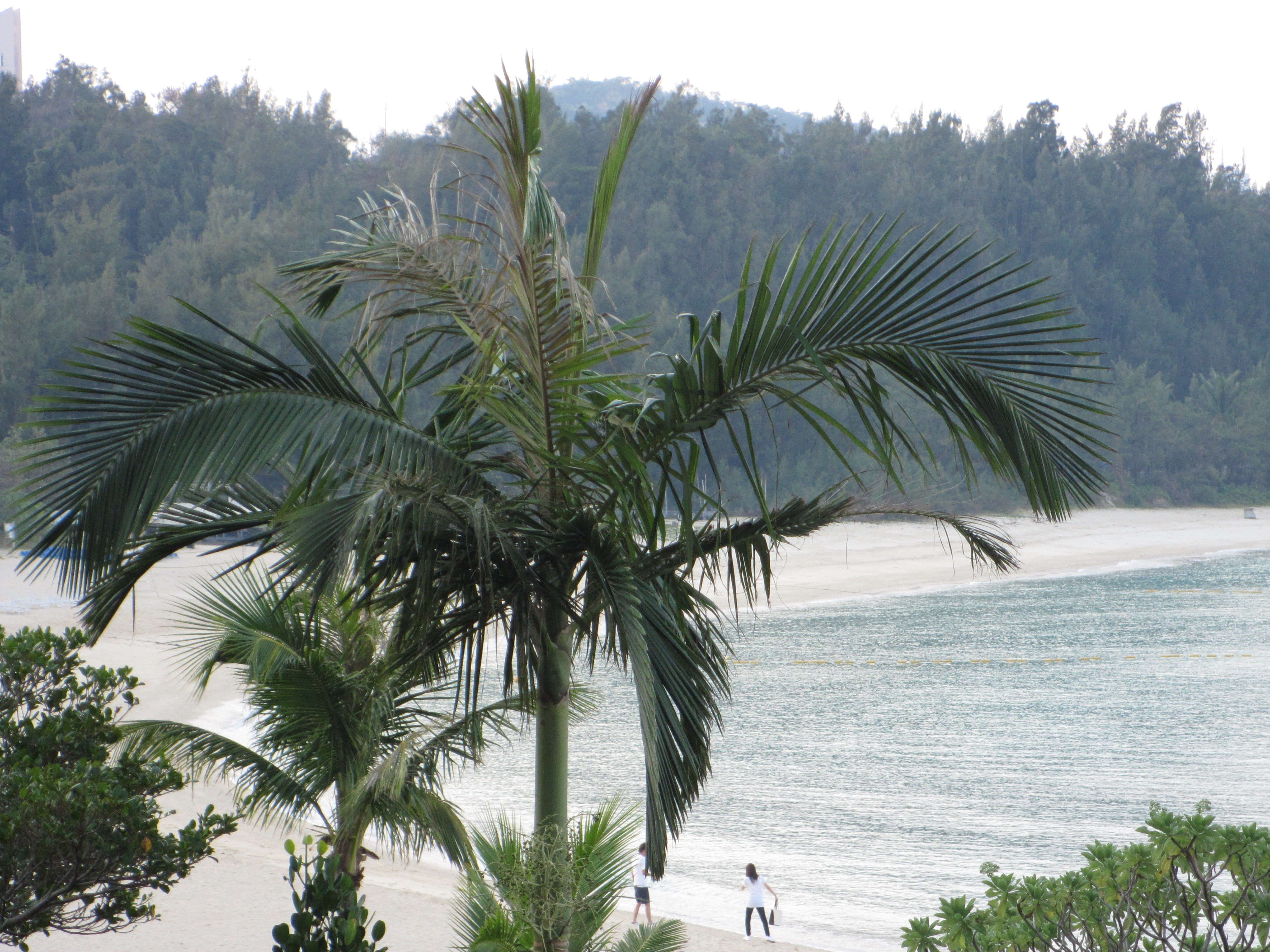
Busena Terrace in Okinawa is the Grand Wailea/ any resort in Hawaii. Naha looks like Lahaina . You can always find the American servicemen and their families at the Mcdonalds.
The Japanese and the Koreans were just as bad to the Okinawans as the Americans in WW2.
Okinawa Aquarium contains the largest fish tank in the world according to the Guinness Book of World Records.
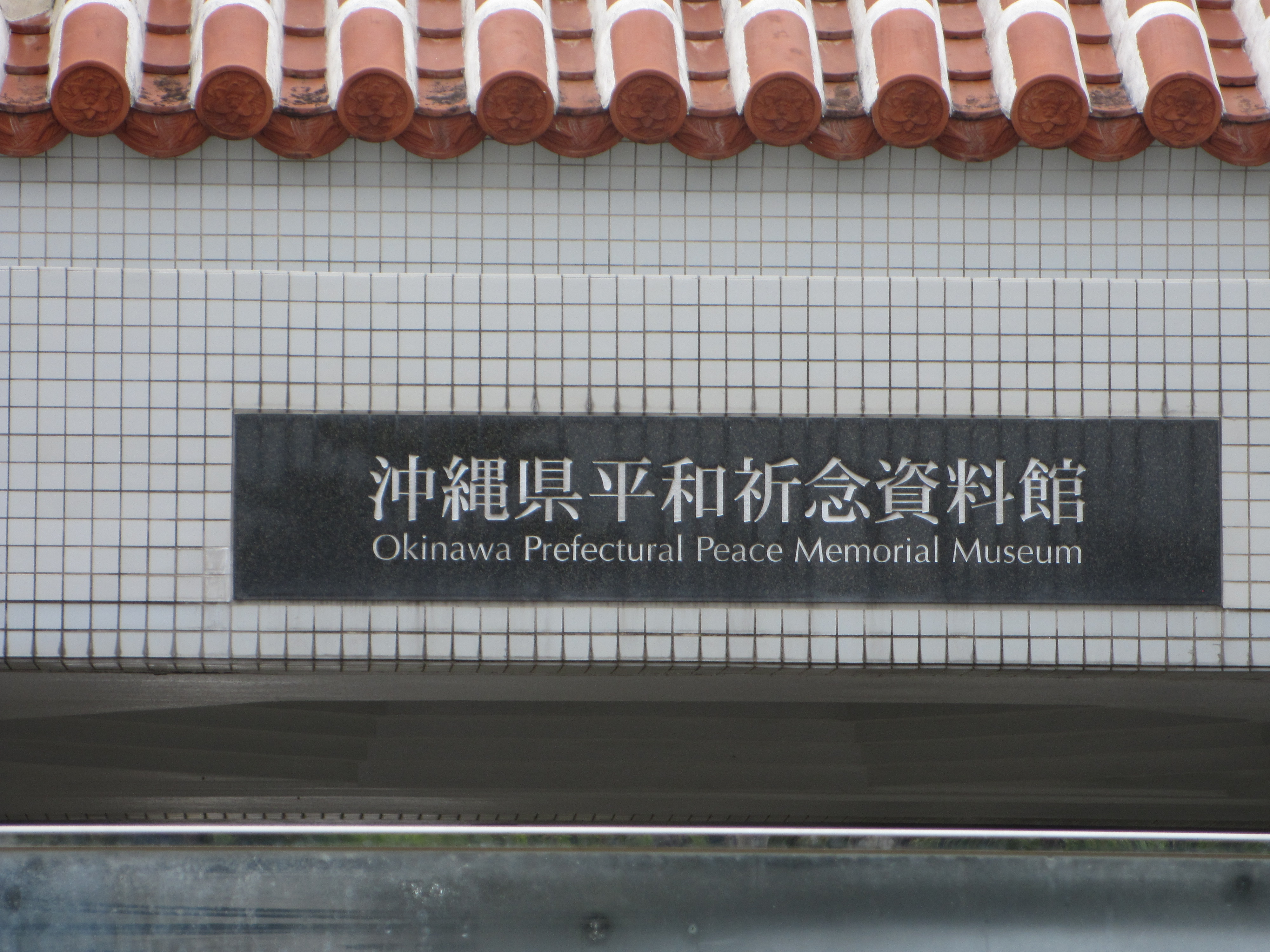
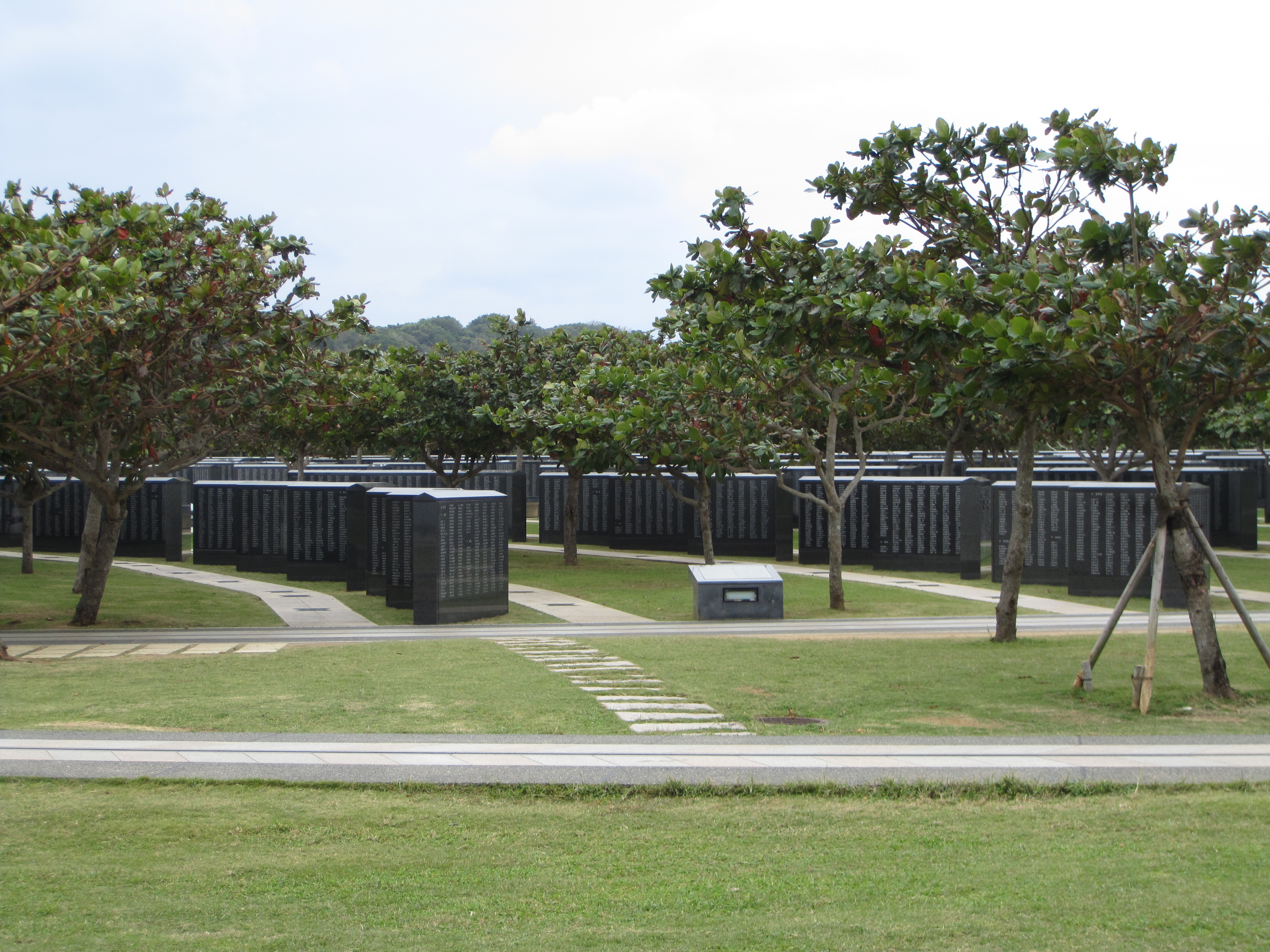
The Okinawa Peace Museum is a memorial dedicated to the 200,000 people who died in the Battle of Okinawa. It is located in the south part of the island where the heavy fighting took place. Over 100,000 were civilians and 12,500 were Americans. The civilians died from shellings, suicides, starvation, malaria and retreating Japanese troops. It was the largest campaign in the Pacific. The lesson of the memorial is the “Okinawan Heart” that rejects any act of war, mourns for those who died in the war, passes on the stories of their struggle to future generations and remind us of our humanity.
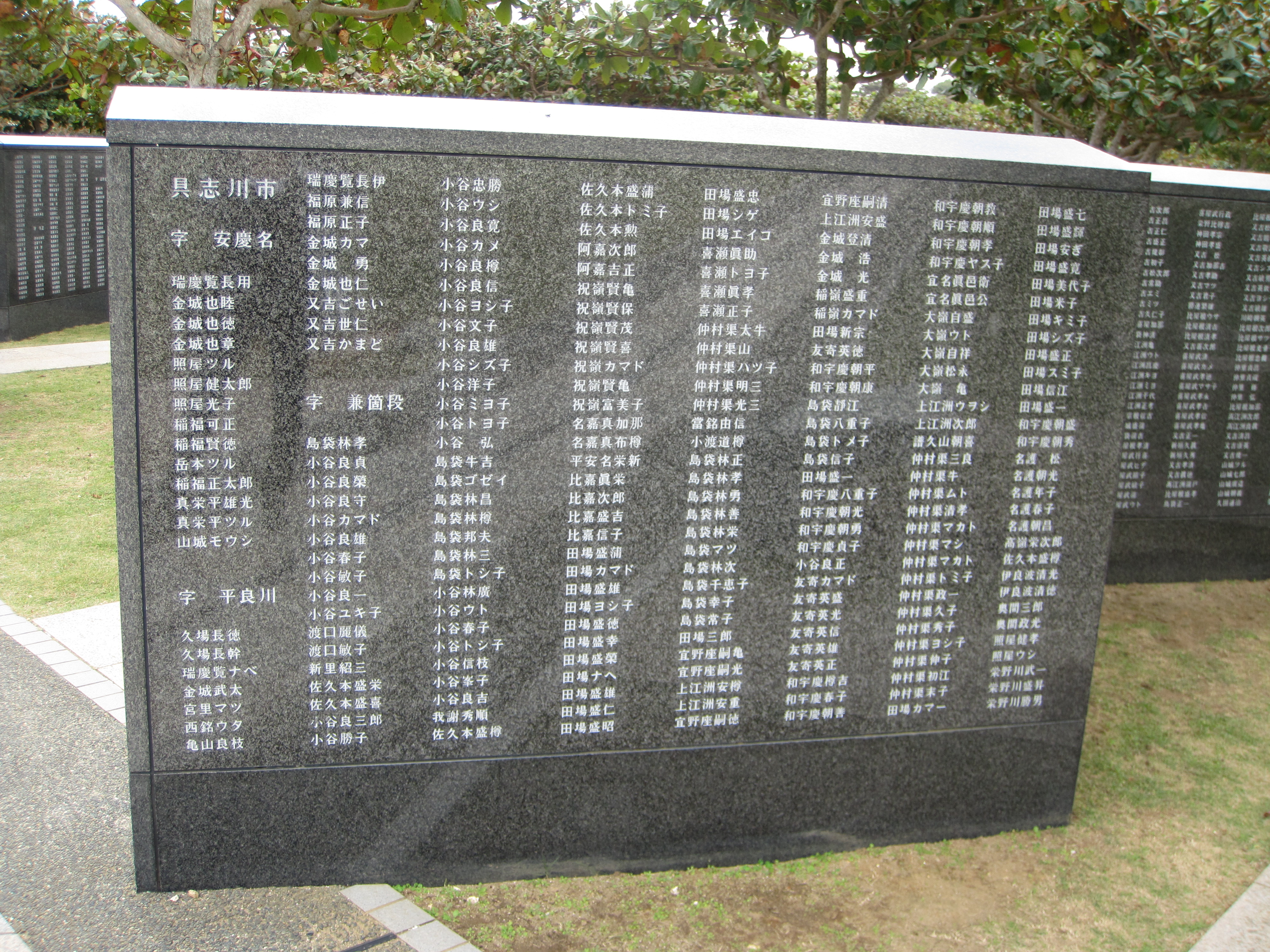
Other monuments in the park include the “Cornerstone of Peace”, a collection of large stone plates with the names of all fallen soldiers and civilians, including Koreans, Taiwanese, Americans and British.
After WWll , Okinawa was under United States administration for twenty seven years. They established numerous military bases on the Ryuku Islands. In 1972, the islands were returned to Japan but the US has maintained a large military presence. There are about 50,000 Americans in Okinawa (including family members). There is protest from the Japanese and the Okinawans about the large American military presence there. They are trying to resolve it with a modified plan.
“As the bomb fell over Hiroshima and exploded, we saw an entire city disappear. I wrote in my log the words”My God what have we done? ”The death was up to about 150,000 There were 76,000 buildings in the city at the time and only 8% of them remained intact after the bomb explosion. The bomb affected an area of around 13 square kilometers and turned that into ruins.”
The closest surviving building to the location of the bomb’s detonation in Hiroshima was designated the Hiroshima Peace Memorial.
After the bombing, Hiroshima began to receive donations of streetcars from all over Japan. (After World War II, Japanese cities – like British ones – wanted to get rid of their streetcar systems due to damage to the infrastructure) Hiroshima rebuilt its streetcar system along with the rest of the city. Hiroshima is now the only city in Japan with an extensive streetcar system (although other cities have streetcar lines). Some streetcars that survived the war – and the nuclear attack – were put back into service, and four of these are still running today.
Hiroshima has now became a center of the movement for world peace and reduction of nuclear bombs, which is commemorated at the Hiroshima Peace Memorial. The city government continues to advocate for the abolition of nuclear weapons . They write a letter of protest every time a nuclear weapon has been detonated anywhere in the world. In 1949, Hiroshima was proclaimed a City of Peace by the Japanese parliament.
The Thousand Origami Cranes was popularized through the story of Sadako Sasaki, a Japanese girl who was two years old when she was exposed to radiation from the atomic bombing of Hiroshima during World War ll. Sasaki soon developed leukemia and, at age 12, inspired by the Senbazuru legend, began making origami cranes with the goal of making one thousand. One popular story is she died before and her classmates finished them. The Hiroshima Museum says she completed them and kept making more when she didn’t heal. One thousand origami cranes is said to bring a thousand years of health , happiness and prosperity. The cranes are left exposed to the elements, slowly dissolving and becoming tattered as the wish is released.
People leave them in her honor and for all the people who died from the bombing at the Eternal flame in the Hiroshima Peace Memorial.
My father was stationed in Okinawa during World War Two. He never talked about it. There were some black and white photographs of him in a uniform, skiing in Hokkaido, and the old Japanese life in the cities.. The first words I ever learned to say in a foreign language was not the Yiddish that my grandparents spoke but I Am An American Soldier in Japanese. Watashi wa Amerika hei desu. I guess I just wanted to see what happened for myself.
“it is better to travel well than to arrive”. Buddha
Looking for Buddha in Bangkok
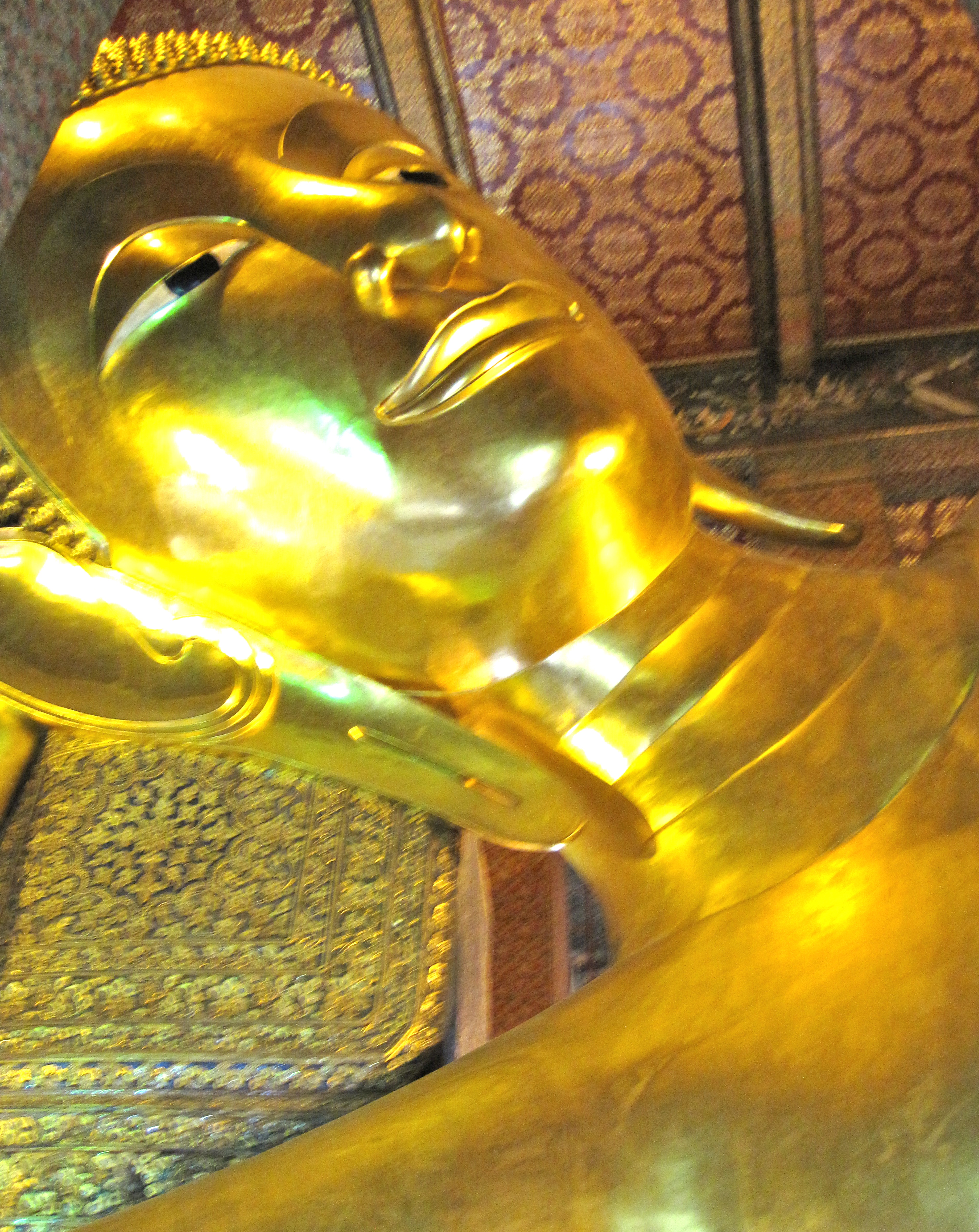
Day 1. I didn’t see Buddha today among all the Golden Buddhas. He wasn’t at the most famous Emerald Buddha where all Buddhists go to worship. He wasn’t around the ancient Buddhist scriptures or at the giant leaning Buddha or the Grand Palace. I heard he was on the sky train but I missed him. I thought I saw him in the night market eating fried crickets on a stick. It turned out to be an old man with a beautiful smile. (it might have been gas- crickets are apparently better for the digestive system when eaten raw). I didn’t see him at Starbucks, nor was he having the most fabulous Thai Massage. I thought I saw him at the flower market among the beautiful orchids but it was just another Buddha wanna be. He wasn’t having Pad Thai , Thai Coffee and Thai Mango at the restaurant on the river. He was not on any of the riverboats that I have been on today. I will look again tomorrow.
Day 2. No, not today.
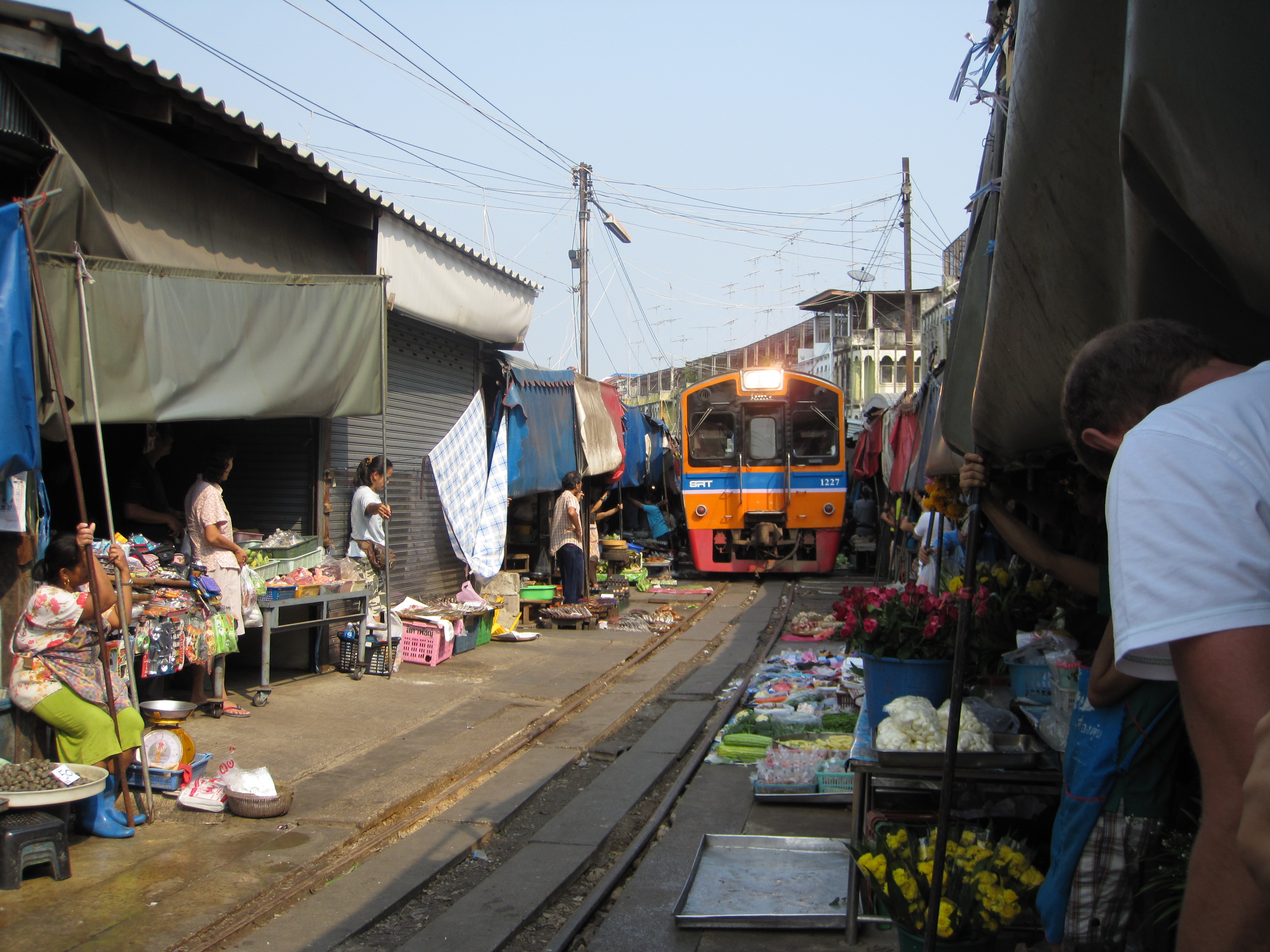
Day 3. He wasn’t at the floating market. Someone swore he ate lunch there everyday. He wasn’t at the train market either. The train runs through the market to Bangkok eight times a day. Eight times a day, they pack up and put out their food. The people help each other do it. It is not very tranquil. No one seems to mind. They all have their shrines to him and they all smile. I think he has been there before.
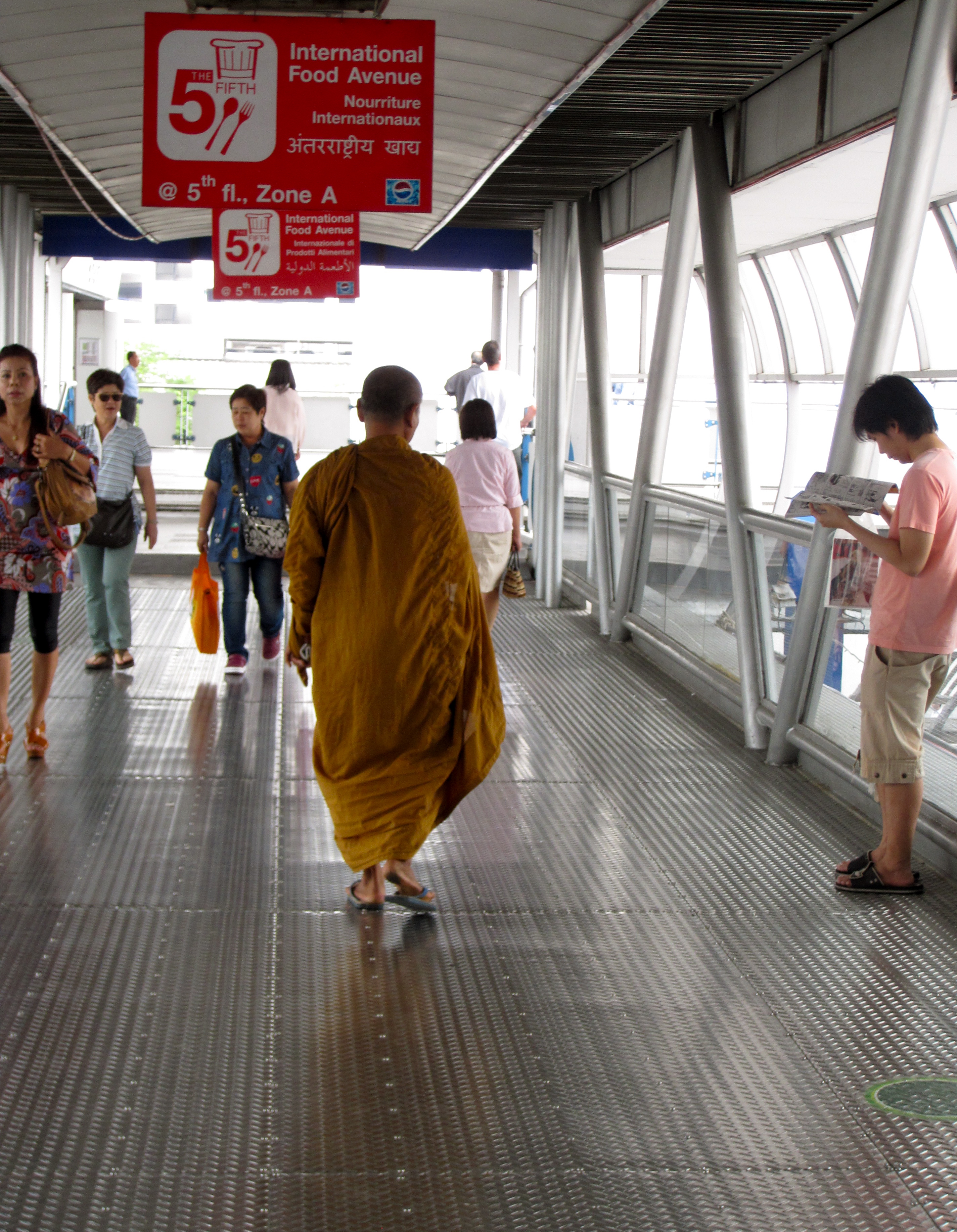
Day 4. Buddha is not shopping at Siam Paragon Mall or MBK. However, there is a monk on a cell phone and two other monks with shopping bags. I hope he is not begging for rice in the food court. He is not at Best Quality Fakes either. Though, I’m sure he would know how to find them.
Day 5. The real Buddha is not at the old capital city of Ayuthetta. There are many Buddha statues and many more decapitated ones. It is the ruined city that is left after the Burmese ravaged the old capital. it must have been quite beautiful when Buddha was there. I couldn’t see him when I was riding the elephant and I was pretty high up.
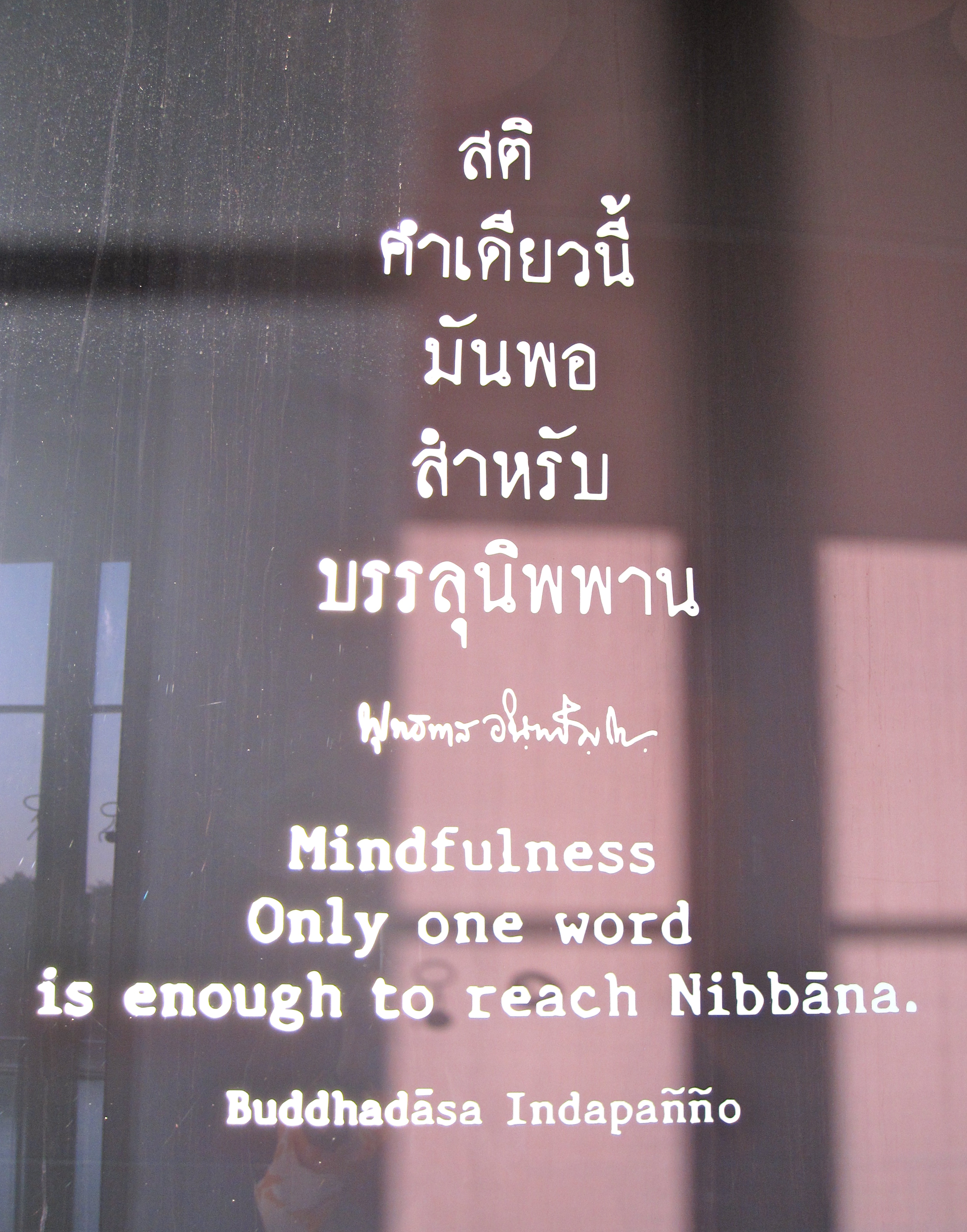
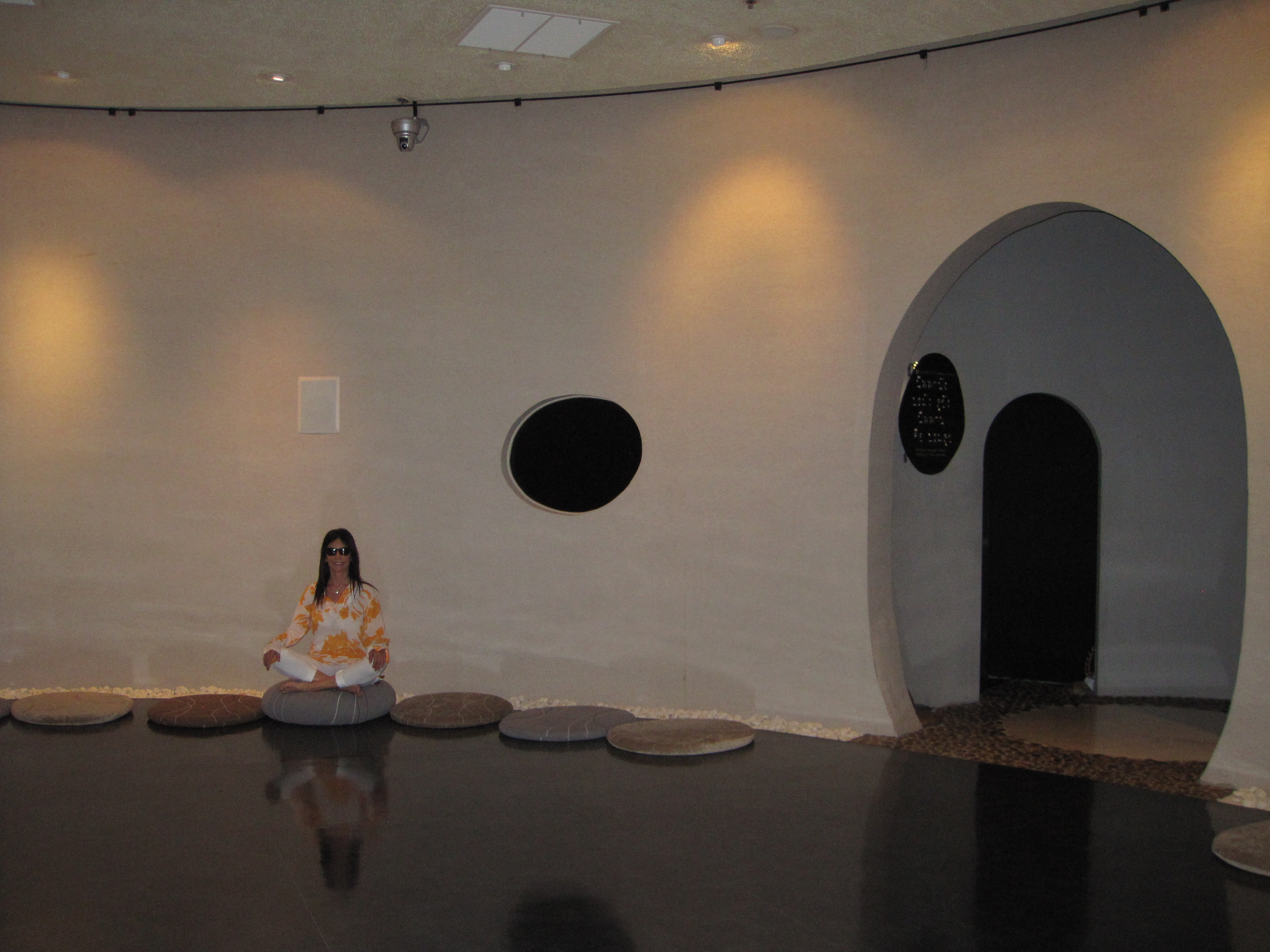
Day 6. He was not at Chatuchak Weekend Market . If he was there on a weekend, I would never see him because it is one of the largest and most crowded markets in the world. It covers over 27 acres and has more than two hundred thousand visitors per day. Surprisingly, He was not at (BIA) Buddhadasa Indapanno Archives. It is the most beautifully decorated space combining art and nature dedicated to Thai Buddhism. When I meditated there , I didn’t find Buddha but I did find peace.
As I rode to the airport I wondered where was he in this very Buddhist country? Was he in the faces of the children, the kindness of the people, the quiet dignity of the elephants, the beautiful orchids, the peace at the meditation center? Was he there all the time? Or, will I just have to look harder on my next visit?



























































 Travel Well, Fly Safe
You must be logged in to post a comment.