Street Art In Krakow, Poland

Image

Street Art In Krakow, Poland

“Creativity takes courage.” Henri Matisse

 The first thing I did in Poland was a private street art tour. I was told to meet the guide at Ghetto Heroes Square.The Ghetto Heroes Square is in the center of the old Krakow Ghetto.This square was called the Umschlagplatz by the Nazis. it was the place where the Jews had to assemble before being transported to the Belzec death camp, Auschwitz- Birkenau or the Plasnow Forced Labor Camp just outside the city. Iron and and bronze empty chairs commemorate this place. It is a holiday and the square is eerily empty.  It is a deeply moving memorial.

 I meet up with Joanna Switala who explains the memorial. She knows a lot about the area and the artists. 

Street art in Poland and other ex Soviet countries derives from the spirit of protest. In the last several years, there is trend to improve the quality of public spaces with commissioned  street art murals. Street art is the uncensored, unofficial, egalitarian voice of the people.

In the districts of Podgorze and Kazimierz, public art is both encouraged and controlled, and street artists are often invited to create elaborate works of art that celebrate the city’s history, culture and revitalization.

 The Jewish Cultural Festival invited one of Israel’s most famous street artists, Pil Peled, to create an image to watch over the district. Entitled ‘Judah’, the mural is said to represent both the vulnerability of the Jews and their strength to overcome.

This black and white mural was created by the Israeli group, Broken Fingaz was for the same festival to honor the memory of the Bosak Family, who lived in this area for four hundred years until World War ll .

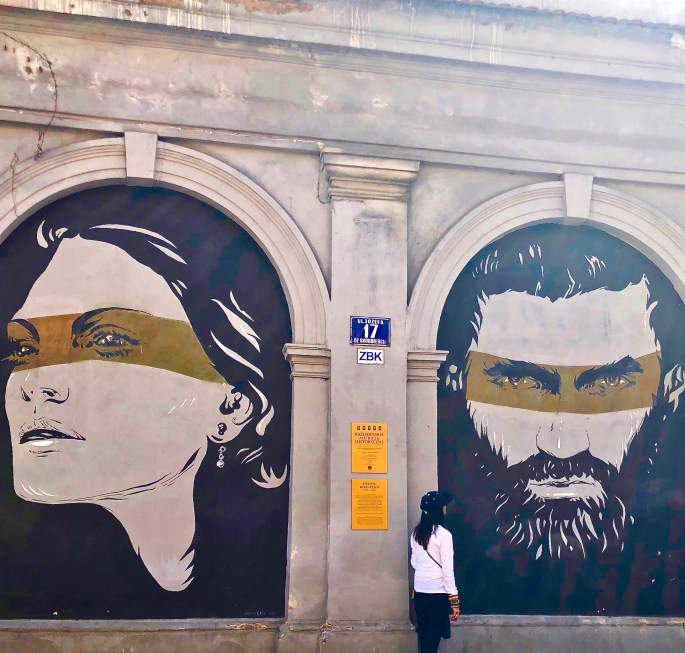
The woman in the painting is Irene Sendlar. .In 1941, .Irene Sendlar was recruited to head the Underground Council to Aid Jews, which was credited for protecting children by working with orphanages and welfare agencies to change their identities. They also smuggled an estimated eight to ten children out of the ghetto monthly by hiding them in suitcases, packages, and sometimes even coffins. Approximately 2,500 children were saved .

This mural was created by Marcin Wierzchowski, and is visible on the wall of the Galicia Jewish Museum. It represents pre-war Kraków and modern Jerusalem.

101 Murals for Krakow was put together by Krakow street artists who created the mural by bringing together multi-format paintings and connecting them with urban, historical, and architectural contexts of the different districts of the city in Kazimierz and Podgórze.

 City officials are forever trying to erase the playful and political stencils of  street artist Kuba .

 Mythical murals are painted across many of the city’s abandoned buildings by Mikolaj Rejs.

The mural at Joseph Street shows various people that are associated with the district: King Kazimierz the Great and his Jewish lover, Esterka; Prince Joseph II, who became the patron of this area during Austrian times; the architect of the district, Karol Knaus; and Helena Rubinstein, the Jewish queen of cosmetics who lived in Kazimierz before WWII.
 Though i didn’t see it that day, we talked about the internal feuding culture of football graffiti in Poland which might more accurately reflect some of the views here. Patriotic white-and-red colors, swastikas, Celtic crosses, football club emblems, Stars of David hanging from gallows, fans who died in fights with rival supporters and the Fighting Poland symbol are found on walls throughout Poland. 

The city-sponsored  ArtBoom festival invited Bolognese artist Blu to create this giant mural called  Ding Dong Dum.

 Street art as a form of protest remains, even in the publically sanctioned events. When the street artist Pikaso was invited to paint a mural as part of the 2012 ArtBoom festival the authorities refused to allow him to create his original design. Instead, he painted the giant and symbolic mural “For God’s Sake the Censorship is Everywhere.”

The dark history of Poland is always there but maybe the urban culture of street art in a country that didn’t have that freedom before, shows that change is possible.

Thanks Joanna for making my first day, interesting, informative, fun and full of art. I highly recommend her street art tour in Krakow. guideskrakow@gmail.com

Fly safe,

JAZ

Cemeteries In Poland

Image

Cemeteries In Poland

“I wish it need not have happened in my time,” said Frodo. “So do I,” said Gandalf, “and so do all who live to see such times. But that is not for them to decide. All we have to decide is what to do with the time that is given us.” J.R.R.Tolkien The Fellowiship Of The Ring

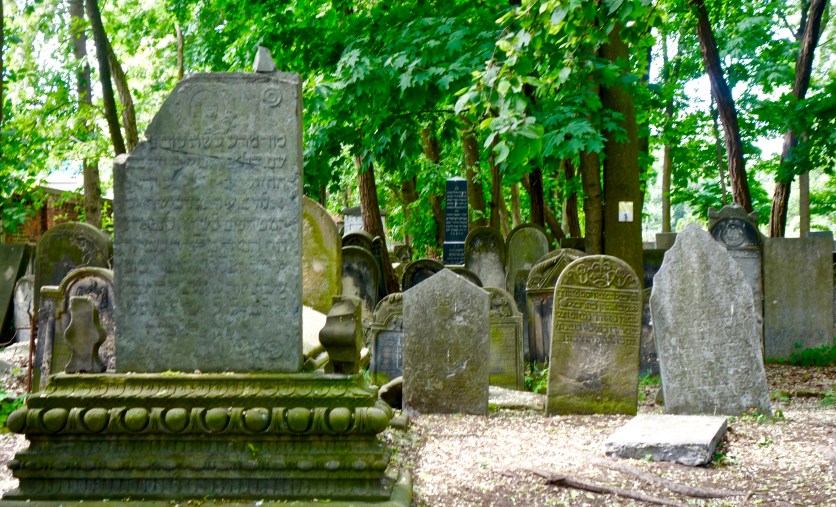
“We were here. We are what is left of what was once a thriving civilization.” This is what the headstones in the Jewish cemeteries in Poland say to me. (Lodz)

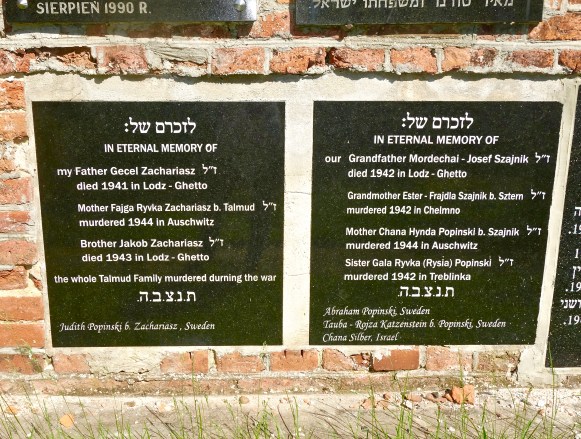
Over half a century after the Holocaust, the headstones and their fragments in the Jewish cemeteries personalize the tragedy of the three and a half million Jews killed in Poland. ( Warsaw)

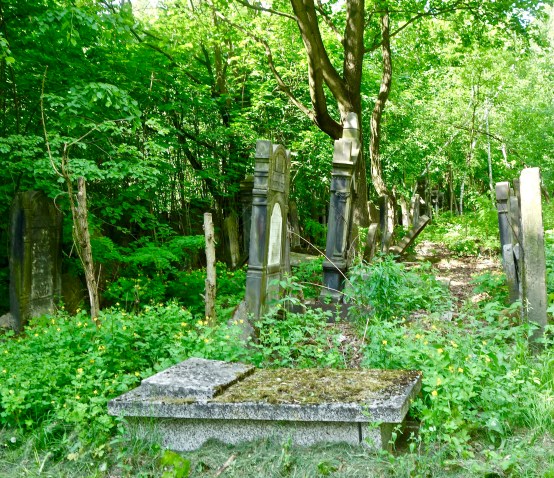
Jews had been in Poland since the Middle Ages. The oldest Jewish grave is in Wroclaw and is dated  1203. In the tangled paths and ruined stones, there is the history of Jewish life in Poland. (Lodz)

In the cemeteries, I feel the ghosts that I did not feel at Auschwitz. Maybe the crime at Auschwitz is too big and too much to comprehend. In the silence of the dead, I wonder if I am doing enough good in this life that I am so lucky to have. (Lodz)

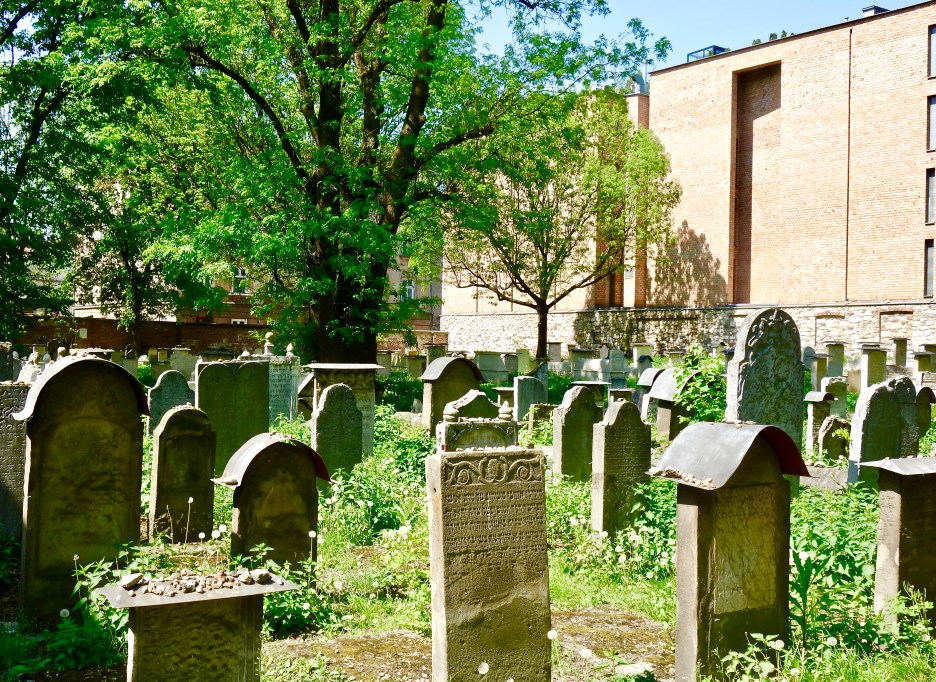
The first cemetery we visit is the Old Cemetery at the Remuh Synagogue in Krakow. It is the oldest cemetery in Poland. It was founded in 1553 and the last burial was in 1800. The cemetery was used as a garbage dump in World War Two and pretty much destroyed.

The gravestone of a famous rabbi – Rabbi Moses Isserles survived and people come to worship there. In 1959, the cemetery was renovated. The fragments of the broken tombstones were cemented together to form a wall.

The Jewish Cemetery created in 1892  in Lodz  was once the largest Jewish cemetery in the world.

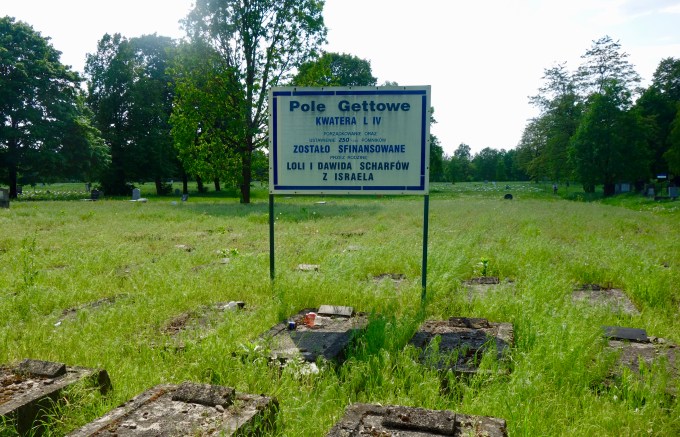
After the German occupation in 1939, the cemetery became a part of the Lodz ghetto.

Between 1940 and 1944, about 43,000 burials took place in the spare part of the cemetery that became known as the Ghetto Field.

The cemetery was the site of mass executions of Jews, Roma gypsies, and non-Jewish Poles. The graves of the Polish scouts and soldiers are found there.

The ghetto was liquidated in August 1944 and about 830 Jews were left as a clean-up crew. They were forced to dig large holes for their own graves near the cemetery wall. The Nazis did not have enough time to kill them, and the empty holes have been left as a remembrance.

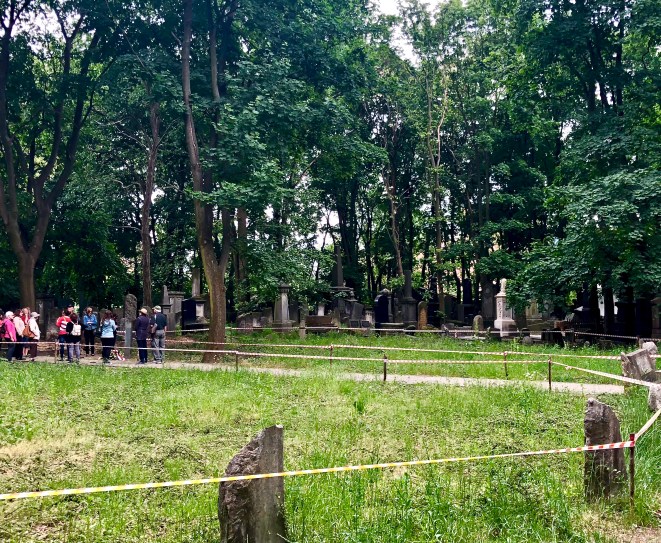
The Okopowa Street Jewish Cemetery in Warsaw was established in 1806.  Among the notable people buried at the Okopowa Street cemetery are the writers Y.L.Peretz and S. Ansky, the actress Ester Rachel Kaminska; Ludwik Zamenhof, the creator of the Esperanto language; Adam Czerniakow, the chairman of the Judenrat in the Warsaw Ghetto and many notable rabbis.

It also has memorials and the mass graves of fighters in the Warsaw Ghetto Uprising.

During the Second World War, the Germans used it as a place for executions and mass burials of victims from the Warsaw Ghetto. 

The cemetery sustained extensive damage when the Germans decided to bomb all the surrounding buildings after the  Jewish Uprising.

The small Jewish community left in Warsaw are trying to diligently preserve and protect the cemetery.

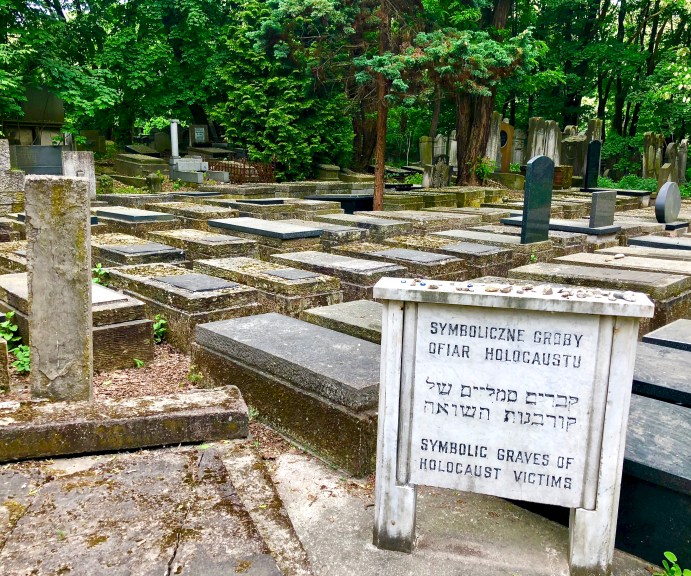
In the Warsaw Cemetery, there is a  memorial for the one million children killed in the Holocaust.

Another memorial is in memory of the Polish-Jewish pediatrician and children’s author Janusz Korczak, who ran an orphanage in the Jewish ghetto of Warsaw from 1940 to 1942. He was deported with his children in 1942 after he refused to abandon them. He was most likely murdered after his arrival in Treblinka.

There were more Jews in Warsaw than in any other European capital before the war, and the cemetery bears silent witness to this rich and vibrant civilization that made Poland the most Jewish of nations in Europe.

Most of the graves in the cemeteries are abandoned. There is no one left to visit them and tend to them.(Lodz)

In every cemetery, I put stones on as many graves as I can. I don’t have enough time  or enough stones. I try to get to the graves that are further away. The graveyards get messy and overgrown with grass and moss. It’s hard to know where I am stepping so I walk on my toes.(Lodz)

  Putting a stone on a grave has different interpretations. For me it means, I was there. I saw your headstone even though the people who remember you are gone.(Krakow)


On Yom Kippur, I light memorial candles for my parents, a friend and one for the people who have no one to light one for them. This year I will light an extra one for the 3.5 million  Jews who died in Poland during World War Two. (Lodz)

Fly safe,

JAZ

Visiting Auschwitz-Birkenau, Poland

Image

Visiting Auschwitz-Birkenau, Poland

“We can do evil. We can stand by and do nothing. Or, we can do good.”Eva For, Survivor

No matter how much you have read, how many documentaries and movies you have watched and how many Holocaust museums and other tragic sites you have visited, nothing can prepare you for Auschwitz, Birkenau. I will never find the right words to describe it.

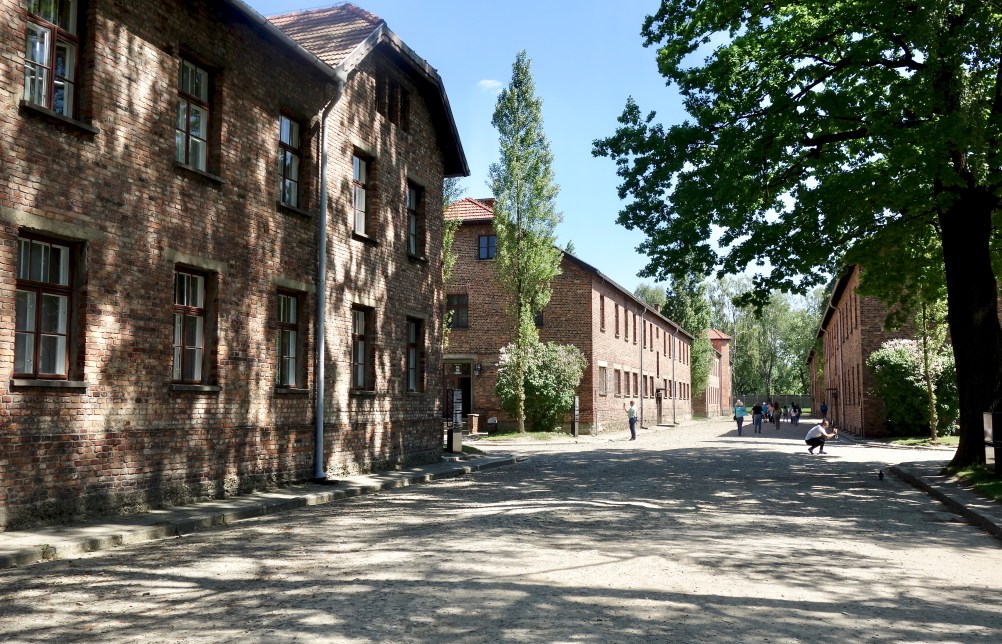
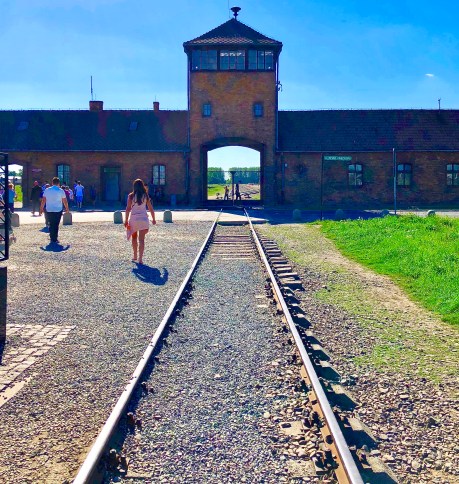
We entered through the main gates of Auschwitz One which was a labor camp. The words Arbeit Macht Frei are clearly seen on the cast iron fence. The direct translation for this is work sets you free. 

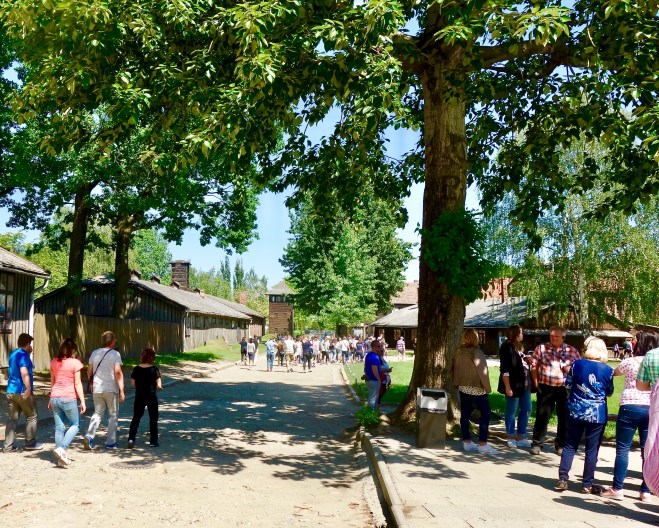
I walked through the gate completely numb. The one thing that I was not expecting was the perfect blue sky, warm sunshine, and bright green grass.

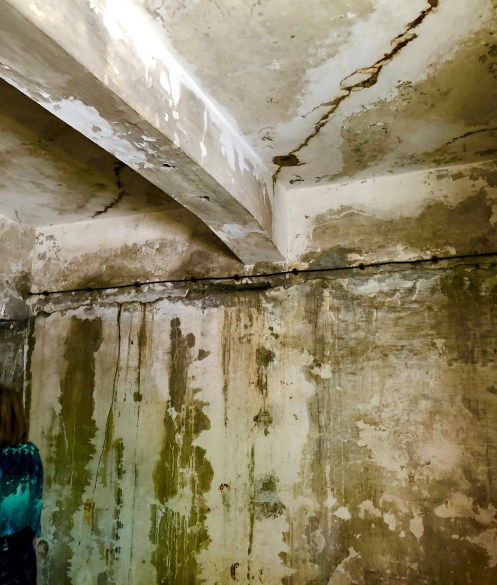
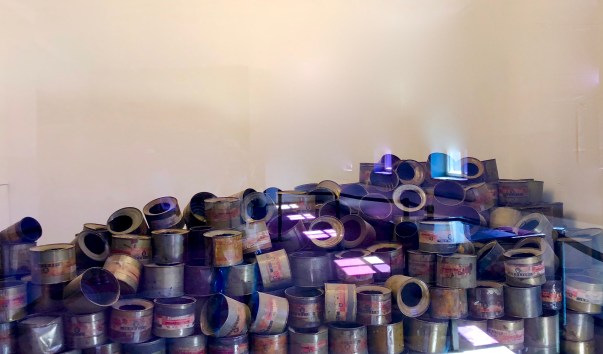
Auschwitz One was occupied by the SS in 1940, where the first prisoners, mostly Polish and Soviet, were deported and killed. It was where the Nazis started the experiments with the Zyklon B gas. (canisters and pellets of Zyklon B – pesticide used to kill prisoners, gas chamber)

The old red brick buildings and people taking photos make it really hard to believe that at this place human beings were cruelly tortured and murdered.

The “museum” is a path where each building (or block with its number, to be more precise), has been given a particular name to show the visitors the horrors that took place during the Holocaust with pictures, signs and explanation panels.

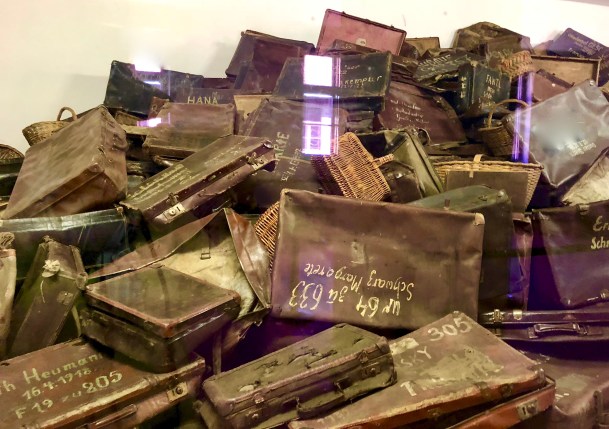
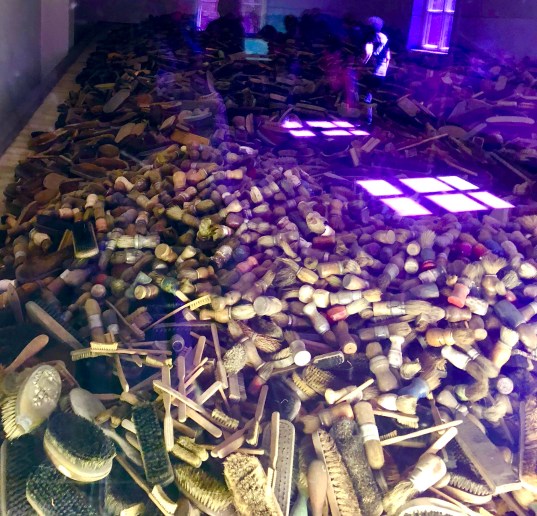
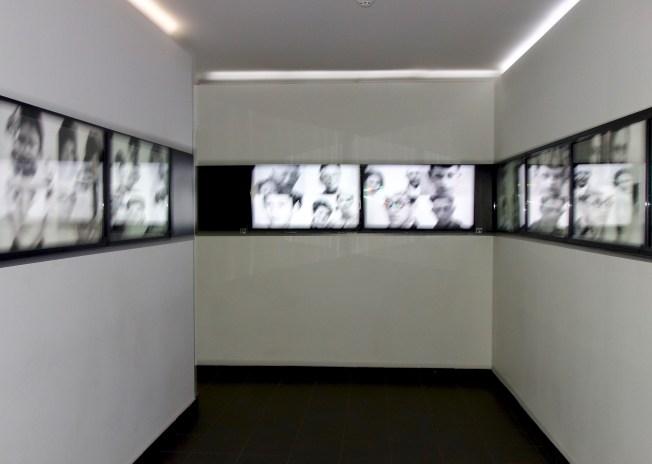
There are buildings dedicated to the extermination plan and gas chambers, to photos and records of the prisoners and to the monstrous medical experiments conducted by Dr. Mengele . There are other buildings where you can see mountains of shoes, personal belongings, suitcases with names, artificial limbs, crutches, wheelchairs and human hair of the victims. My eyes focus on a tiny kid’s shoe, a suitcase with the name Eva Hecht clearly marked on it and a woman’s artificial leg. Every item tells a story of a family torn apart and a life taken away. My numbness gives way to too many emotions.

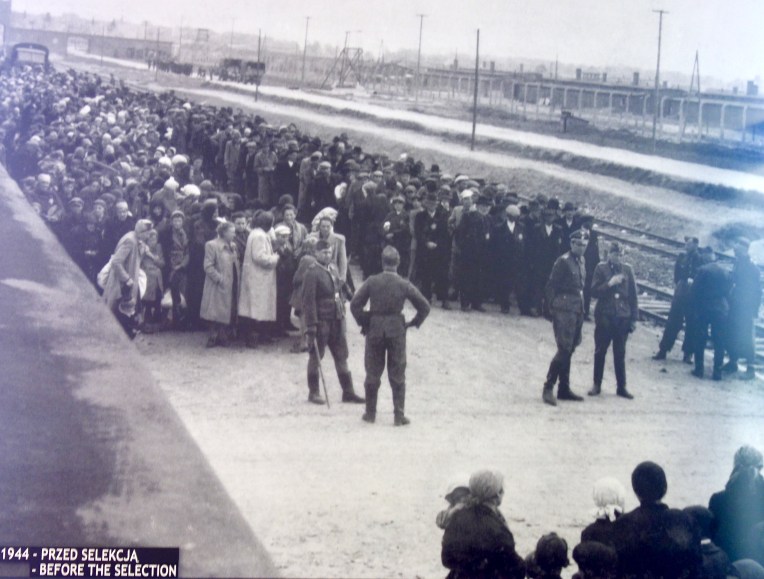
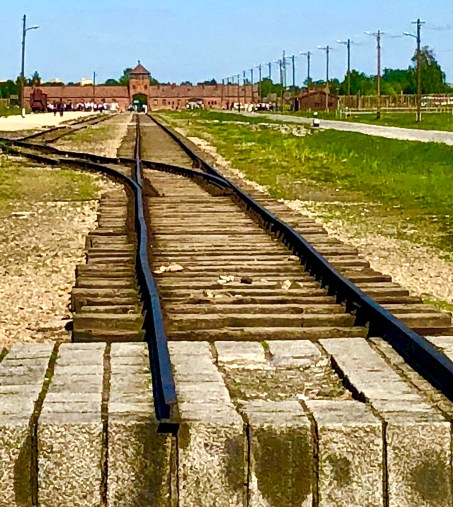
Birkenau is the mass extermination camp a few miles from Auschwitz.

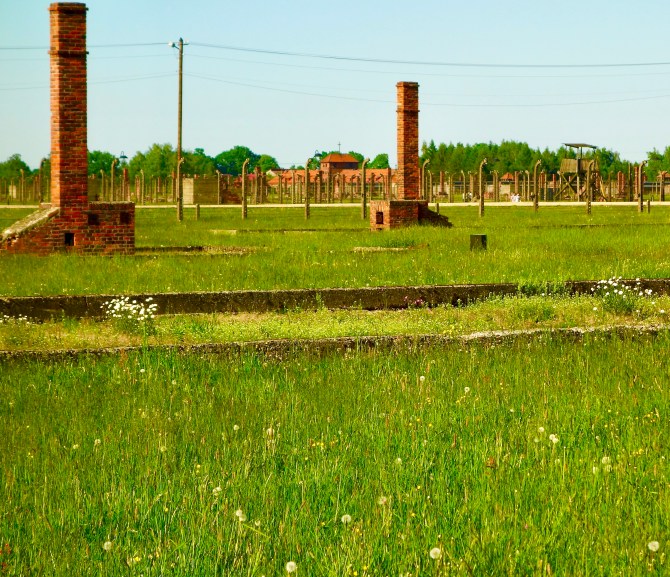
The train tracks lead into the camp and stop at the mostly destroyed crematoria.

The Nazis tried to destroy the evidence of what they had done in 1945. 

The camp is huge.  The many barracks and group latrines were empty and clean.

The chimneys go on forever. 

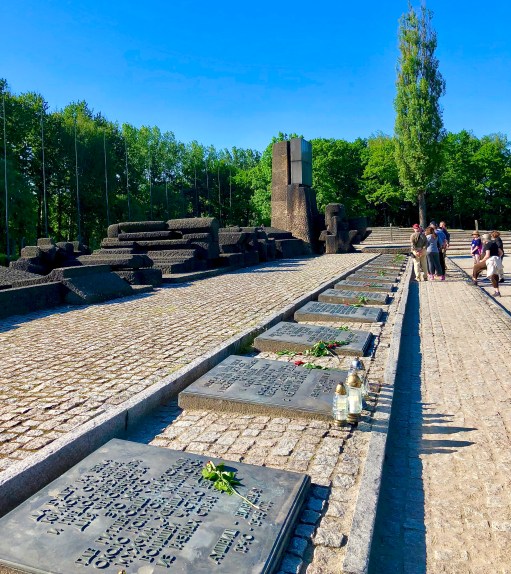
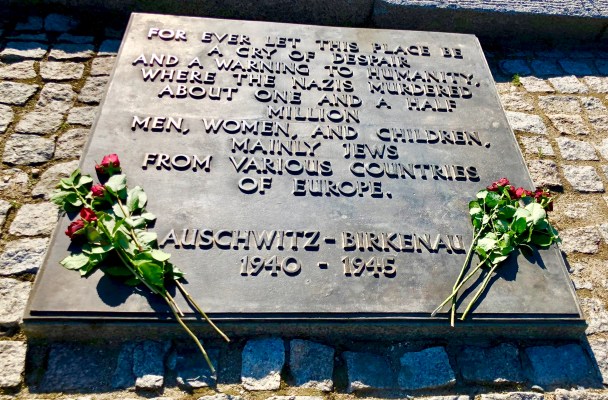
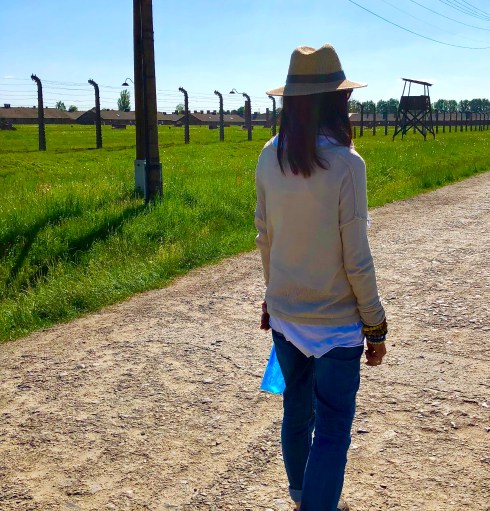
I walk these paths of hell and I feel nothing. I feel no pain and no ghosts of the over one million people killed there. I feel no evil. I just feel empty – like the emptiness of the camp that I was looking at. I hear the guide talking but i’m enveloped by my own numbness. I say the prayer for the dead at the memorial to the Holocaust victims there.

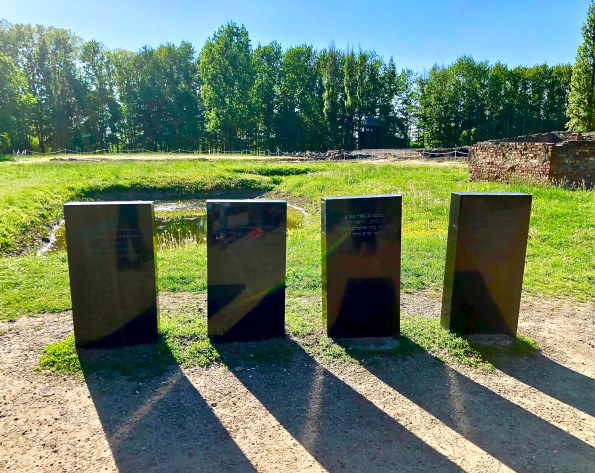
I say it again in my head at the memorial where some of the ashes are buried in a pit.

There wouldn’t have been any grass. There wouldn’t have been any wildflowers.  It would have been freezing, covered in snow in winter and muddy and miserable when it rained. The air would have been filled with smoke and ash at all times.  Even on a day like today, when for a few minutes they could close their eyes and feel the warm sun on their face, it would still have been the worst place on earth.

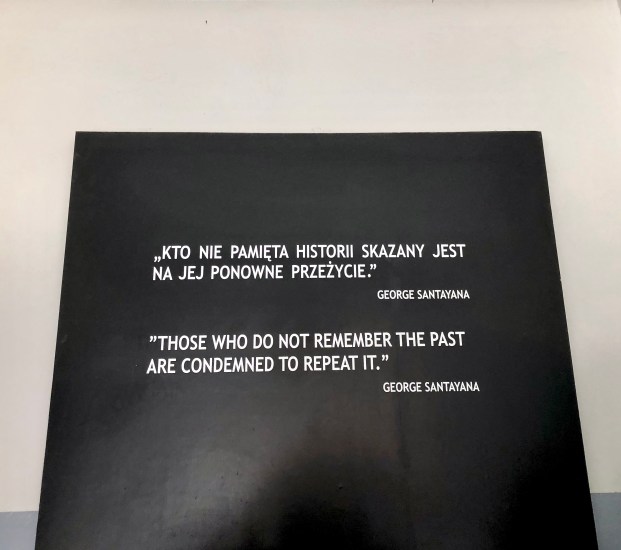
Auschwitz Birkenau asks as many questions as it answers. As a quote on the wall at Auschwitz says: “Those who do not remember the past are condemned to repeat it”. George Santayana

. I had to go and see it for myself and pay my  respects to those who died here.

 I had to go and see this and hold on to these images.

 Our world is filled with hate and my visit to Auschwitz will always remind me that it can never happen again – to anyone. 

Fly safe,

JAZ

Auschwitz (Oswiecim) Poland

Image

Auschwitz (Oawiecim) Poland

“At a mass meeting in Berlin, Adolf Hitler shrieked, “And who is responsible for all our troubles?” Ben Cohen shouted, “The bicycle riders and the Jews!” Hitler looked up, astonished. “Why the bicycle riders?” “Why the Jews?” replied Cohen.” Leo Rosten.

We start our day at the Auschwitz Jewish Center in Oświęcim (Oshpitzim in Yiddish), a small town in southern Poland 31 miles west of Krakow .http://ajcf.pl/en/ The town went from anonymity to being known by its German name Auschwitz.The word Auschwitz has become synonymous with the worst things human beings can do to each other.

As with other parts of Poland, there is an old synagogue (that was returned to the Jewish community)  and a museum about Jewish life in Oscwecim over the last hundred years and no Jews.

The Center is used a lot by tourists and schools to promote dialogue about Polish Jewish life, xenophobia and the Holocaust. The Museum Of Jewish Heritage that I am traveling with was responsible for helping to create this Center. It does not have local community or government support.

Maciej Zabierowski our wonderful  guide for the Jewish quarter in Krakow works there. As with our other guides, Maciej’s quiet honorable manner makes you feel hopeful that there are more like him than the Nationalists in this country. Tomasz Knncewicz  tells us some of the history. We ask about the law passed earlier this year which criminalizes false attributions to Poland’s responsibility in the Holocaust. I have read that Auschwitz  guides have been accused of downplaying the fact that 74,000 Poles were also killed in Auschwitz. He mentions that there are pressures being exerted on Holocaust and Jewish Museum directors and Auschwitz guides due to the wave of hate.

I think about it on the short drive to the Auschwitz Birkenau Camp.  On one hand, the government is right. It is a distinction without a difference and a horrific thing. But, the Jews were killed because of racism. Many other victims were also deemed by the Nazi’s racial ideology  as unfit to live such as gypsies, homosexuals and the handicapped. The Poles and people from other German conquered countries were killed because of power.

The Holocaust happened at a time in the present to people like you and me. How did a civilized society do this? At what point does the Nationalism and hate rhetoric we are hearing in the world today, take a turn like this?

We pull into the very busy Auschwitz car park along with many buses and cars. There is train whistle in the distance.

Fly safe,

JAZ
Ten Things That I Want To Do In Poland

Image

Ten Thing That I Want To Do  In Poland

“It was a small room with dim light coming in the window, reminiscent of old Polish films.” Haruki Murakami

Choosing to visit Poland. is not an easy decision for me. There are many places in Poland where horrific events took place during World War Two. I’m trying to combine those with seeing what the country is like now. I want to have an open mind but racism seems to be under new management again in Poland.

Since I love street art, I will be taking a Krakow Street Art Tour. I haven’t done one in Eastern Europe before so it will be interesting to see if it has an activist, protest quality. Poster Art has been a tradition in Poland so it was probably be a natural transition to street art.

Krakow is one of the most fascinating medieval cities in Europe and one of the few that escaped destruction in World War II. Today it’s famed for its soaring Gothic church spires and cobblestone streets, while its Old Town is a UNESCO heritage site, it is also known for having one of the liveliest after dark scenes on the continent.

The story of Oskar Schindler and his employees is one which has been well-known. It was made famous by Steven Spielberg’s film Schindler’s List (which was shot almost entirely in Kraków). The factory has been turned into a museum about his story and the occupation of Poland.

A visit to Auschwitz is a test in humanity that not everybody is prepared to take, One can hardly call it a tourist attraction. The three million victims of the largest of Nazi Germany’s concentration camps don’t need high attendance records. What they need is a moment of reflection on what happened and what should be done so that this tragedy never happens again.

You wouldn’t imagine that a museum dedicated to people digging for salt would become a popular tourist draw, but that’s exactly what Wieliczka Salt Mine is. It is an easy day trip from Krakow. The mine was in operation from the thirteenth century till 2007 .Now it sees over a million visitors a year, who take the tiny elevator down into the depths and explore the “buildings” inside, which include chapels, statues, and even a whole cathedral carved out from the rock.

There are various ways to explore the music of Frédéric Chopin, Poland’s famous composer. While walking through the city there are many black benches with buttons on them. Simply press the buttons at any time and they play the music of Chopin. Chopin concerts are held regularly in venues throughout Warsaw, To understand all about the man himself and see his last piano, head to the Chopin Museum.

Before World War ll, Warsaw had the largest Jewish community in Europe.The WarsawGhetto was the largest ghetto set up by the Nazi’s during the war. Over seventy years ago, the area of Jewish residents (which numbered up to one million) was sealed off from the rest of the city. It was enclosed by a wall that was over 10 feet high, topped with barbed wire, and closely guarded to prevent movement between the ghetto and the rest of Warsaw. Life deteriorated quickly.  The world already knows the terrible history of the Jews in the ghetto. There are memorials and museums dedicated to remembering the victims. The Warsaw Ghetto was the location of the Warsaw Uprising where the Jews fought back from Mila 18 street.

Warsaw’s central Old Town neighborhood is one of the city’s most popular areas and a UNESCO World Heritage Site. This historic district, which was rebuilt after bombings from World War II destroyed most of it, is filled with restaurants, art galleries, shops and cafes housed in structures designed to replicate the region’s former fourteenth to eighteenth century buildings.

The market square in Wroclaw is one of the largest in Europe with two town halls. Piwnica Swidnicka located on the square is the oldest restaurant in Europe. It is always crowded and fun.

Łódź’s Museum Of Modern Art (Muzeum Sztuki) is one of the oldest museums of Modern Art (ha) in the world and holds the largest collection of world art from the 20th and 21st centuries in Poland.

Recently, Polish Prime Minister Mateusz Morawiecki caused an uproar when he said that there were “Jewish perpetrators” in the Holocaust, along with Polish and Russian ones. Is it how everyone feels or is it like Trump saying ”There are are good people on both sides which means some good Nazis?”

I believe travel is one of the ways we can educate humanity about our similarities. It is how I learn that I am not so different from you. Since I have this opportunity to be there, it is my responsibility to see what is going on for myself and figure out the truth. I have to challenge my assumptions and not judge the people I meet based on history and the media.

Fly safe,

JAZ

Nine Things That I Will Take To Auschwitz

Image

Nine Things That I Will Take To Auschwitz

“Monsters exist, but they are too few in number to be truly dangerous. More dangerous are the common men, the functionaries ready to believe and to act without asking questions.” Primo Levi

I have studied about World War II in school, read a lot, saw the movies, documentaries and visited other concentration camps. I’ve obsessed over the Holocaust since I read Anne Frank when I was nine years old. I don’t really know how to  prepare for my trip to visit the Auschwitz-Birkenau death camp. Since opening to the public in 1947, it has become a world-known symbol of the atrocities that took place during WWII. Here is my list of things that I will take with me.

1.Courage. How will I stand in front of the gas chambers that killed one million people? Can I be brave and afraid at the same time?

2. Anti anxiety medication or at least some lavender oil. It will be hard to be in a place of so much darkness.

3. Mental toughness. How many stories of pain can I tolerate? How will I see and hear about the intolerable and insufferable acts  when I am actually there?

4.Camera and Notebook. I’m not sure if I will use them or if I will instead really be present and be an observer of what has happened.

5.Sadness. I know i will feel some deep, horrible sadness.

6.Memories of the people I knew who had those numbers on their arms; of the strangers that I saw with them and the people who died that I never knew but heard their stories. Memories outlast mortality.

7.Reason. It’s not possible to apply normal logic when trying to understand the Holocaust. How will I comprehend anything when I am actually there? In his will, Hitler blamed  WWII — including the Holocaust — on the Jews. On the people he was systematically exterminating. No, there is no logic there; no sense to be made of it. There was only madness and the people who followed it.

8.Anger at the current wave of antisemitism in Poland in response to the new Act on the Institute of National Remembrance, This law makes it illegal to accuse the Polish nation of complicity in crimes committed by Nazi Germany, including the Holocaust.The law also bans the use of terms such as “Polish death camps” in relation to Auschwitz and other camps in Nazi-occupied Poland and carries a three-year prison sentence.

9. Faith that monsters do not last forever and eventually truth and hope prevails.

Fly safe,
JAZ