What To Bring Or Not Bring To Someone’s Home In A Foreign Country

What To Bring Or Not Bring To Someone’s Home In A Foreign Country

“What you consider gross—dead rats—I consider considerate gifts.” Jarod Kintz

I’m a person who always likes to bring the right gift so having dinner in foreign country at someone’s house always requires a bit of research for me.

To the Japanese, gift giving is a way of communicating respect, friendship, and appreciation. It is good to be ready for the gift giving ritual that has been deeply rooted in the Japanese culture for centuries. Everything should be beautifully wrapped and ripping open the paper is bad form. Downplay the importance of the gift. This is typical in all Asian cultures. Always present the gift with two hands.

Do not give wine as a hostess gift in Argentina because it is considered common. Champagne or hard liquor is fine. Don’t bring scissors or knives because that means you want to sever the relationship.

What can you bring to someone in China? They make everything there. First off gift giving is not easy. They don’t open their gifts in front of you and they refuse them several times. You have to be persistent but not pushy. It’s a delicate balance. Again no knives or scissors to break the relationship. I am missing something. When people in these countries get invited for dinner is the go to gift a pair of scissors? Why do they have even have to say that? Also no clocks or anything in sets of four. Four is an unlucky number in Chinese because it sounds like death. This is true in most Asian countries. Avoid white chrysanthemums because they are used at funerals.

In Malaysia pay attention to the Muslim culture. Avoid pork, knives, alcohol, and highly personal gifts. Present gifts in the right hand only. In Indian sections of Malaysia, avoid black and white colors. Instead, opt for yellow, red or green which symbolize happiness.

Israelis have a tendency to overdo gift giving and put a lot of thought into choice and presentation. If you are going to the home of Orthodox Jews or Muslim Arabs remember that the gifts must not violate any of their religious beliefs. Candy, flowers and gifts for the kids are always appreciated.

If you are invited to a Quechua home in the mountains of Peru, coca leaves are an acceptable gift. Coca leaves have always been present at all important moments of community life. Today, the history and traditional use of the coca leaf in Peru are a solid part of ethnic and national identity.

In Korea, generosity is a highly valued personal trait. Give expensive gifts if possible.

When invited to a home in Russia, bring something other than vodka. If you bring flowers only present them to a woman. Avoid yellow flowers (unless you picked them yourself in the countryside). White flowers should be given with caution. Same with red as they usually mean love. Fine chocolates are always appreciated.

In Italy, it is nice to bring cakes for coffee when invited to dinner. The cakes have to be of a special kind, bought in a pasticceria by weight. These delicious cakes are placed in intricate patterns on a golden paper tray and wrapped in paper nicely folded with carrying handles After opening the present the hosts and the other guests will take pains to point out which cakes, they each do not like. In the end the cakes are pushed aside in the assumption that nobody can eat another bite after having partaken of a full delicious meal.

You must bring a gift if you are invited to someone’s house in India. Chocolates or flowers is acceptable. Different flowers have different meanings in India so always check with the florist about what is a proper choice. When in doubt red roses usually work. If they have children (and many do) it is nice to bring something for them. If you are visiting during a festival always carry a box of sweets with you. Be cautious in giving leather as a gift. The cow is sacred in India and many Hindus are vegetarians.

In Ethiopia a traditional gift if you are visiting someone’s home is coffee. However a chicken from the market may be well appreciated. They cost anywhere from $5-12. The average weekly wage is around $25 a month in a government job. So a chicken is quite a gift. If they have room the family may keep it for eggs. If not then it will make the next meal. To transport them, just pick them up by their feet. When chickens are upside down they do not move or make noise. They are very easy to handle. See this is where they lose me, I feel bad to carry an upside-down chicken around.

Fly safe,

JAZ

Things I’ve Learned In Venice

“ If you read a lot, nothing is as good as you’ve imagined it.  Venice is! – Venice is better. “             Fran Liebowitz

Things I’ve Learned in Venice

Venetians hate Napoleon because he stole from them the very treasures that Venice had previously stolen from Constantinople. The French hate that the Venetians have two museums (Palazzo Grassi and the Dogana) devoted to French modern art.

The pigeons in Venice have special protection because of their popularity with the tourists. No self respecting Venetian over the age of two would pay any attention to a pigeon.

There are two Venices – the actual one and the reflection in the water. Which is real and which is the illusion?

Directions in Venice may involve going” through a sestiere, past the scuola, down the fondamenta or the riva to the rama to the rio tera, to the calle, rughetta or salizzada and under the soltoportego”.( good to travel with map people)

Peggy Guggenheim has a room in her museum devoted to her daughter’s art. (don’t we all?)

An important Venetian holiday is held on the third week in July. It is the Feast of the Redentore commemorating the end of the plague that killed fifty thousand people including Titian. The fireworks display is so extensive and significant that the re-election of the mayor is contingent on their quality ( sort of like us picking a governor based on his movies) I have to add that they were the most incredible fireworks of our lives –I  hope that mayor got re-elected.

If you find  yourself in Venice on a vaporetto going out into the open sea, don’t worry, it will come back into the city……. eventually.

Vaporettos (water buses) in Venice are on the honor system. Many stops do not have kiosks to buy tickets which makes it hard to be honorable.

St. Mark, (patron saint of Venice) had his body “rescued” from his grave in Alexandria. Venetian fishermen covered the relic in pork to repulse the Muslim inspectors. There are mosaics that tell this story in the Basilica. If it was today, it would be covered in pork belly-something I see on every menu.

There is always reconstruction and renovation going on in Venice. The city slogan is “com’era dovera “  ( as it was and where it was)

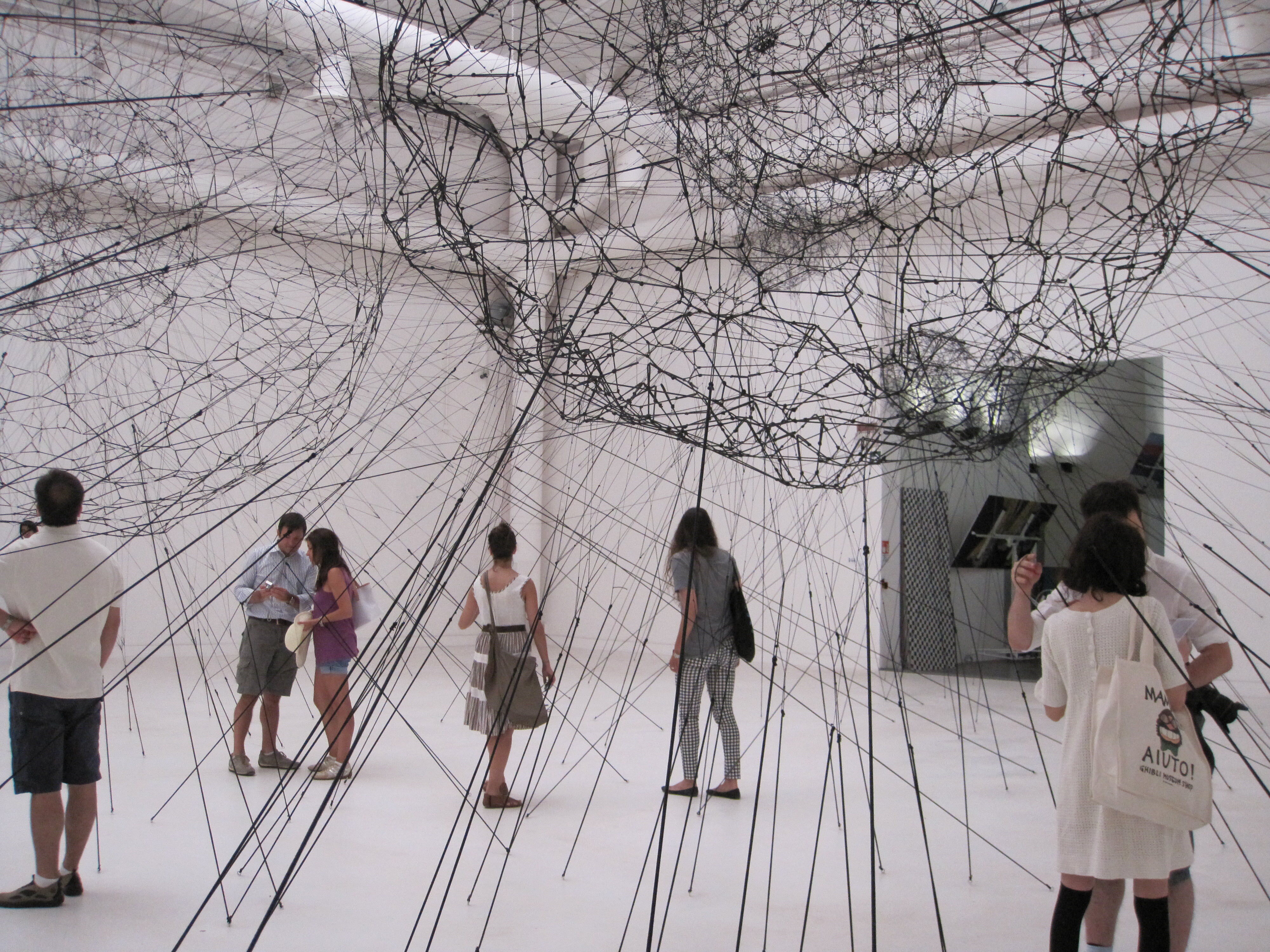
The Biennale  ( Worldwide Art  Exhibition) in Venice is filled with the same pretentious art people one finds anywhere else. The difference is that in the summer,  they bring their kids. You can hear in several different languages, what was that? When are we leaving?

The Bridge of Sighs (Ponte dei Sospiri) connects the Doges palace to the Prigioni  (prisons). The name comes from the fact that the prisoners used to sigh as they saw Venice from the tiny windows on their way to the prison. “I stood in Venice, on the Bridge of Sighs; a palace and a prison on each hand.”   Lord Byron

There is always a small choice of musical concerts in Venice. They all play Vivaldi.

Napoleon called St Marks Square ‘the finest drawing room in Europe.’  In the summer it is filled with tourists, pigeons, musicians and waiters. Try to see it late at night or early in the morning .

Volare is a song I never expected to be woken up to in the morning or hear 100 times a day.

The Rialto Bridge was built in just three years between 1588-91. It replaced the wooden bridge built in the twelfth century. The architect was Antonio Da Ponte. He beat out Michelangelo and Palladio for the contract. His name means Anthony of the Bridge . I cant help thinking he went into the competition with an edge.

Venice has no sewer system. Household waste flows into the canals and is washed out into the sea twice a day with the tides.(in case you were thinking of tasting the water or swimming )

There are many mask shops in Venice but only a few are traditional mask makers. Remember if its cheap, its fake.  La Bottega Dei Mascareri is a traditional mask making studio near the Rialto Bridge.

They say the best way to explore Venice is to get lost among the endless narrow streets and bridges. I don’t think that is the best way to explore Venice with my daughter. But no matter how good at directions you think you are, you will get lost in Venice.

Bauer Il Palazzo Hotel is one of Leonardo Di Caprio’s favorite hotels. (and mine also!)

Don’t touch the produce in Venice. In fact it is considered offensive to touch  fruits and vegetables in the markets  all over Italy.

The Bellini was invented by Guiseppi Cipriani, founder of Harry’s Bar. It is fresh white peach juice mixed with Prosecco. (sparkling wine). Its pink color reminded him of the color of the toga of a saint in a painting by Giovanni Bellini.  It is named for the artist.

Gondolas are operated by highly skilled oarsmen.  Only 3 gondolier licenses are issued annually after extensive training and a written exam. There are only 400 licensed Gondolieri operating in Venice today and 350 gondolas. (I wonder if anyone else had to take it three times)

Almost everyone in Venice belonged to a scuola in the fifteenth and sixteenth century. They were  like fraternities formed around occupations or immigrant groups .The scuole were self governing and helped their members integrate into society or with their problems. They became important artistic patrons. The themes were usually the lives and miracles of the Saints. Caravaggio was a favorite painter of the scuole.  It is worth it to go and see the art in some of the scuole around Venice..

Venetian food is simple, fresh and delicious. There are no food jokes here. Seafood, small birds, liver,  fresh fruits and vegetables and local grains are the staples.  Some traditional dishes are risi e bisi (risotto with peas) eaten by  the Doge on St Marks Day, pasta e fagioli ( pasta with beans a hearty peasant dish), dried cod, cuttlefish cooked in squid ink and sardines with onions. They are not known for pizza,  but eating pizza in Italy is always a good thing.

Ciao, Fly Safe,

JAZ